

TLDR:
- We just launched Site Maps to help you connect the dots between your website and its most important visitor: AI.
- See what’s working (and what’s not) across your site to prioritize next steps and drill down page by page to improve AI search performance.
- Learn how AI agents read your site, pinpoint problems, optimize pages, and deliver content directly to AI platforms with a click.
What is your website for?
The answer is less and less likely to be “talking to humans.” Instead, it’s “talking to the AI working on their behalf.”
The problem: Your site isn’t speaking AI’s language. Site Maps fixes that for you.
We designed Site Maps to help you spot exactly where AI is struggling with your website, prioritize problem areas to focus on, and fix them so you show up as the answer in AI search—all in one workflow.
You can now:
- Map your website to get a complete view of your AI search performance and see which pages require your attention.
- Drill down into any webpage to explore performance over time and by model, see what AI sees when agents visit your site, and uncover prompts you should be winning.
- Conduct a deep audit of underperforming pages to identify AI search blockers.
- Generate an optimized, AI-only version of any page based on intent, target persona, and key prompts.
- Deliver AI-optimized content directly to AI agents without disrupting the human user experience.
Site Maps is the end-to-end system for seeing what’s working on your website, fixing what’s broken, and maximizing the impact. Step by step.
The result? Better brand discoverability and accuracy across the AI surfaces your customers turn to instead of your website.
We could tell you more about each feature, but we’d rather show you. See what’s new below.
See the full picture with Site Maps
Job to be done: Get a bird’s eye view of website performance and see which pages need attention so you can prioritize fixes based on actual performance data, not hunches.
Say you’re in charge of AI search at a B2B software company. Your job is to make sure your brand shows up for the right prompts (and shows up accurately).
When you click into Site Maps in Scrunch, you pull up a visual tree of your website, with each webpage acting as a branch.
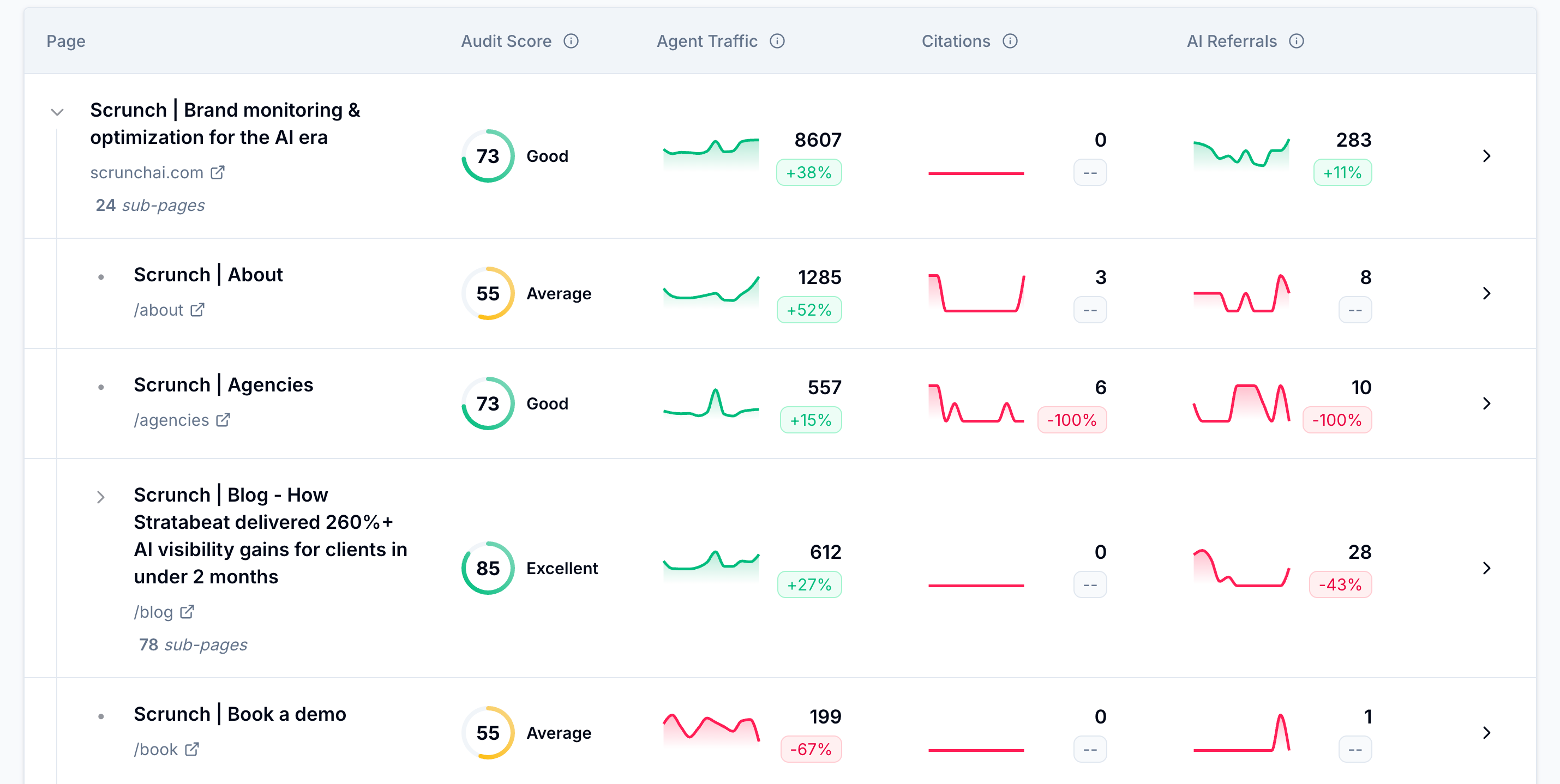
This data is continuously updated and can be refreshed at any time with a click.
At a glance you can see how each page is performing over time:
- Audit Score: Technical health of the page based on content quality, structure, and links
- Agent Traffic: Number of AI requests to access the page
- Citations: Number of times the page has been cited by AI
- AI Referrals: Number of referrals from AI to your website
No cross-referencing reports. No playing detective across tabs. Everything you need to prioritize your workflow is right at your fingertips.
You can customize your view based on the time frame. You can sort pages by ascending or descending metrics. And you can pull up any page you want in the search bar.
But something catches your eye.
One of your key product pages seems to be struggling. Its audit score is middling, and while it’s getting tons of AI traffic, it barely has any citations or referrals.
Time to dive a level deeper.
You click into the page and see:
- Performance: Page performance across different AI models over time
- Diagnostics: Access checks, AI agent activity, search index status, and human versus AI content experience
- Prompts & Responses: Prompts where this page is cited in responses—as well as prompts where this page should be cited but isn’t—across AI platforms
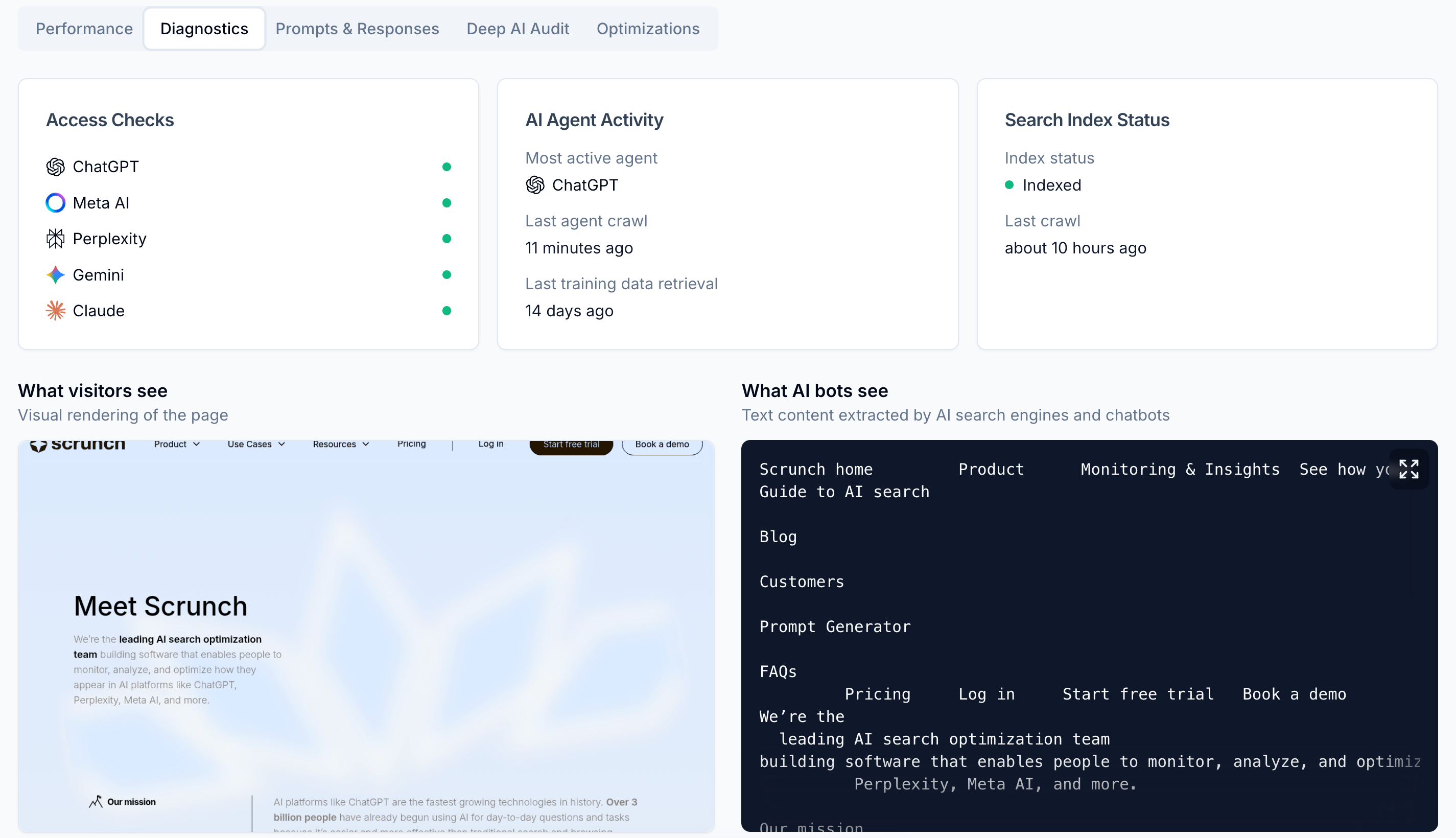
Something doesn’t add up, but the issue isn’t immediately clear. So you click the “Deep AI Audit” button.
Identify issues with Deep AI Audit
Job to be done: Rapidly diagnose exactly why a page is underperforming so you can make updates without requiring a cross-departmental fire drill.
The page is audited by Scrunch in seconds.
Now you have total visibility into:
- Access controls: Whether your site is configured to allow AI agents to access the page
- Content delivery: Whether the page content is delivered with the right technical hygiene and speed
- Content quality: Whether the page content is optimized for AI consumption
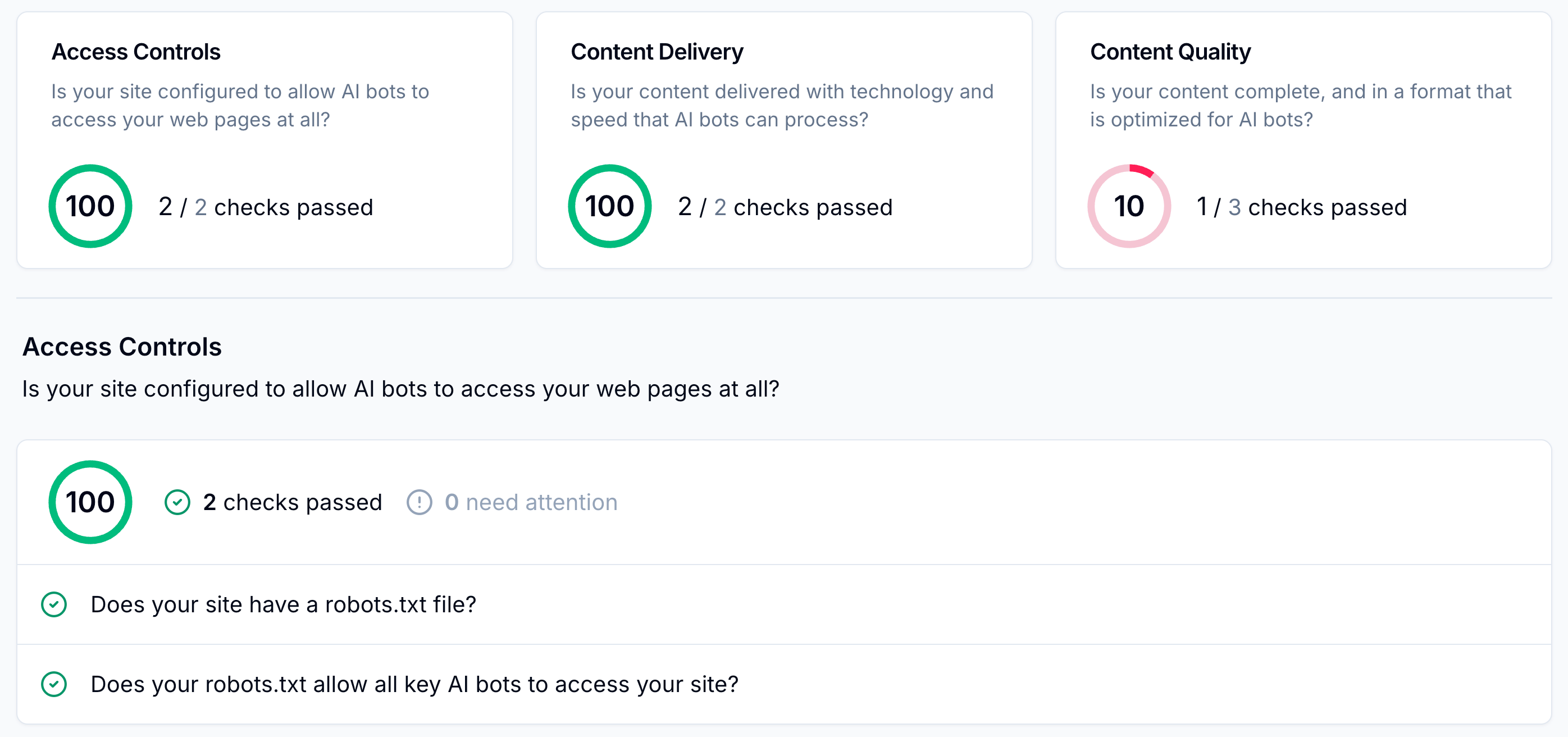
What used to require a developer, a search specialist, and multiple meetings now happens instantly. You get the diagnosis, the explanation, and the fix—all in one place.
Scrunch walks you through each section step by step, surfacing the fixes that need your attention.
In this case, content delivery and content quality are your culprits. There’s too much JavaScript on the page and your metadata isn’t relevant to the page content.
Not to worry—you can fix it with a click using Optimizer. You select the “Optimize” button at the top of the screen.
Design optimized content with Optimizer
Job to be done: Automate AI-ready content optimization so you can boost AI search performance at speed.
You get one of two optimization paths in Scrunch.
If you’re not using the Agent Experience Platform (AXP), Scrunch will return detailed recommendations to help you improve your content for better AI search visibility.
Think practical updates you can apply to the human-readable version of your site to make it more AI-friendly, like adding clarifying summaries, descriptive image text, semantic markers, FAQs, and more.
Scrunch walks you through each issue on the page and the recommended change. You can copy-paste directions or export them to share with your team.
But in this case you are using AXP.
So Scrunch analyzes the page in question and returns a fully customizable optimization plan, including:
- Intent: The overall intent of the page
- Target persona: The primary persona the page should target
- Prompts: Suggested prompts the page should be optimized for based on the prompts you’re currently tracking (and the option to add more)
- Sources: Suggested pages on the site to pull relevant content from (you can also add your own)
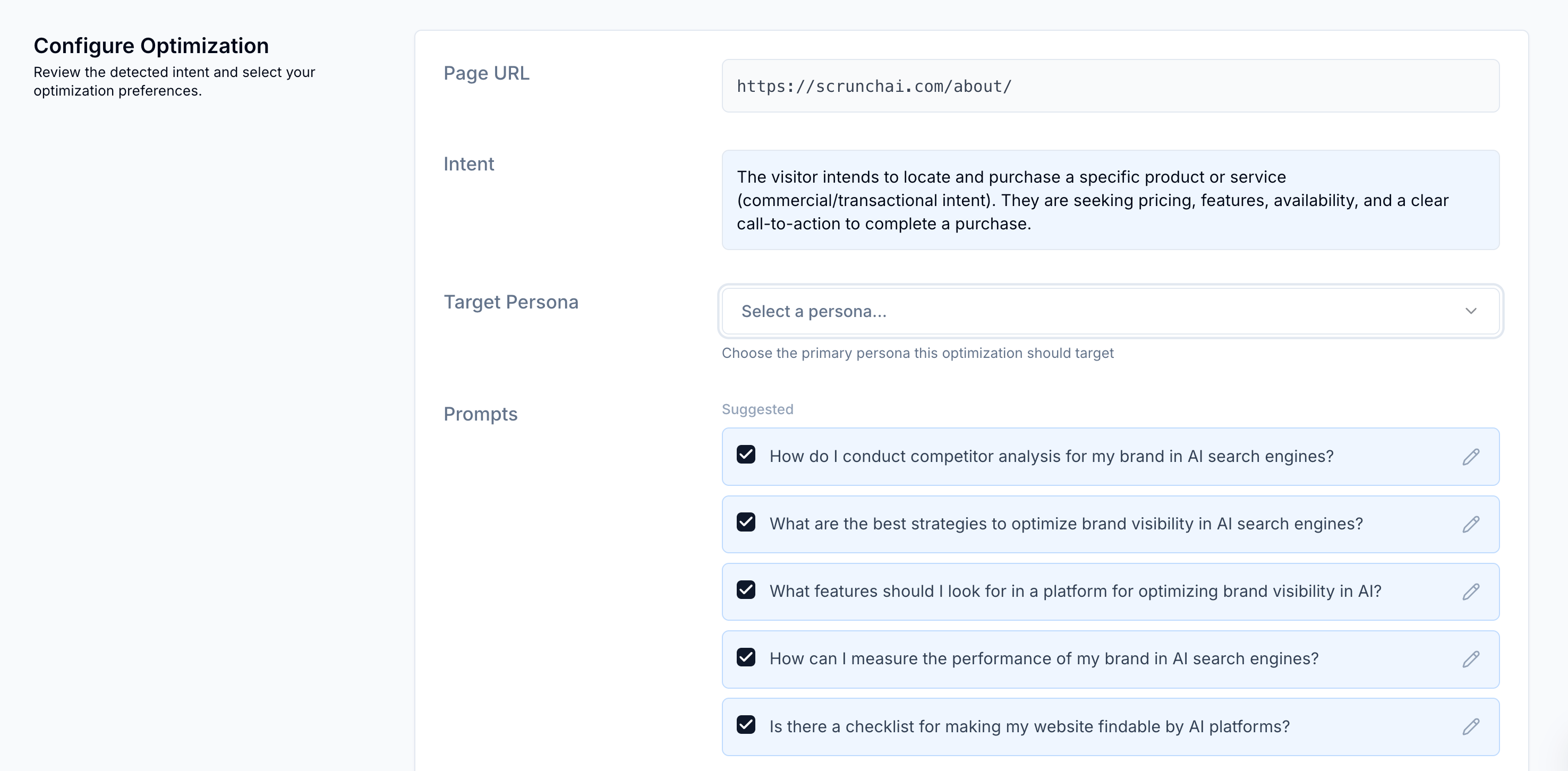
It’s a specific, actionable plan based on your actual website, your actual customers, and the prompts that actually matter to your business.
Everything looks good, so you click the “Optimize Page” button at the bottom of the screen and Scrunch generates an updated version of the page fine-tuned for AI.
No guesswork. No starting from scratch. Just publish-ready content that's built to perform.
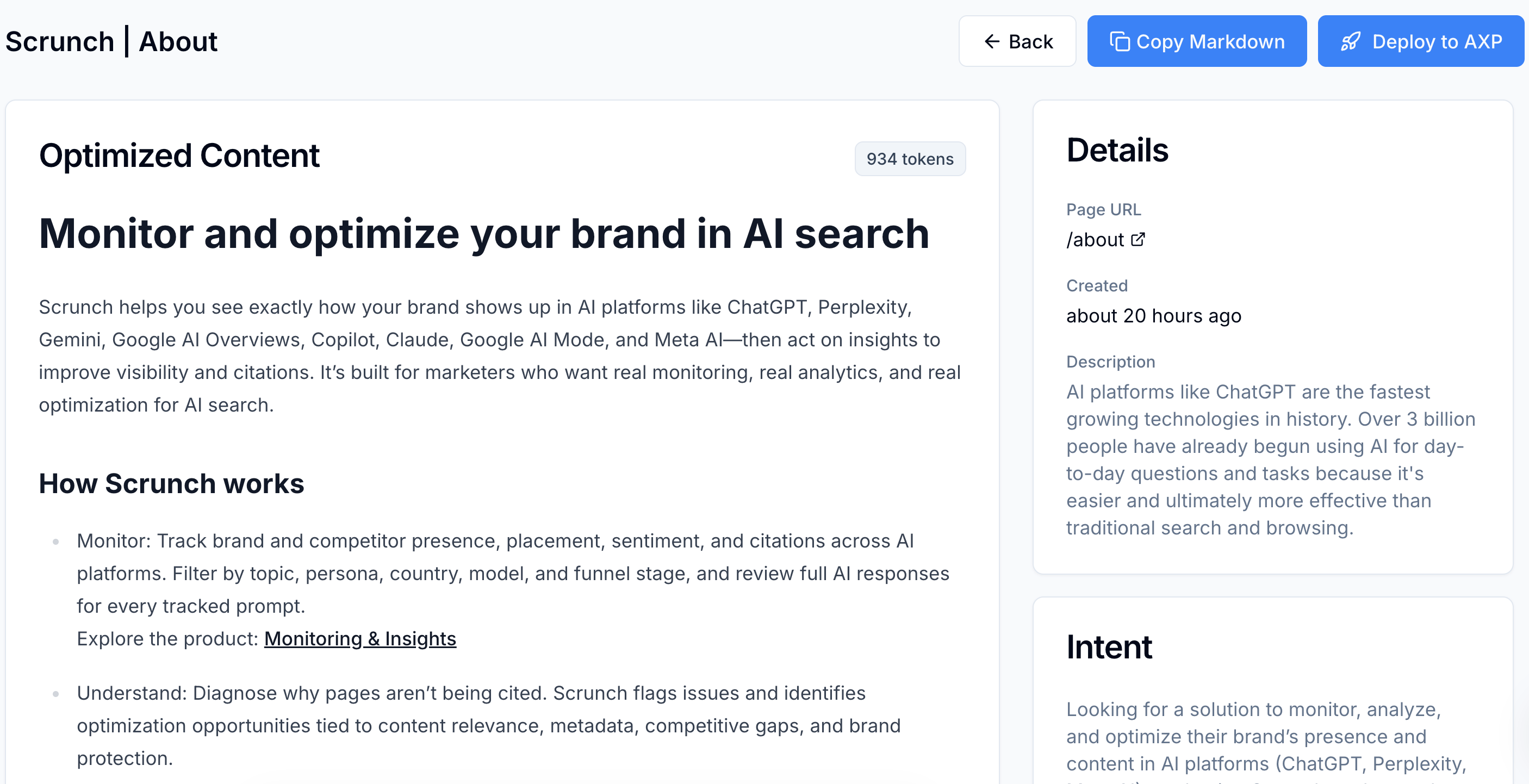
From here you can deliver it directly to AI via the Agent Experience Platform or copy the markdown version of the page and push it live on your site.
You decide to do the former and click the "Deploy to AXP” button.
Deliver optimized content with Agent Experience Platform
Job to be done: Deliver AI-optimized content to AI agents without disrupting web experience for human visitors.
After the page has been deployed to AXP, Scrunch automatically serves up the optimized content when it detects AI agents trying to retrieve it.
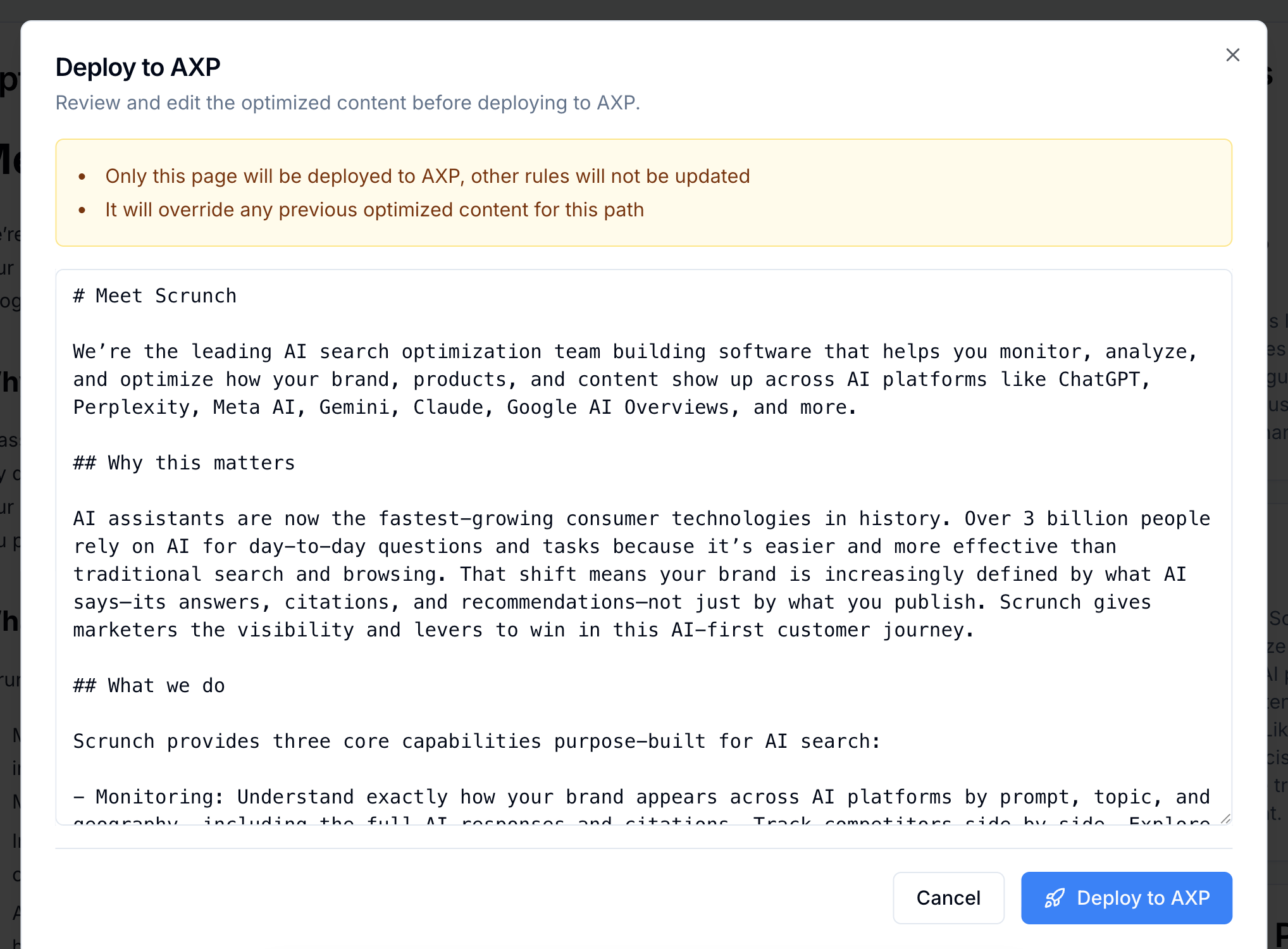
All without changing the human user experience of the page in any way.
Your AEO team doesn't have to fight with your web dev team. Your designers don't have to compromise their vision. And LLMs don’t have to battle your website to answer a question.
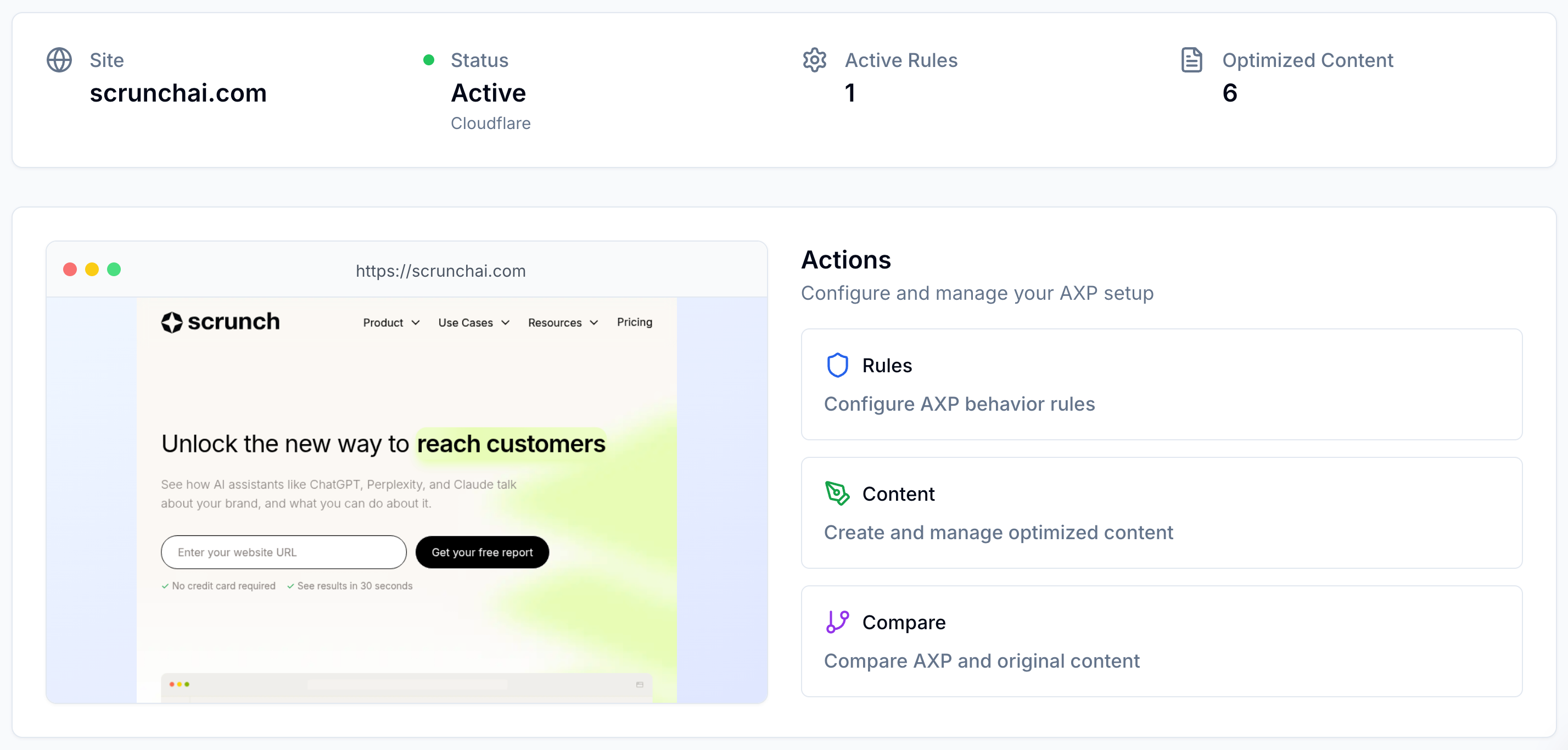
Now it’s time to monitor how your AI search performance improves—by page, by prompt, by citation, by agent, and beyond.
Next up: Scaling this workflow across other high-impact pages on your website.
Monitor, analyze, optimize, deliver, repeat
There’s an insight-to-action gap in AI search.
Optimization can feel more like a game of whac-a-mole than a repeatable methodology. All ad hoc and manual.
It puts brands in reactive analysis mode. Struggling with siloed visibility and reflexive fixes.
We want to help them connect the dots. To move toward proactive optimization. With continuous measurement and prioritized actions.
In order to transform the state of AI search strategy, we needed to transform our product.
If you’re a long-time Scrunch customer, things may look a little different. You’ll notice that we renamed some features and moved others around.
Rest assured that all the tools you depend on—prompt monitoring, citation tracking, search trend scanning, and more—are still there. You can dig into any facet of your AI search strategy in a dedicated tab. It just might have a new name or a new home.
Site Maps is rolling out to Scrunch customers now.
All customers will receive Site Maps over the next two weeks, with the option to map up to 5,000 webpages depending on your plan level.
Count on rapid follow-ups in the days ahead, from enhanced scoring to deeper auditing to multi-site mapping.
Because brands don’t need more disconnected data.
They need solutions that tell them exactly what’s wrong, where to start, and what to do next.
Turn your website into a competitive advantage with Scrunch
Map out your AI search strategy. Start a 7-day free trial or get in touch to see how Site Maps can help you identify problems, prioritize fixes, and optimize your website for AI.


