


Key takeaways:
- This is a guest blog post from Jackson Wightman, founder of tech PR and GEO agency Proper Propaganda.
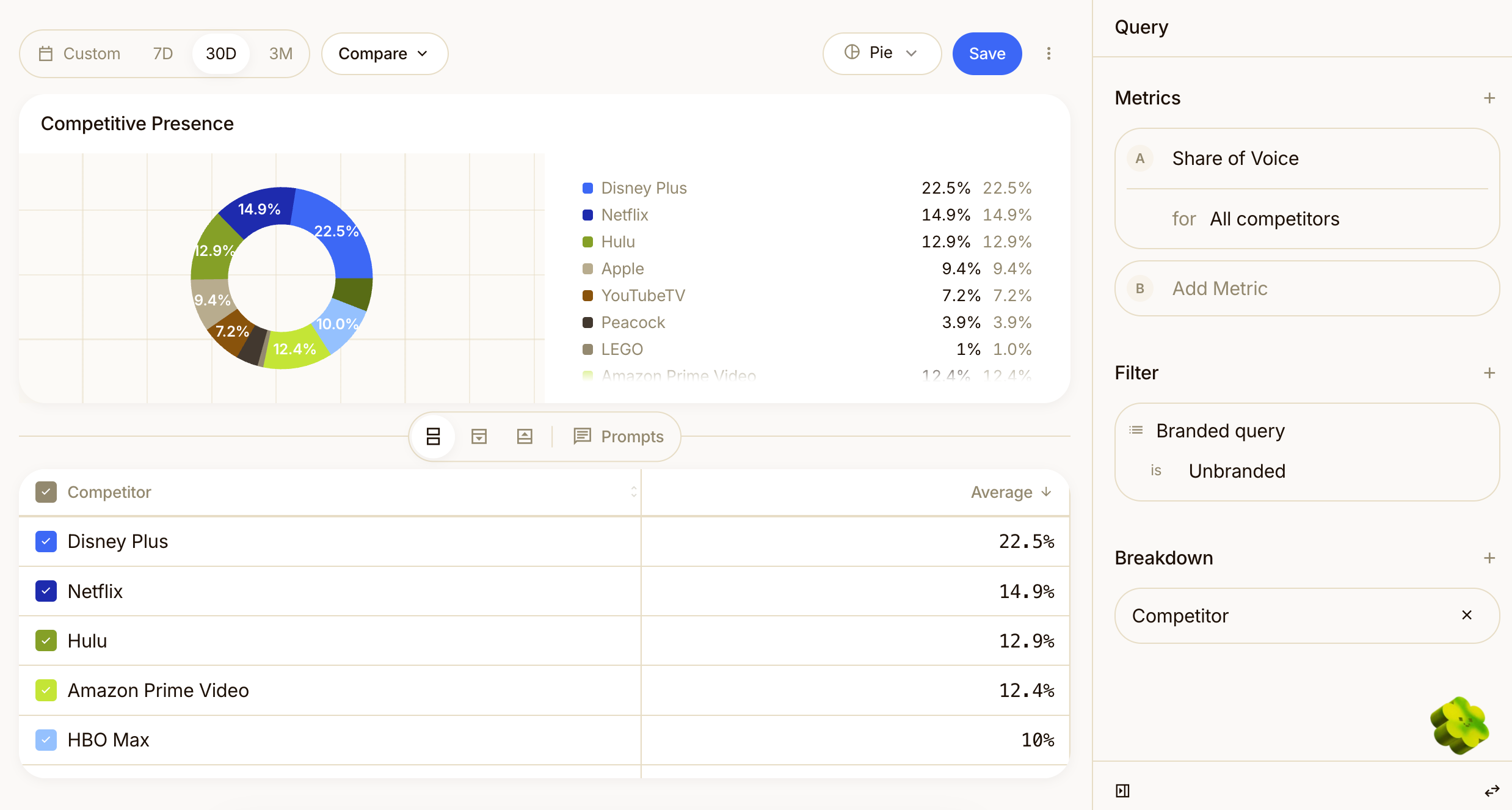
- Share of voice is a critical AI search metric, but it only defines winning at one stage of the buying journey.
- AI search covers the full customer journey—from top-of-funnel to post-purchase—and different metrics should define success at different stages.
- To measure AI search accurately, build a prompt set that spans the whole funnel and match your metric to the buyer's stage.
Too many brands worship at the altar of share of voice (aka share of answer in AI responses).
Don’t get me wrong—share of voice is critical in AI search. If AI doesn’t name you when someone asks what the best X for Y is, you may as well not exist.
But based on my experience with clients, other agencies, and the wider AI search echo chamber, I’ve come to believe that brands are overindexing on it at the expense of other critical metrics.
Partly because it’s damn satisfying to see AI put your name forward when a prospect asks a question about your category. But mostly because brands mistake the top of the funnel for the full buying journey.
Let me show you what I mean and why you should be measuring more than your brand presence for discovery-level, unbranded prompts.
A kitesurfer walks into ChatGPT
Data from Scrunch shows that generative engine optimization is a full-funnel enterprise.
People ask AI at every stage of the buying journey: education, discovery, evaluation, validation, purchase, post-purchase.
When it comes to complex purchases, AI is a passenger in the sidecar of the buyer’s motorcycle. It’s along for the whole ride, not just the first mile.
Say someone just discovered the joys of kitesurfing and wants to get serious about it. They open up ChatGPT and ask: “What's the best kite for a beginner learning kitesurfing?"
If you make kites, being in that answer is table stakes. To even be in the running for the sale, you have to be present. This is share of voice’s moment, and it's a real one.
But a new kite can run $2K-$3K. A purchase that substantial won’t be settled by one prompt.
So the buyer keeps digging:
- "Between Brand X and Brand Y, which is better?"
- “Is Brand X or Brand Y having a sale right now?”
- "How easy is it to repair a kite from Brand X versus Brand Y?"
I only listed four prompts in the example above, but for a purchase with that price tag, the number of prompts could easily break 10 or more.
And share of voice only mattered for the first one.
In other words: Across 75% of this make-believe buying journey, the metric many GEO programs live and die by is irrelevant.
The problem isn't the metric itself. If you don't show up at the right moment, you can't compete.
The problem is tunnel vision.
I see teams pouring all of their time and energy into a single top-of-funnel moment, but GEO is more than a top-of-funnel game.
A more complex sale can be won or lost at any stage, and the stages below discovery are where a lot of the deciding actually happens.
The scoreboard changes at every stage
My kitesurfing example maps to a repeatable framework the team at Proper Propaganda has been building.
Our thesis: The metric that defines winning in AI search changes every time the buyer moves to a different stage.
Stage 1: Education
Example prompt: “I just started kitesurfing and want to buy my first kite. What things should I consider when buying a beginner kite?"
The buyer is learning how to solve their problem. Your objective is to build authority and educate.
The metric that matters most is your brand’s citation rate (that is, whether your website helps shape the AI answer and whether AI puts forward one of your URLs as the source).
Citation influence score (available in Scrunch) is a good one to keep an eye on here, too. Agent traffic—aka how frequently AI bots consume content on your site relevant to this prompt—is also a solid supporting metric.
Stage 2: Discovery
Example prompt: “Give me a list of the best beginner kites.”
The buyer is exploring options. Your objective is to enter the consideration set.
This is where share of voice shines.
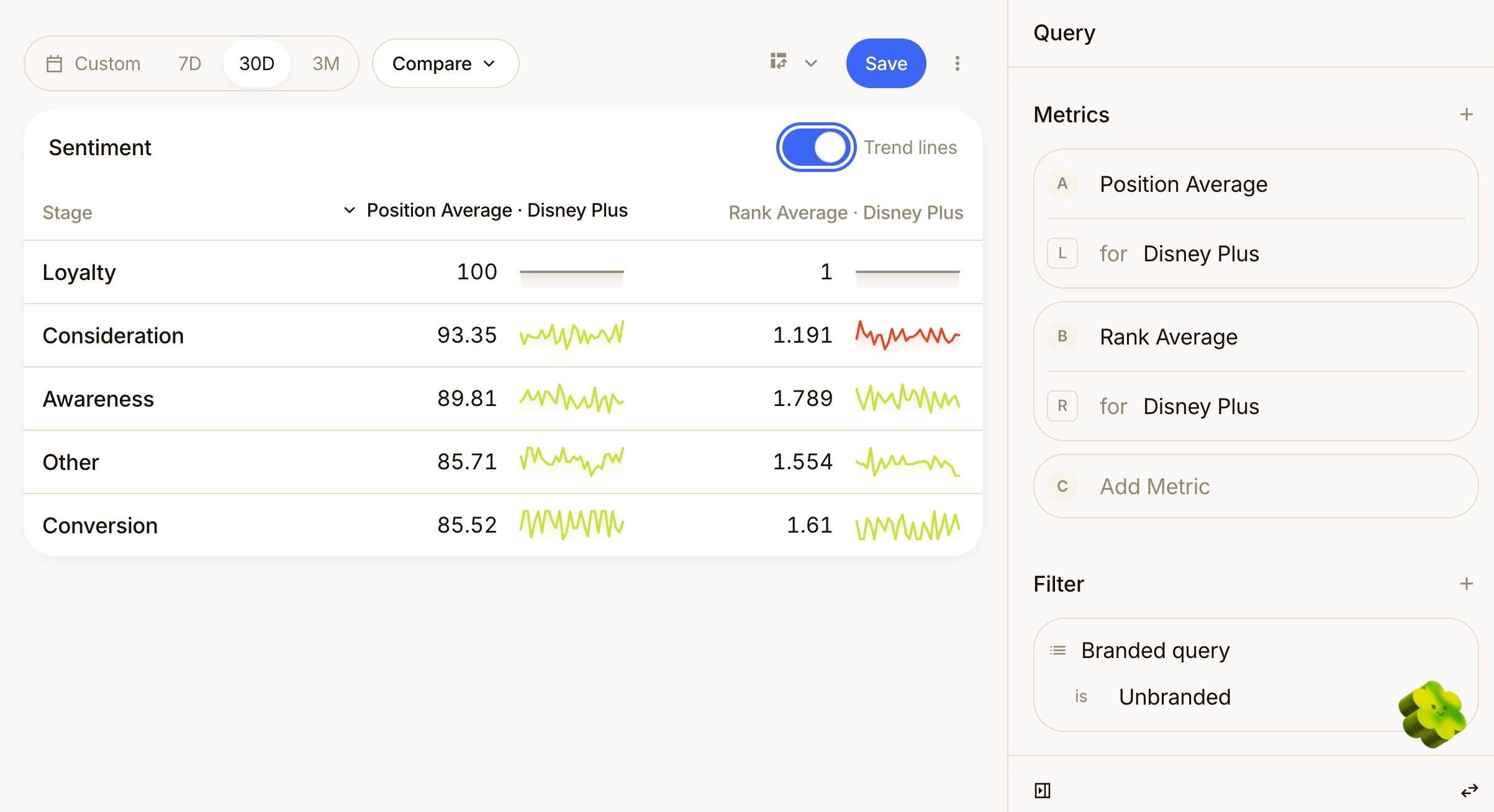
Beyond how your brand mentions compare to competitors, you’ll want to track your position and rank in the answer (the higher up and sooner you’re mentioned, the better), as well as recommendations versus mentions.
Stage 3: Evaluation
Example prompt: ”Could you provide a detailed comparison of Brand X and Brand Y? I want pros and cons for both kite models I’m considering."
The buyer is comparing options head to head. Your objective is to win the comparison.
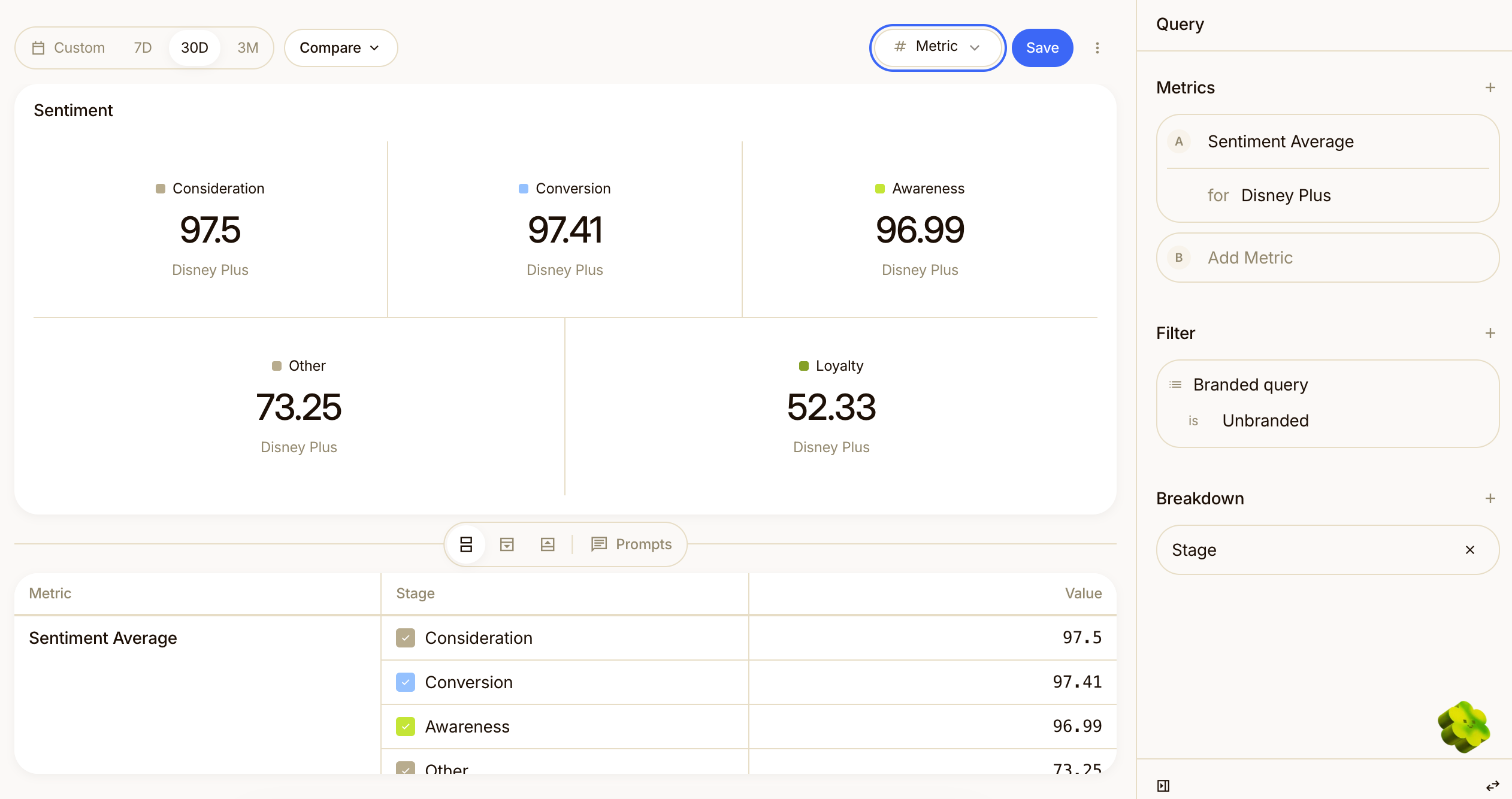
Brand presence is already settled, so the primary metric shifts to sentiment—how positively AI describes you.
Answer accuracy and whether you’re recommended versus just mentioned come into play here, as well.
Stage 4: Validation
Example prompt: “I think I like Brand X. But can you tell me if it’s reliable? Do reviews say it’s worth the money? Help me out."
The buyer wants proof before committing. Your objective is to build confidence.
Sentiment still leads, supported by accuracy.
This is an area where offsite content—PR, customer testimonials, online reviews—comes heavily into play.
Stage 5: Purchase
Example prompt: "I live in East L.A. Where’s the closest place I can buy Brand X's kites? Do you have info on where the best price is or if a sale might be on somewhere?”
The buyer is ready. Your objective is to remove friction.
Now accuracy is everything. AI has to get your product, pricing, and availability right.
Share of shelf and retailer share round out what you should be tracking (psst—Scrunch lets you track your AI search performance at the product level, too).
Stage 6: Post-purchase
Example prompt: “My Brand X kite just ripped during a session. I need to repair it. Any tips on how to do this fast and for cheap?”
The customer already gave you their money and now needs support. Your objective is to help them succeed.
The metric returns to citations to see whether AI cites your support content. You need to also look at accuracy and agent traffic as supporting metrics.
Six stages. Six different definitions of winning. Share of voice owns a crucial one, but it’s still only one.
Measure every stage, not just the start
Three moves I recommend:
- Monitor the entire funnel: Build a prompt universe with a meaningful share of top-funnel, mid-funnel, bottom-funnel, and post-purchase queries. A complex sale can be lost at any stage.
- Match your metric to the stage: As the framework above shows, the scoreboard changes as the buyer descends. Things like sentiment and accuracy matter more for lower-funnel prompts. Measure accordingly.
- Align incentives to match: This is specific to agency clients, but still: If you work with an agency, tie part of their compensation to metrics that capture performance across the full funnel, not share of voice alone. You get what you measure, and you definitely get what you pay for.
To be crystal clear, none of this makes share of voice a bad metric. It’s an essential ingredient, you just can’t bake the whole cake with it.
Complex purchases are long, winding roads. Winning them means thinking past the obvious and accounting for how measurement priorities change at every turn.
This is exactly why we use Scrunch to slice AI visibility by different metrics, across funnel stage, persona, competitor, and more.
See how your brand shows up across the entire buyer journey, not just the top of it. If you need a hand, the team at Proper Propaganda is here to help.
Win the full funnel in AI search with Scrunch
See share of voice and so much more. Start a 7-day free trial or get in touch to see how Scrunch can help you track and improve performance across the whole customer journey.


