Agent Experience
Monitoring & Insights






The prompt-to-purchase pipeline: What millions of search events told us about how AI influences buyer behavior
TLDR:
- When an AI platform recommends your brand to someone new, that person becomes ~182% more likely to search you on Google, ~117% more likely to visit your site, and ~185% more likely to view your products on a retailer's page within the week.
- Brand mentions move the needle, but not as much as recommendations. When AI actively puts your brand forward, it does roughly double the funnel-moving work of a mention.
- Platform, placement, and framing matter. ChatGPT drives a bigger surge in post-answer intent than Gemini. Meanwhile, brands named first or framed as "best" or "top" see the biggest jump in follow-up searches.
Attribution has long been a smudged windshield that marketers learned to squint through. AI search painted over the glass.
Before it was a question of how to connect organic search traffic to real revenue. Now it’s a question of how to connect AI answers to site visits at all.
Clicks across traditional search channels are declining thanks to AI platforms like ChatGPT, Perplexity, Gemini, and Claude.
And while you can connect the dots between an AI answer and a website session using tools like Scrunch, it’s far less likely for a person to visit a website directly from an AI search result than a Google search result.
AI search is primarily a zero-click channel.
So what’s the real value of improving your brand visibility in AI search? We decided to find out.
We analyzed millions of search events—both anonymized AI conversations and those same users’ anonymized web activities (think traditional Google searches, brand-site visits, and retailer product-page views) from February 2026 to May 2026. All data was derived from a privacy-safe opt-in panel.
The results reveal that when AI platforms recommend a brand to someone who isn't already using it, within a week, that person is more likely to search the brand, visit its website, and check out its products (either on the brand’s site or another retailer’s).
And there’s a good chance you’re giving “organic” or “direct” traffic the credit.
You can dig into our findings below.
But if brands take one thing away from this research, let it be this: When AI recommends your brand, people go looking—even if your existing analytics miss it completely.
Why is our research primarily focused on ChatGPT and Gemini?
ChatGPT and Gemini are currently the two most widely used general-purpose AI chatbots in the world.
Claude has a large (and growing) market share, but it’s often used more for business purposes versus general AI search. We included some Claude data for a smaller, more directional read on our findings. We excluded Google’s AI Overviews and AI Mode because searching brands via traditional Google search was one of the outcomes we wanted to measure, so adding them would have made our analysis circular.
Meanwhile, data related to searches on Perplexity, Microsoft Copilot, Grok, and Meta AI was too limited to be statistically meaningful for our purposes.
Last-click attribution doesn’t tell the whole story
Pretend you work for a business that sells running watches.
Someone opens up ChatGPT and types, “I’m training for my first marathon and need a running watch. Give me options that have good GPS and a long battery life. I don’t want to spend more than $400.”
The LLM recommends brands like Garmin, Coros, Polar…and you.
The user learns a bit about your brand, compares you to other options, looks you up online a few days later, and lands on a product page on your website.
By the time this happens, the AI nudge is nowhere to be seen in your analytics. Your team chalks it up to “organic” or “direct” traffic without realizing that AI was the on-ramp.
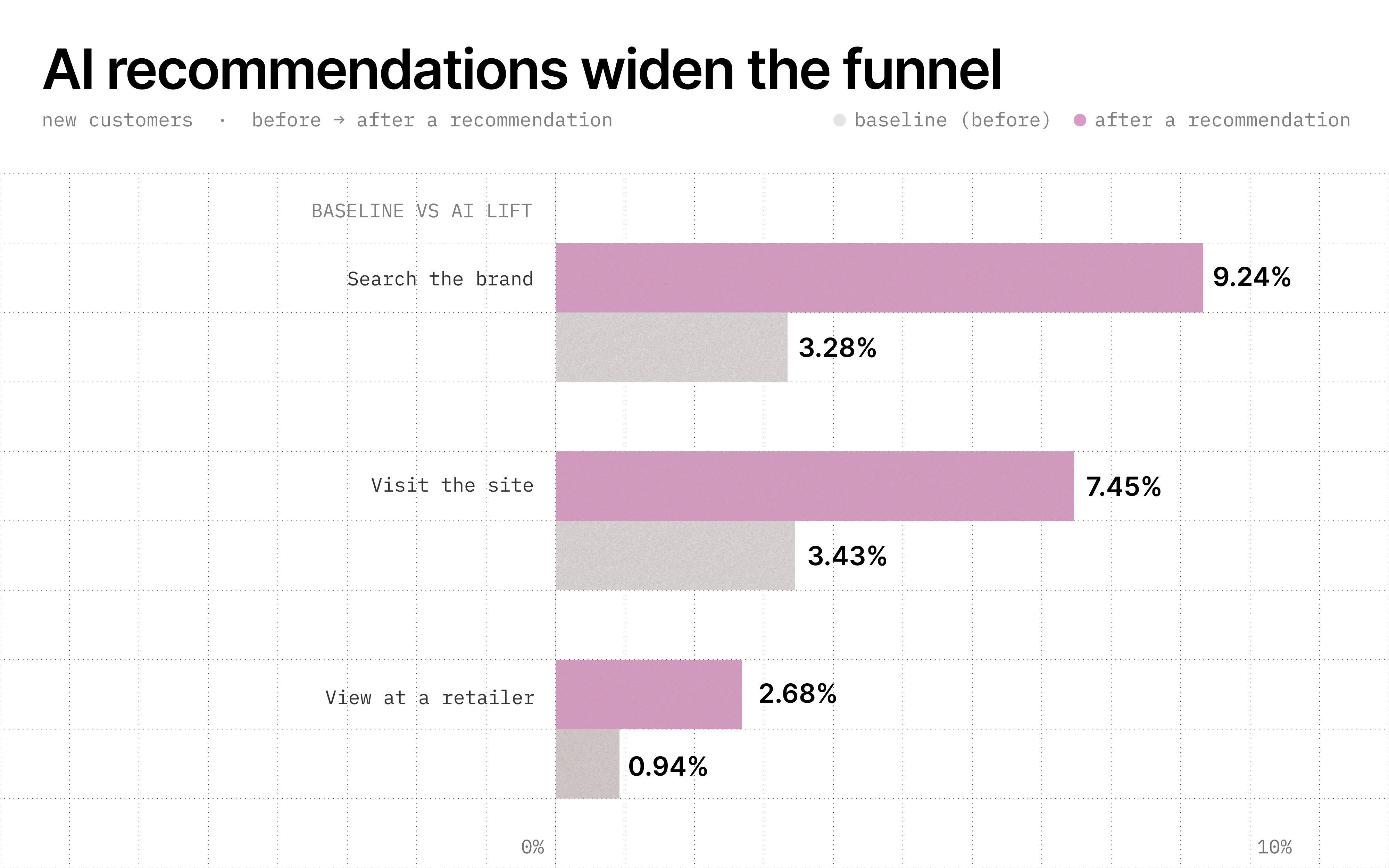
Our research shows that when an AI platform recommends a brand to someone with no recent sign of using it, over the next week, that person becomes approximately:
- 182% more likely to search the brand on Google (3.28% → 9.24%)
- 117% more likely to visit the brand's website (3.43% → 7.45%)
- 185% more likely to view it on a retailer's product page (0.94% → 2.68%)
Great news, as research shows that AI traffic is far more likely to convert than traditional organic traffic.
But if you grade the value of AI search by your existing analytics dashboards alone, you may see nothing while it quietly feeds your funnel.
That disconnect is dangerous. It means your brand may undervalue and underinvest in answer engine/generative engine optimization, which leaves you vulnerable to being replaced by the brands that take it seriously.
That being said, it’s important to understand that not every AI answer moves the needle in the same way.
Audience, platform, and how your brand shows up all play a part.
AI answers reach new buyers, not the ones you already have
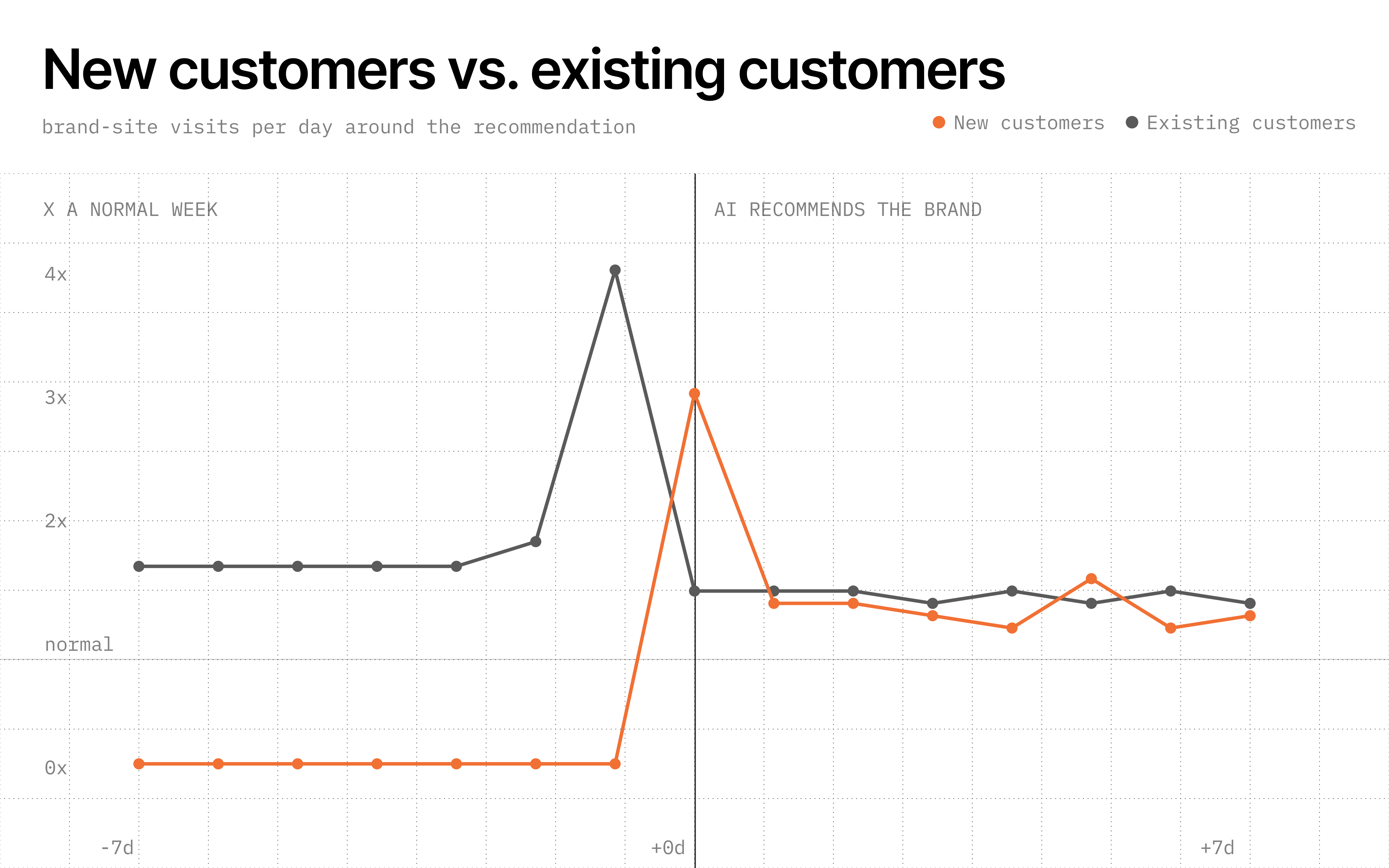
The lift in our study is driven by what we call “new customers”—that is, people with no brand searches, brand-site visits, or retailer page-views for that brand in the prior week.
For “existing customers”—or people who were already searching for a brand, active on a brand’s site, or viewing a brand's products on a retailer's site—AI mentions didn’t measurably change results.
That contrast—between a lack of build-up followed by a jump versus build-up that precedes a mention—is how we estimate that a recommendation moved someone rather than just coincided with interest they already had.
Our takeaway? AI answers act more like a billboard reaching a new audience, as opposed to a salesperson closing someone who’s already in the store.
Additionally, we found that the impact is much more concentrated on some AI platforms versus others.
A quick note on our data visualizations
These steps are not a strict sequence.
Some people execute a search first, some go straight to a brand’s website, and some jump right to a product page on a retailer’s site, so a lower stage in the funnel can be larger than the one above it.
We initially expected all AI assistants to behave the same. They didn’t.
ChatGPT recommendations move the funnel significantly more than Gemini.
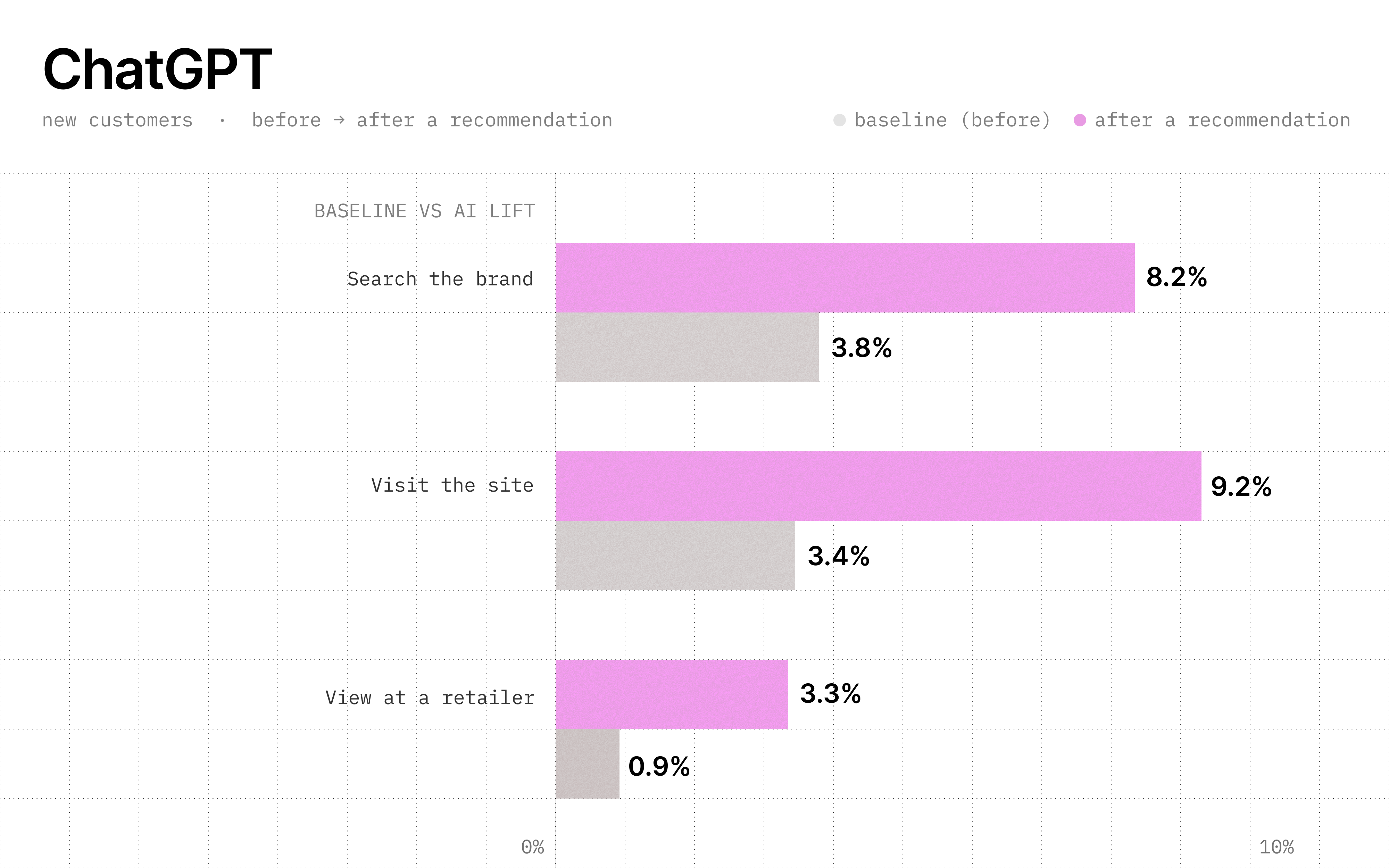
ChatGPT users are approximately:
- 116% more likely to search the brand on Google (3.8% → 8.2%)
- 171% more likely to visit the brand's website (3.4% → 9.2%)
- 267% more likely to view it on a retailer's product page (0.9% → 3.3%)
Meanwhile, Gemini users are approximately:
- 109% more likely to search the brand on Google (2.2% → 4.6%)
- 39% more likely to visit the brand's website (3.6% → 5%)
- 33% less likely to view it on a retailer's product page (0.6% → 0.4%) [Note: This is within the margin of error—we’ll dig into this more below, but Gemini’s retail baseline is relatively low because its users seemingly don’t use it to shop as often.]
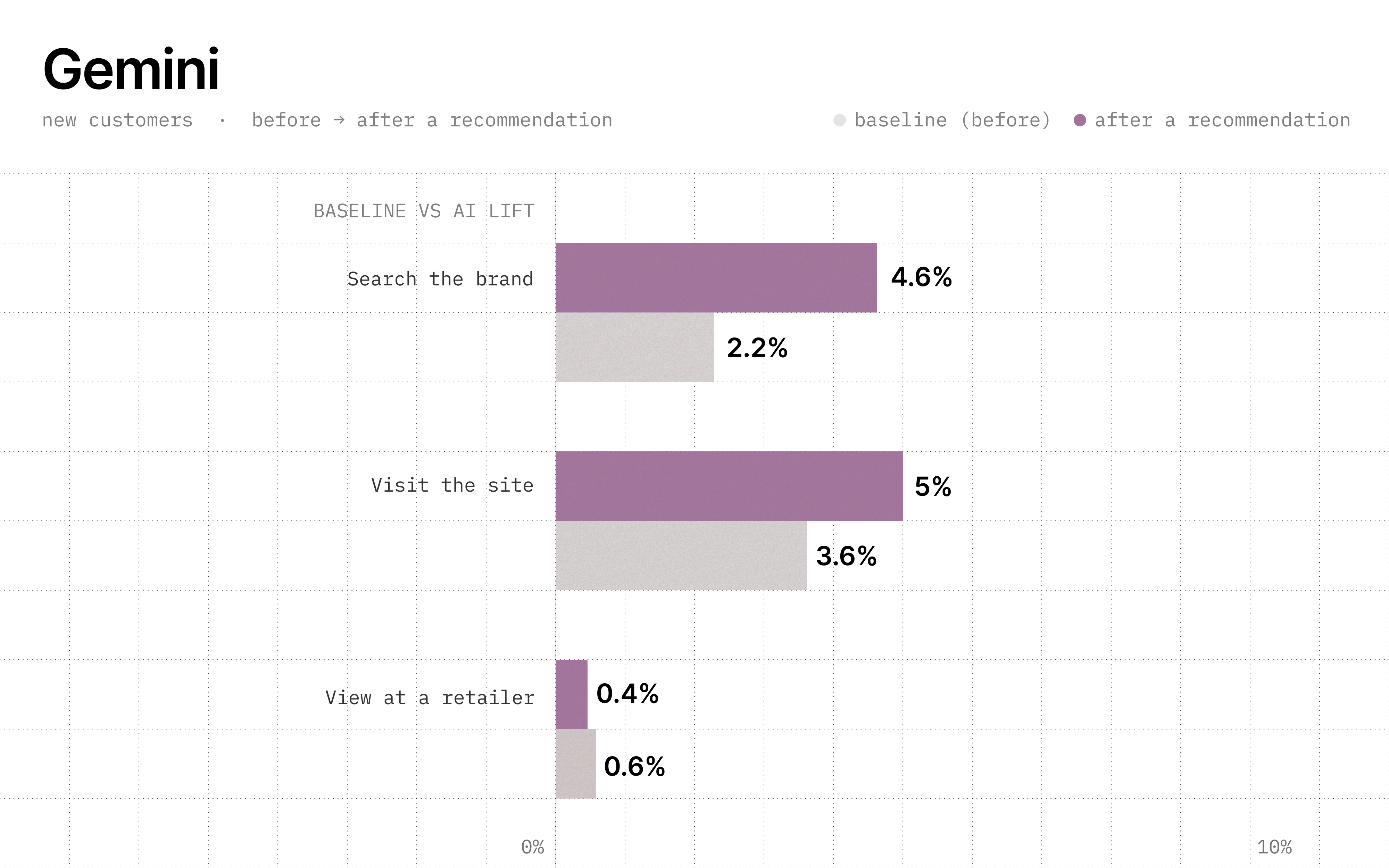
But here’s the twist: The gap is more about who uses each AI platform than the platform itself.
People who use ChatGPT more often simply appear more purchase-ready than people who lean on Gemini. When we compared the same person across both platforms, the difference mostly disappeared.
Meanwhile, we took a smaller sampling of data from Claude users to compare and contrast.
This data was captured partway through our research, so the sample is thinner and the numbers swing more. Even so, the pattern held and looked more like ChatGPT than Gemini.
Based on partial data, Claude users are approximately:
- 436% more likely to search the brand on Google (4.4% → 23.6%)
- 174% more likely to visit the brand's website (3.1% → 8.5%)
- 247% more likely to view it on a retailer's product page (1.9% → 6.6%)
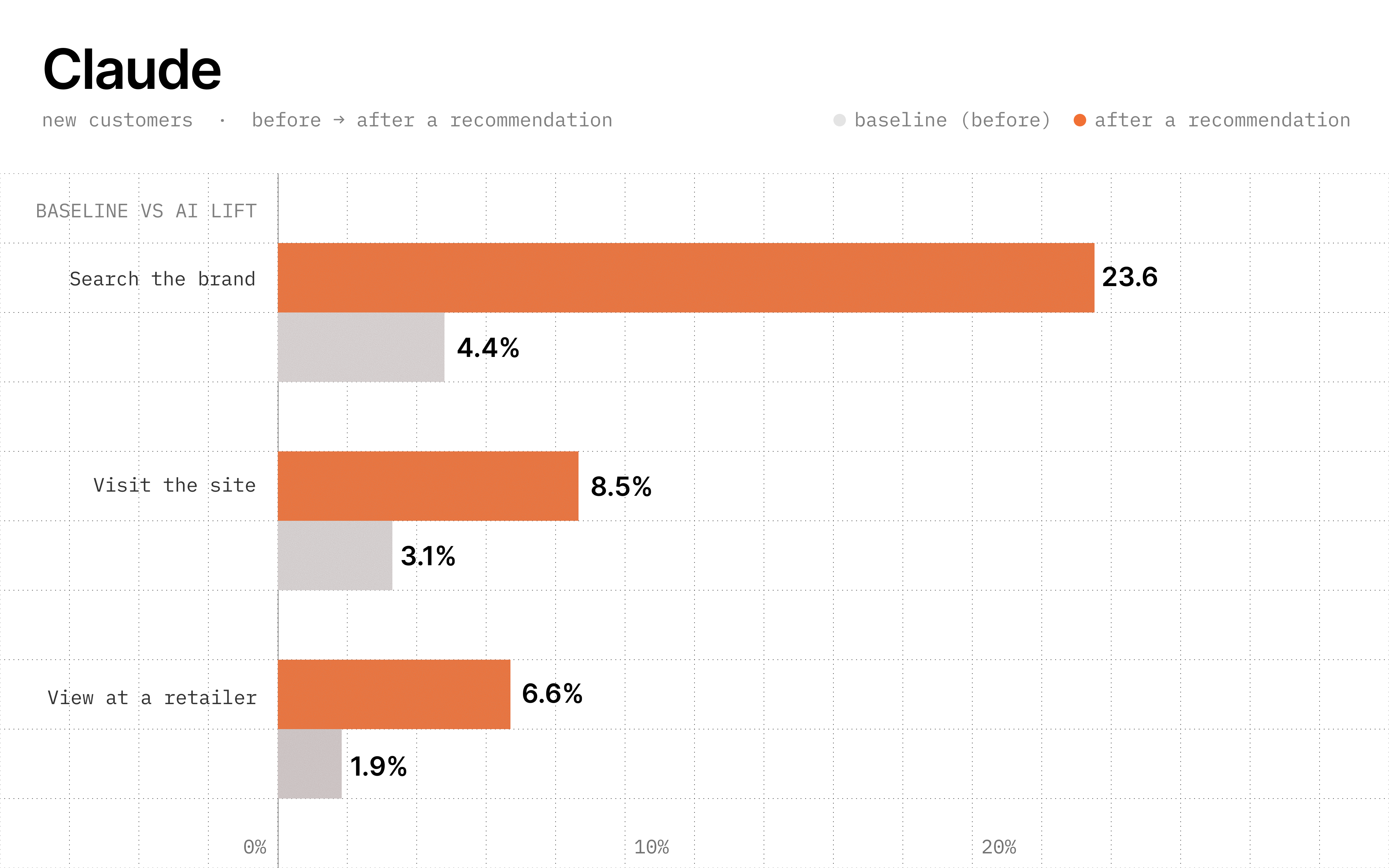
While some platforms appear to influence buyer behavior more than others, all of them showed that AI answers correlate with deepening buyer intent.
Recommendations matter more than mentions
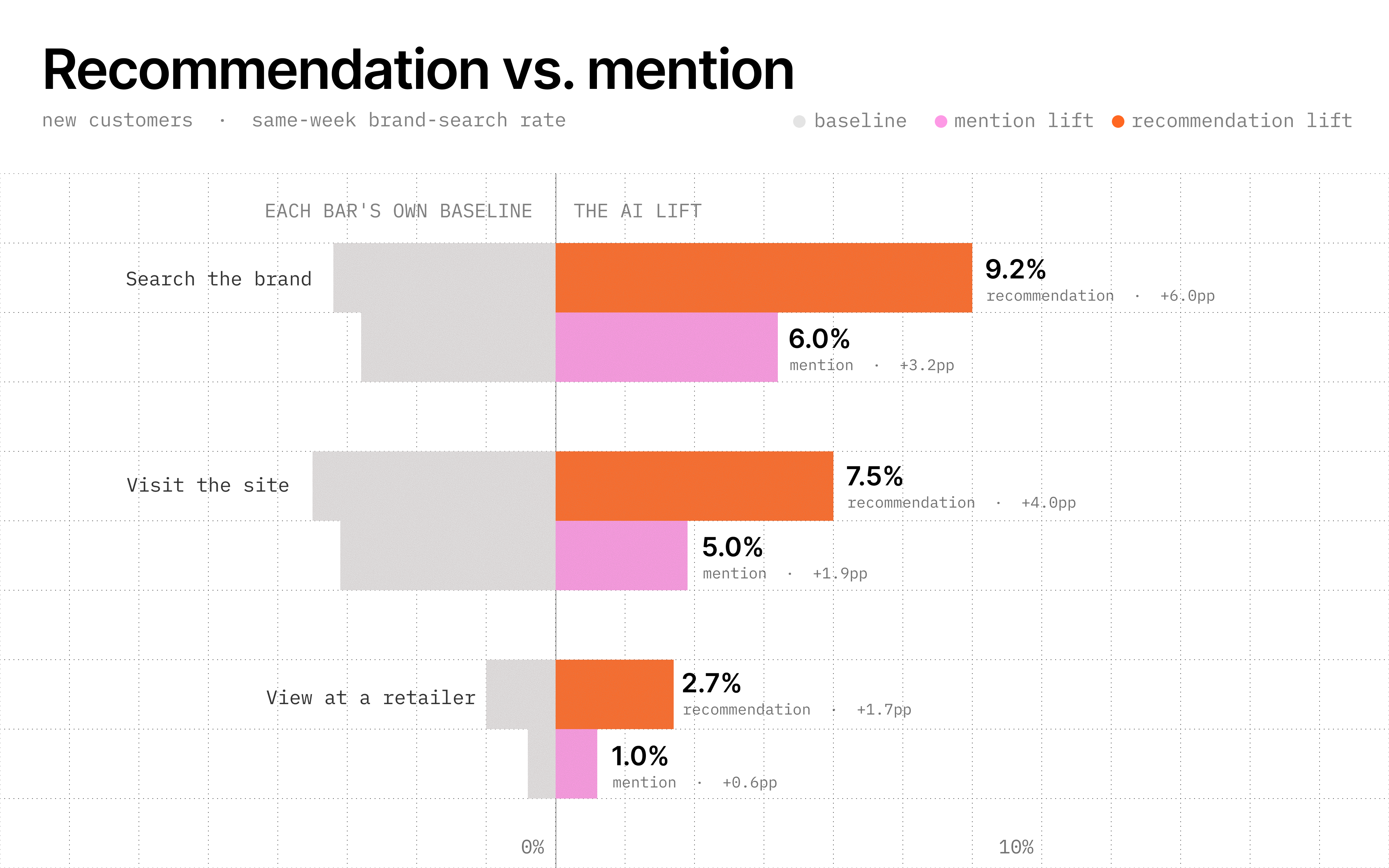
Our research also found that recommendations get more people searching, visiting your site, and viewing your products than mentions.
Mentions account for AI naming a brand at all—sometimes in passing ("unlike Garmin…") or as a brand the person already uses ("your Coros purchase").
Recommendations are when an AI actively puts a brand forward ("a great option is Polar").
A passing mention nudges consumers, but a recommendation really moves the funnel.
When a brand is mentioned, the likelihood that the user:
- Searches the brand on Google increases by 3.3 percentage points
- Visits the brand’s own website increases by 1.9 percentage points
- Views it on a retailer’s product page increases by 0.6 percentage points
When a brand is recommended, the likelihood that the user:
- Searches the brand on Google increases by 6 percentage points
- Visits the brand’s own website increases by 4 percentage points
- Views it on a retailer’s product page increases by 1.7 percentage points
Put another way, a recommendation pretty much does double the work of a mention at each step.
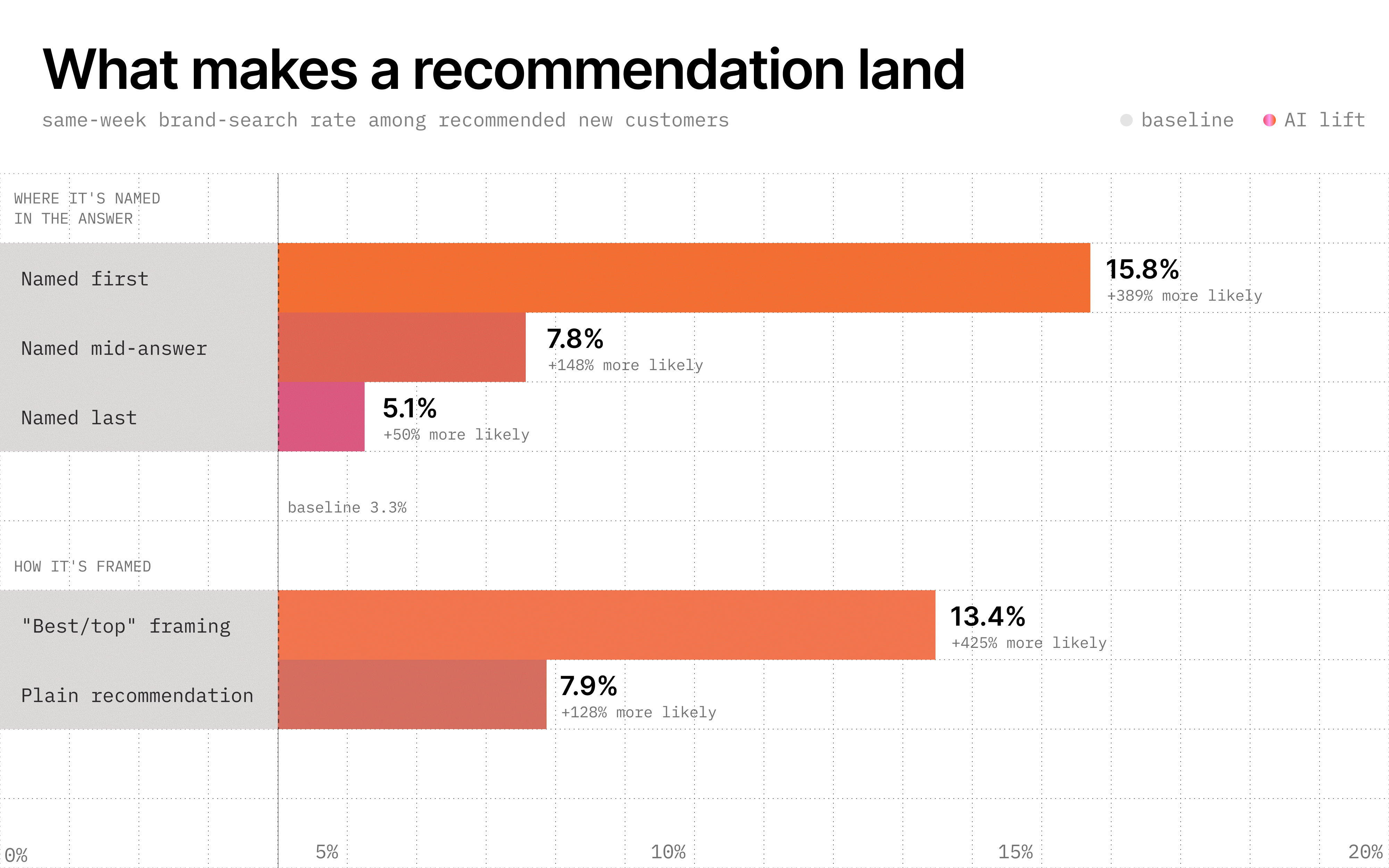
So what makes a recommendation land?
Answers that name your brand first and answers with “best” or “top” framing all improve the odds that someone will go on to search you in Google within the week.
In terms of where your brand falls in the answer:
- Brands named first are 389% more likely to be searched
- Brands named mid-answer are 148% more likely to be searched
- Brands named last are 50% more likely to be searched
And in terms of framing:
- Brands recommended as “best” or “top” are 425% more likely to be searched
- Brands recommended in plain language are 128% more likely to be searched
Don’t let outdated analytics steer you off course
So how should brands act on this information? Here are a few tips:
Invest in AI search as a real top-of-funnel channel
Just because you can’t always connect the dots between AI answers and website visits doesn’t mean nothing’s happening.
Our research shows that AI answers strongly correlate with top-of-funnel intent activity. Invest in AI search optimization accordingly.
Audit which AI platforms you show up on
Highly visible on Gemini but not on ChatGPT? You’re missing a major piece of the purchase-ready pie.
But keep in mind that while some platforms move the funnel more than others, the same directional pattern repeats across multiple AI surfaces. Prioritize based on audience and visibility gaps, but employ a multi-model approach.
Create content that gets you recommended, not just named
Responses where AI recommends your brand, rather than just mentioning it, are more powerful.
The levers you can pull are the same inputs AI platforms lean on: well-structured product and service content, highly cited comparison resources, strong brand presence on review sites. Put them to work.
Scrunch shows you which AI platforms your buyers actually use, the questions they ask, how they ask them, which ones matter for your category, how you and your competitors show up in the answers, and why.
More importantly, we help you do something about it so you can improve your odds of being recommended.
AI doesn't care whether your dashboard gives it credit or not. But you should.
The brands that measure and optimize for AI search performance will win the recommendations that feed the funnel.
Track and improve AI search performance with Scrunch
Show up in answers and capture buyer intent. Start a 7-day free trial or get in touch to see how Scrunch can help you win AI search.
A quick note on our methodology
This data comes from an opt-in panel that links people's real AI conversations to the same people's anonymized web activity (searches, brand-site visits, retailer product-page views) from February 2026 to May 2026. It's privacy-safe and aggregated: We report rates, lifts, and ratios, never individuals.
AI platforms: We used ChatGPT and Gemini for a head-to-head comparison; we also included Claude as a smaller, directional read—its capture began partway through the window, so its numbers are noisier. We excluded Google’s in-search AI Overviews and AI Mode because “searching the brand” is one of the outcomes we measure, so including them would make the analysis circular. Grok, Copilot, and Meta AI appeared too rarely for meaningful analysis.
What we counted: We read each response and separated genuine recommendations from passing mentions. We then stripped out the cases where the AI was just naming a brand the person already uses. Only recommendations to new customers count toward the lift.
How we measured lift: For each person, we compared the week after a recommendation to that same person's matched earlier weeks—a within-person before-and-after. That controls for "active people just do more," so the lift we report comes from the AI, after removing the person's own baseline.
What we measured: The early, high-intent steps: searches, site visits, and product-page views. That's exactly the activity last-click attribution misses.
How to read the images: Search, site visits, and retailer views are parallel signs of intent, not strict stages. People don't always search first; many head straight to the brand's site or to a retailer.
Who's counted as a “new customer”: Someone with no brand search, brand-site visit, or retailer page-view for that brand in the prior 7 days—no recent sign they were already engaged.
Causation vs. coincidence: People often open an AI platform already carrying intent, so we don't just look at “after.” Two guards: the within-person before-and-after removes their own baseline, and within the same response the named brand moves more than the un-named brands sitting beside it—something “they were already shopping” can't explain.
How data holds by category: We re-ran our research across beauty, apparel, and audio; the lift reproduces, though the destinations differ (beauty leans to specialty retailers, electronics to the brand's own site). The running-watch example is illustrative, not the only case.
About the panel: It's an opt-in group willing to share both their AI chats and their browsing—more AI-engaged and privacy-tolerant than the average buyer, so read cross-population generalization with care.
About the scale: These are per-person probability lifts off small bases—most people still don't act in a given week. The value is incremental reach at the top of the funnel multiplied by how often AI puts you in front of new people, not a guaranteed conversion.
Data studies



More articles

What happens when you crown yourself #1: Inside thousands of listicles and their impact on AI answers

YouTube influencers have an AI audience: What millions of citation events reveal about influencer sponsorships
