


TLDR:
- There's no Black Friday cheat code. Peak week queries mostly look like any other week in our data, with shoppers asking ordinary shopping questions, so year-round fundamentals beat seasonal shortcuts.
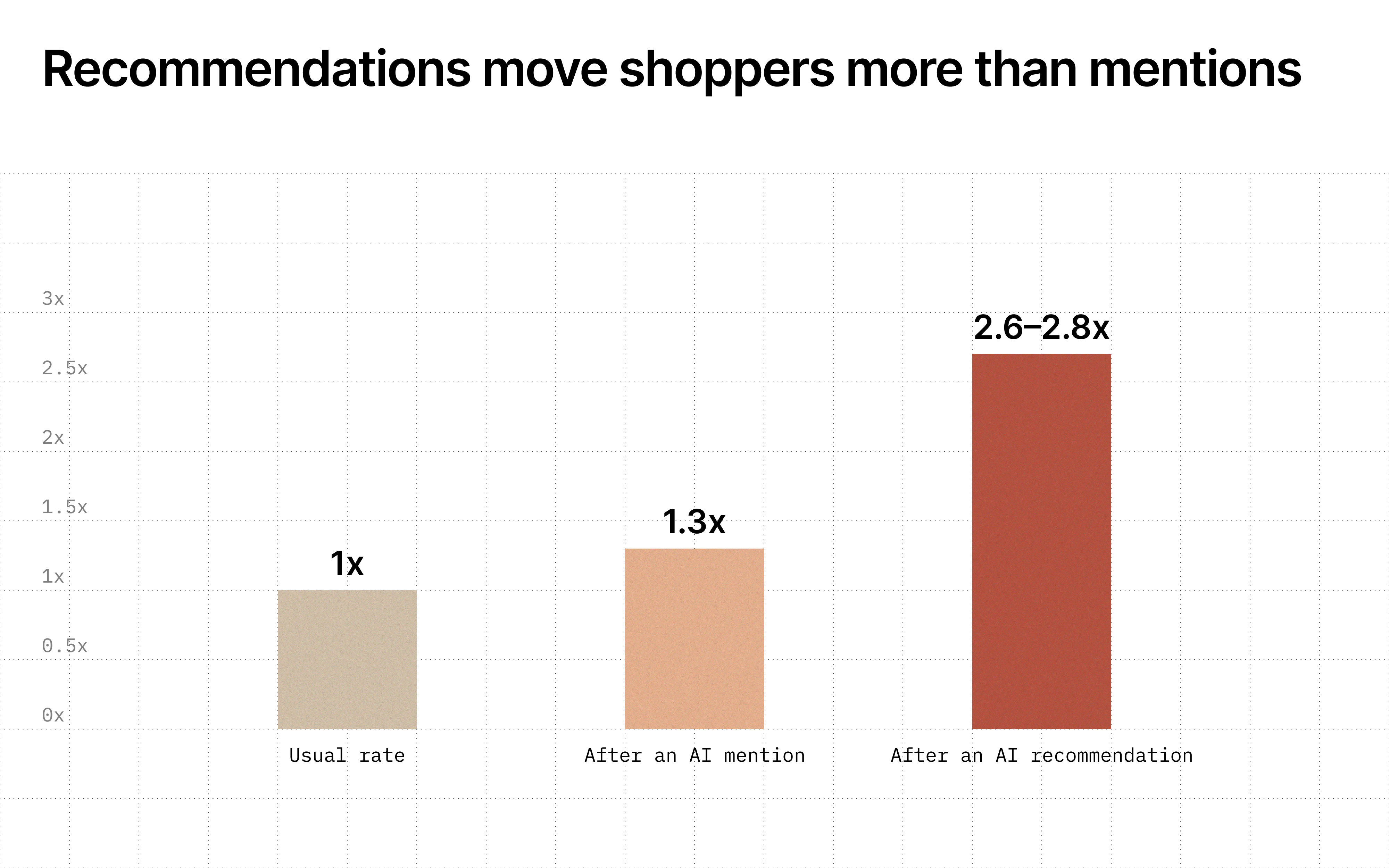
- Be findable, and aim for recommendations over mentions. Make every product discoverable by its exact model name, and remember that a recommendation drives roughly 2.6-2.8x the usual store visits versus about 1.3x for a mention.
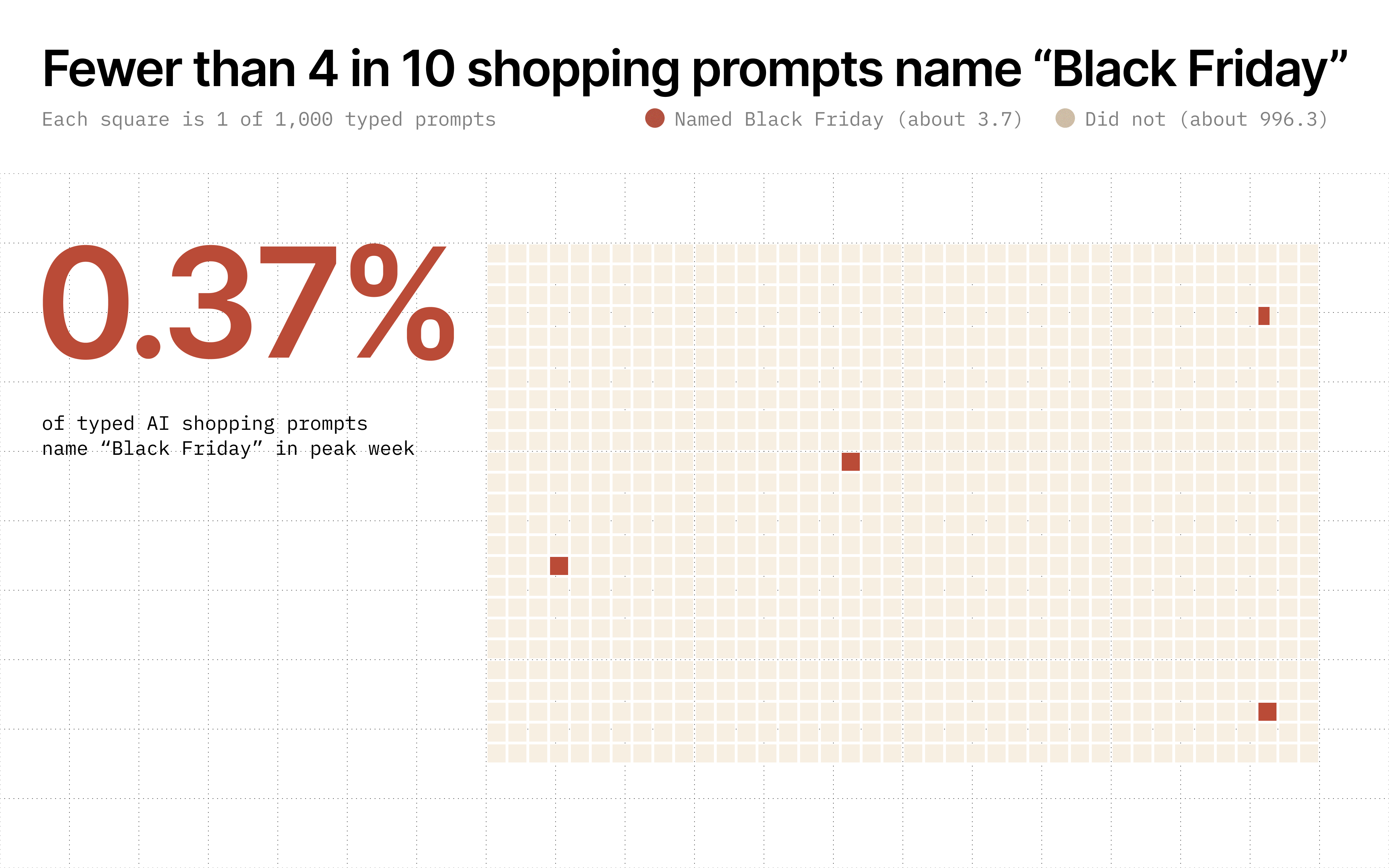
- Skip the BFCM page spree. Fewer than 4 in 1,000 shopping prompts name Black Friday. Put your effort into accurate, information-rich product listings and evergreen comparison and review content instead.
Shoppers in the US are expected to spend upward of $85 billion in 2026 during the four-day stretch between Black Friday and Cyber Monday.
AI will be shaping a lot of those purchases.
So what can retail and ecommerce brands do to win their fair share of AI-influenced spending?
There’s no shortage of “tactics” floating around. Some are backed by data. Some aren’t.
We ran them against a slice of our privacy-safe opt-in panel—which includes millions of conversations and citations across AI assistants, as well as comparisons of shopper behavior in AI assistants and web search—to see what’s worth your time and what’s not.
If there’s one thing every brand should take away from our findings, it’s this: Year-round fundamentals beat seasonal shortcuts.
That isn’t a reason to do nothing. It’s a reason to spend November, and every month after, doing the work that pays off all year long.
Here’s how.
A quick note before we start
We mostly reference “Black Friday” down below, but the advice applies to Cyber Monday, too.
The dos and don’ts of BFCM
Do: Make every product findable by its exact model name
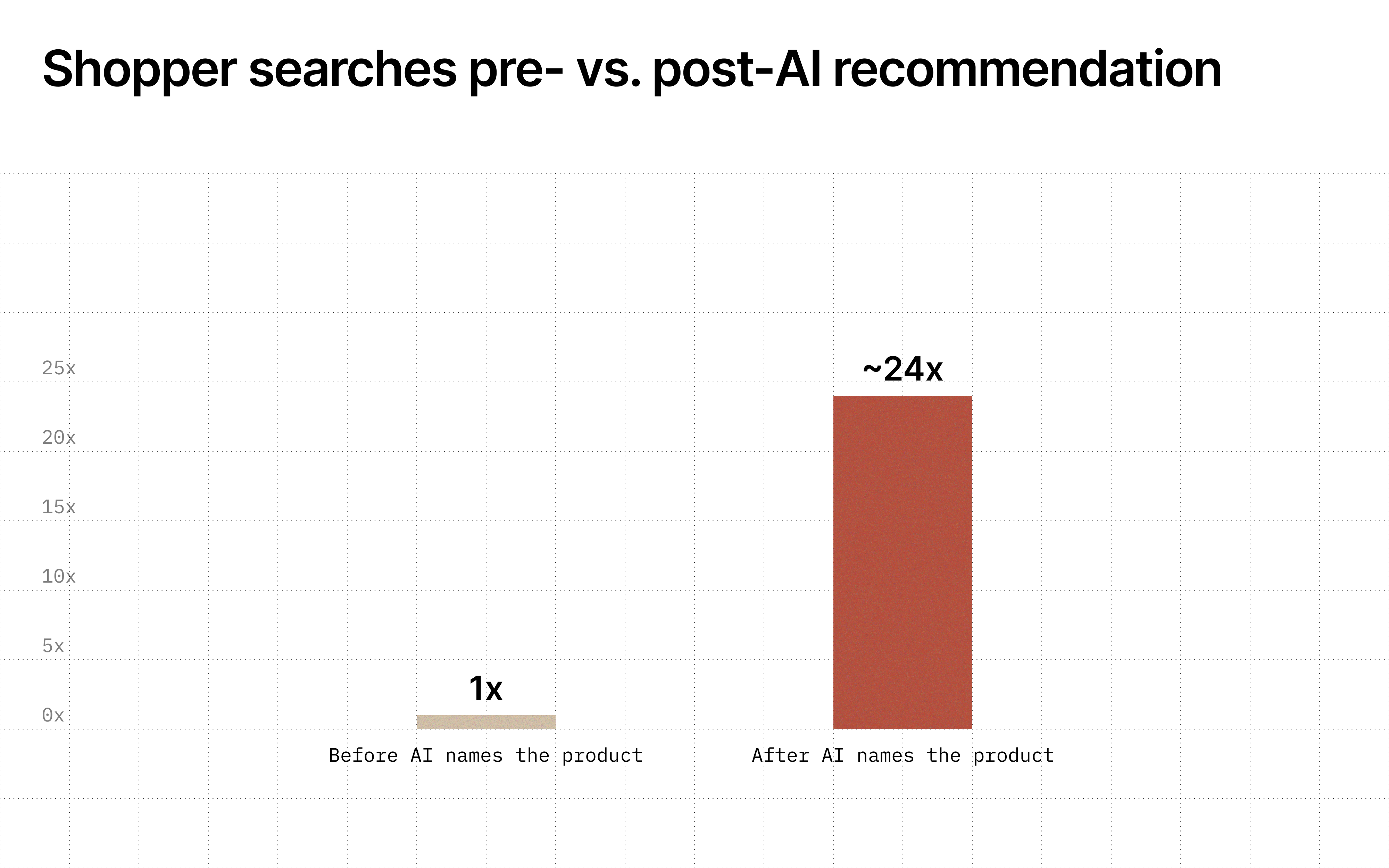
After an AI answer names a product, a shopper’s searches for that product run about 24 times the usual rate. That pattern held the week of Black Friday 2025, as well as the weeks before.
The catch: Roughly 7 in 10 post-AI store visits arrive without an AI link, most often through a traditional web search. You can’t count on traffic clicking straight through to a product page from an AI chat, so it pays to be findable by the exact name the AI answer uses.
Make sure product titles, URLs, site search capabilities, and model numbers are accurate on your own site and across every retailer and marketplace listing. Searches often land on a marketplace (think sites like Amazon) rather than the website of the named brand.
Our advice
Get visibility into how your products appear in AI shopping results across LLMs: whether you’re being shown first, shown correctly, or shown at all. You can't fix what you can't see.
You can use Shopping in Scrunch to learn which prompts surface your products, which ones competitors are winning and you’re not, and what AI answers look like across different queries.
We also show you which retailers are capturing AI visibility for your products, how often AI links out to your website versus a third party’s, and which retailers are most likely to intercept your AI-driven clicks and conversions.
Don’t: Settle for mentions when recommendations are on the table
As we’ve covered before, recommendations do more work than mentions alone.
Based on our latest analysis, store visits run about 2.6 to 2.8 times the usual rate after an AI answer recommends a store or product there. A mention only moves store visits about 1.3 times.
This is where facts and figures that speak directly to user queries make a big difference. If someone asks for a 65-inch TV under $400 that fits a narrow media console, AI is more likely to recommend you if your content and catalog include the necessary information. Things like product specs, price, and availability will move the needle a lot more than a marketing tagline.
Our advice
Get a read on where you’re landing in AI answers today for different queries and cross-reference against your key product pages.
Scrunch makes it easy with Explorer, a self-serve analytics surface that lets you slice and dice your data across any and every metric, including answer position and answer rank. You can easily spot the questions where you’re a footnote instead of the top pick.
Meanwhile, Site Optimization and Agent Pages give you the tools you need to change it.
The former provides you with technical and editorial fixes you can make on the appropriate pages to improve performance. The latter helps you deliver optimized content directly to verified AI agents at the edge so your content is easier to access, read, and use.
Do: Throw a bone to BFCM deal hunters
Black Friday queries are far from the norm (more on that below), but some shoppers will use them. And in those cases, 85% of ChatGPT's citations are Black Friday-specific pages.
Our data on Black Friday prompts breaks down like this:
- 24% of queries were asking about a retailer’s sales, hours, or ads
- 19% were marketers or salespeople asking AI to write Black Friday-related copy
- 14% were category deals (e.g., “Best Black Friday TV deals”)
- 10% were about deals for a specific product
- 7% were about a brand’s specific Black Friday deal
- 12% didn’t fit cleanly into any category
It doesn’t hurt to publish content for shoppers seeking a Black Friday or Cyber Monday deal. Just remember that one solid page for the people who ask is worth it. Twenty pages isn’t.
Our advice
Craft content engineered to beat the pages currently being cited for the topic areas you want to win. Content Generation in Scrunch was built to do exactly that.
It automatically scores and fine-tunes content based on our proprietary Site Optimization data model, using a massive dataset of real AI answers and citations to write content designed for AI consideration and selection.
It also keeps your content accurate and on-brand by grounding it in your approved internal sources and voice guidelines via Knowledge Studio.
Don’t: Turn every product page into a “Black Friday” page
A plan built only for Black Friday (or Cyber Monday) questions tunes the edges of the holiday season, not what most shoppers are asking.
Our research finds that even during the week of Black Friday (aka peak week), only a small fraction of typed shopping prompts name Black Friday at all. Fewer than 4 in 1,000 prompts mentioned Black Friday in our dataset, and some of those may be due to go-to-market teams asking AI to write their Black Friday promotional copy.
In other words: Pasting Black Friday language across every product page is the wrong move.
Our advice
Focus on your brand’s share of voice for popular shopping queries across key product areas, buyer personas, and funnel stages, not just holiday keywords.
Also keep an eye on any big shifts in your data leading up to the peak of shopping season. That includes meaningful changes in brand mentions and citations, as well as trending topics that are relevant to your brand.
Scrunch’s Signals automatically flags significant data shifts so you know the instant something important happens, from a drop in visibility across key topic areas to a new competitor entering the comparison set. We also tell you why it matters and what to do about it.
Meanwhile, our Trends feature helps you keep tabs on estimated prompt volume for different topics so you can see how consumer demand is changing over time.
Pro tip: Don’t just dig through the data manually, ask Scrunchie to do it for you. Our in-app AI assistant can help you answer any question and diagnose any issue in natural language, inside our platform or in your preferred chatbot, no pointing or clicking necessary.
Do: Optimize evergreen comparison and review content
As we’ve reported before: AI likes to reach for comparison content.
When shoppers ask general product questions, about 45% of ChatGPT's own background searches use words like "review," "test," or "compare."
That said, Black Friday pages aren’t what AI goes for: On ChatGPT, only about 1 in 2,000 citations for all questions reference Black Friday content. So focus on getting your evergreen comparison content right.
Our advice
First, make sure your owned comparison content is AI-ready. Scrunch’s Site Optimization and Agent Pages can help.
Next, make sure you’re represented well in comparison content off your site. Scrunch’s citation optimization features allow you to zero in on the pages AI cites for the prompts you care about, as well as identify which pages are most influential.
You can use this shortlist to not only see where you want to be added, but also which existing brand mentions are inaccurate and need to be fixed.
Don’t: Forget about comparison tools and suggestions on your site
AI agents don’t do all the shopping (unless someone’s tasking a personal agent like Muse or Instinct with their holiday list).
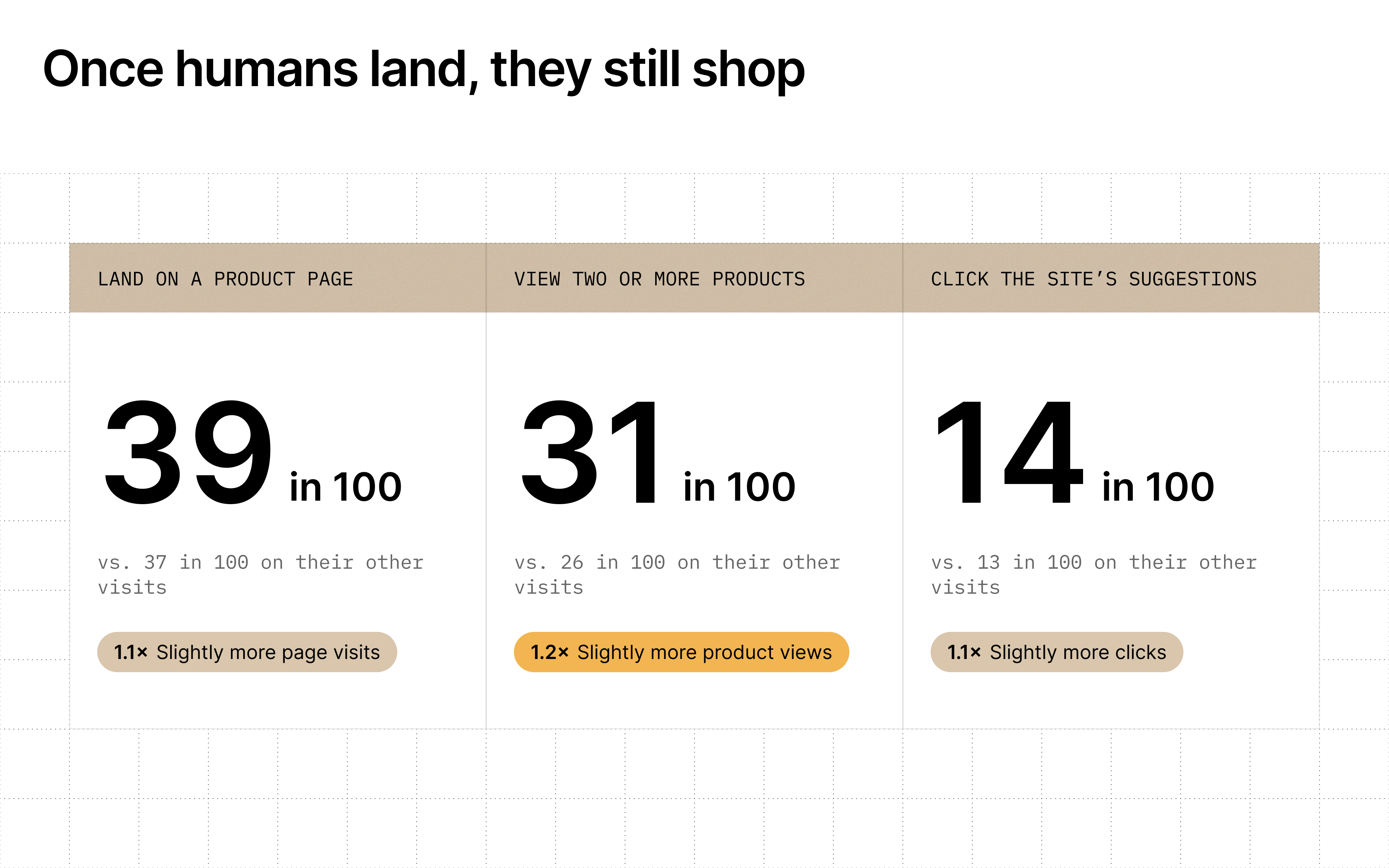
Shoppers who arrive after an AI answer are just as likely, if not more so, to land on a product page and click on a site’s product suggestions as other shoppers.
In fact, they’re 1.2x more likely to look at a second product (31 versus 27 in 100).
Our advice
Don’t let an AI-referred shopper hit a dead end. Optimize for machines and humans.
Continue investing in onsite comparison tools and product recommendations. Even if AI recommends one product, a human shopper may want to browse a little after they land and potentially swap it or add a second purchase to their cart.
Just make sure the information you have is readable by humans and AI agents alike.
AI answers don’t take a holiday
We looked for a Black Friday effect: a week where the rules changed and the usual work mattered less than seasonal hacks.
We didn’t find one. Peak week queries in November 2025 looked much like September and October before it.
That’s the takeaway.
There’s no special holiday switch to flip. There’s your brand, how AI reads it, and whether you make the answer or don’t.
Before you spend November testing out seasonal cheat codes, ask the one question worth answering: What does AI say about your products right now, and why?
That’s what Scrunch is built to show you, and what it helps you fix.
Optimize for AI year-round with Scrunch
Be the answer any time of year. Start a 7-day free trial or get in touch to see how Scrunch can help you show up better and more frequently in AI answers.


