


TLDR:
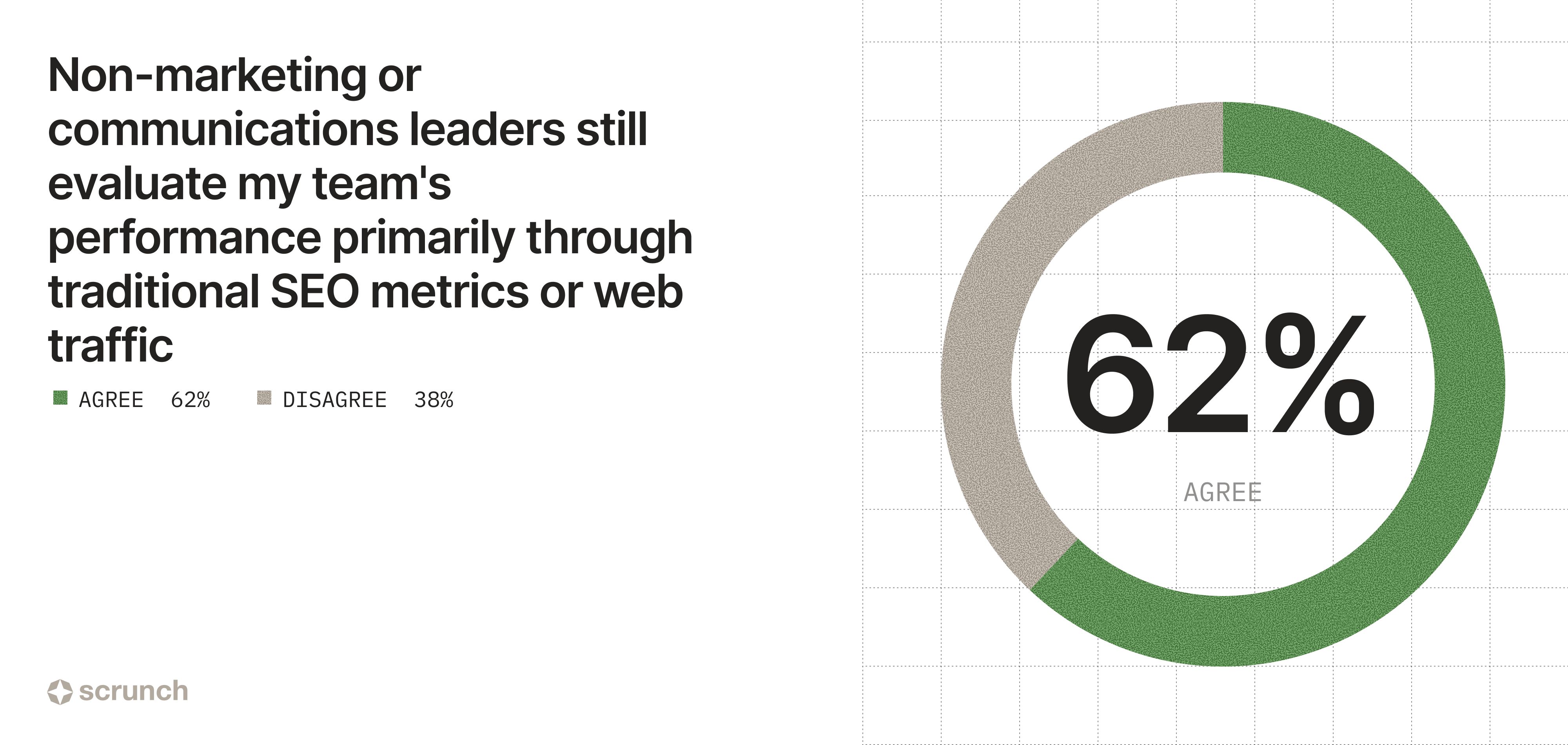
- Sixty-two percent of marketers say non-marketing or communications leaders still evaluate their team’s performance primarily through traditional SEO metrics or web traffic.
- Fifty-two percent say misalignment around AI visibility metrics is limiting their team’s ability to execute an effective AI visibility strategy.
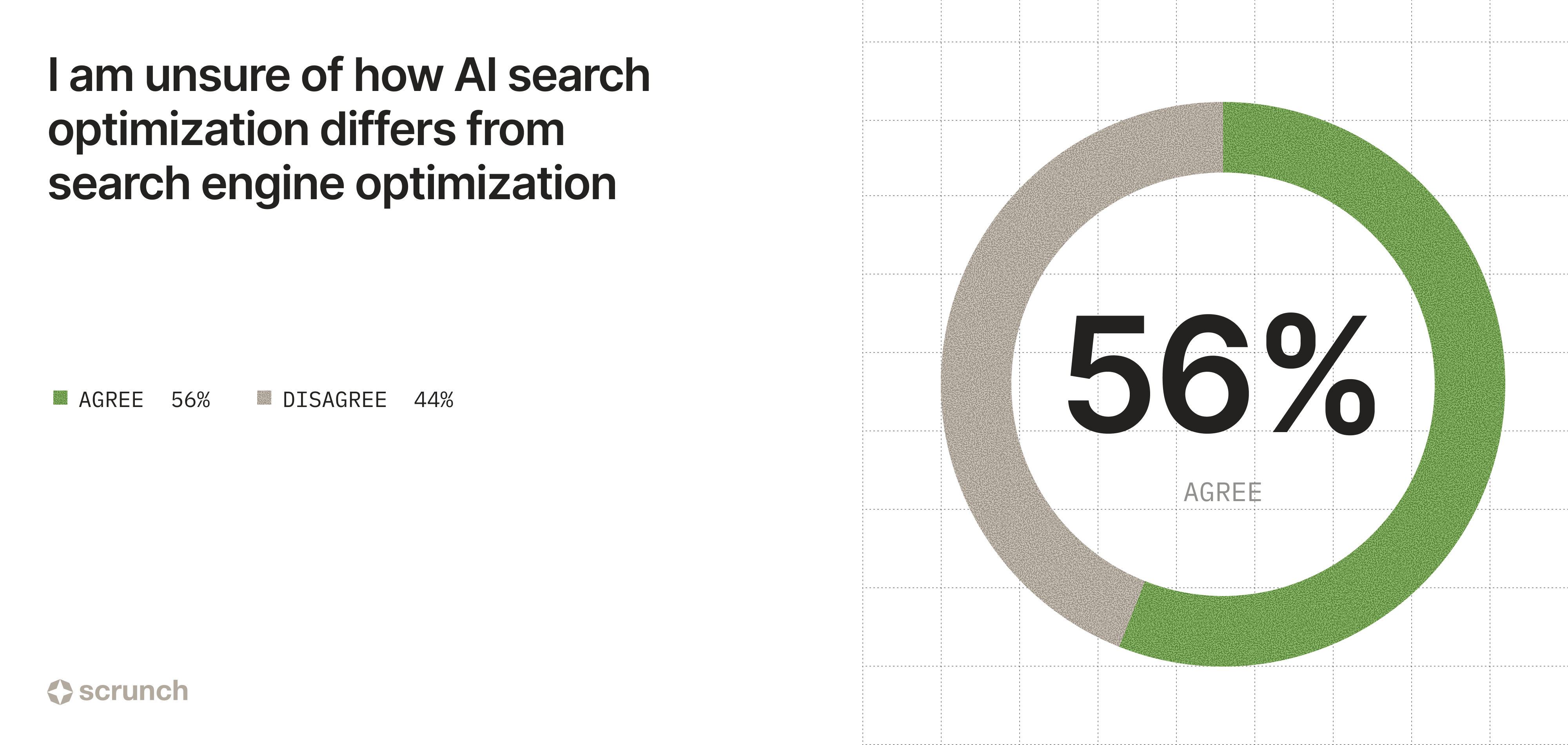
- Fifty-six percent say they’re unsure how AI search optimization differs from search engine optimization.
Some people think answer engine optimization (AEO) is just SEO 2.0. The logic: If you show up in traditional search, you'll show up in AI search.
It's not a crazy assumption. The two share DNA—both are about getting found, after all—and traditional search performance influences how brands show up in AI answers.
But sharing DNA doesn’t make them identical. Case in point: Google's top-10 organic results and AI Overviews citations overlap just 17-38% of the time. Winning one doesn't automatically mean winning the other.
The difference matters when it comes to measurement. Our survey of 600-plus marketing and PR professionals found that many teams' AI search performance is still judged on SEO metrics and web traffic—which makes little sense for a channel that's synonymous with "zero-click."
Here's why teams shouldn't measure AEO like SEO—and what to do instead.
AI search often gets graded with an SEO rubric
Our survey found that:
- 62% of respondents say non-marketing or communications leaders still evaluate their team’s performance primarily through traditional SEO metrics or web traffic.
- 52% say misalignment around AI visibility metrics is limiting their team’s ability to execute an effective AI visibility strategy.
The numbers tell a similar story in the agency world:
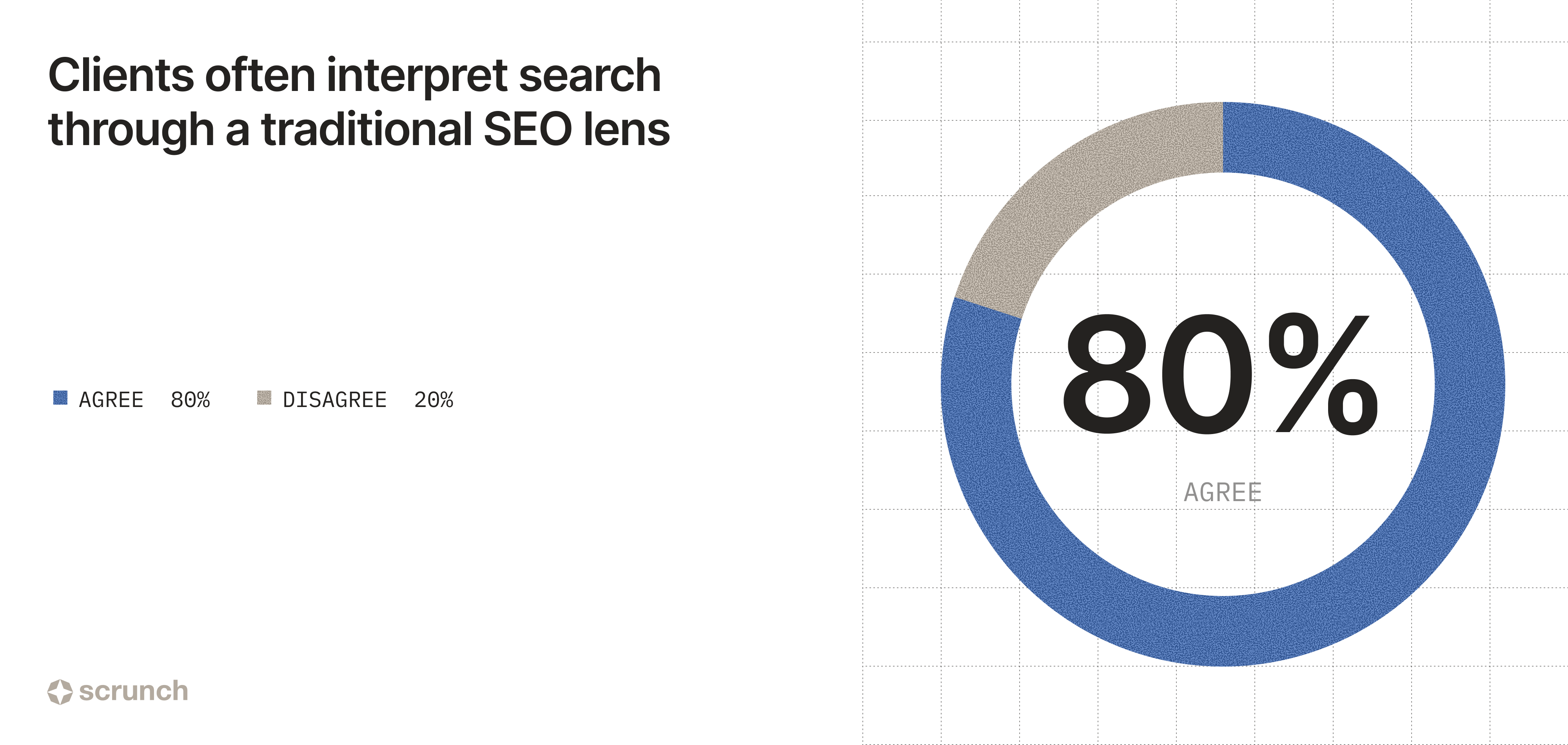
- 80% of agency respondents say clients often interpret search through a traditional SEO lens.
- 71% spend more time explaining AI search fundamentals and managing expectations than executing GEO strategies.
But this isn’t just a case of leadership (or client) confusion: More than half (56%) of survey respondents said they’re unsure how AI search optimization differs from search engine optimization.
SEO is still a business-critical discipline, but how you show up in Google and how you show up in AI answers—not to mention what happens after—are two very different things. They need to be measured differently.
Build an AI-native scorecard
These are the AEO metrics that should be in every team’s arsenal:
- Brand mentions: How often your brand is named in AI answers to prompts that matter for your business. It's the new "page one,” in Google parlance.
- Share of voice: How often your brand appears versus competitors across a set of tracked prompts. Think of it as share of answer—it tells you whether you're leading the conversation in your category or trailing the pack.
- Sentiment: Whether AI answers describe your brand in a positive, mixed, or negative way. Showing up matters, but showing up favorably is what moves buyers.
- Answer position/rank: Where your brand lands within an answer—top, middle, or bottom—and in what order. Just like with search engine results pages, placement near the top tends to draw the most attention.
- Citations: The external sources a model references to build its answer. They're the connective tissue of AI search. Influence the citation and you influence what AI says.
- AI agent traffic: How often AI bots like GPTBot, PerplexityBot, and ClaudeBot train on, index, and retrieve your content. It's your earliest visibility signal—if bots aren't crawling you, you're not even in the consideration set.
- AI referral traffic: The human visits that land on your site from an AI platform. It's low in volume but high in value—someone who clicks through has essentially already been prequalified by the AI model.
Speaking of referral traffic: AEO doesn’t drive as many immediate clicks as traditional search, but that doesn’t mean it’s not driving real outcomes.
We found that when an AI platform recommends a brand to someone new, within the next week, that person becomes approximately:
- 182% more likely to search the brand on Google
- 117% more likely to visit the brand’s website
- 185% more likely to view the brand’s products on a retailer's page
The rub? Most of this traffic comes through as direct or traditional-search driven.
In a recent study of how AI impacts publisher traffic, we discovered that only 1.1% of post-AI conversation visits show up as direct AI referrals.
Your attribution dashboard can’t correctly measure AI’s impact. That makes the metrics above your best bet at understanding how you’re performing in AI search and whether you’re best positioned to reap the rewards—not impressions, keyword rankings, backlinks, or organic traffic.
Unfortunately, our survey showed that many teams are missing out:
- 71% of respondents aren’t analyzing AI share of voice against competitors.
- 70% aren’t monitoring sentiment toward their brand in AI answers.
- 67% aren’t analyzing AI bot traffic
- 60% aren’t analyzing which media sources are surfaced by AI systems.
How it works in Scrunch
- Explorer: Scrunch’s self-serve analytics surface lets you dig into all of the above: mentions, share of voice, citations, sentiment, answer position and rank, and more. Build and share any data visualization with a click or with natural language using our in-app AI chatbot.
- Agent traffic: Scrunch shows you agent traffic over time, traffic distribution (i.e., the type of bot), human versus bot traffic, the most active AI agents on your site, which webpages are accessed most by retrieval agents, and a chronological log of recent bot requests.
- AI referrals: Scrunch shows you every view and session on your website that originated from an AI platform, as well as the source, which URLs AI is driving traffic to, attributable transactions and purchase revenue, and how it all changes over time.
Different channels need different yardsticks
AEO isn't SEO, so brands need to stop holding it to SEO's standards.
That means measuring the right metrics. It also means not writing AEO off just because it sends fewer direct clicks—that's the nature of a zero-click channel, not a sign it isn't working.
Need proof that the game has changed? Check out your website’s agent traffic sometime. Odds are that more AI bots are hitting your site than humans right now.
That's the audience you're trying to win over. You should measure like it—then act on it.
We built Scrunch to help you do exactly that.
Want to go deeper? Read the full survey report or check out our AI search guide.
Get started with Scrunch
Get your site AI-ready so you show up in answers, get cited, and grow revenue. Try a free 7-day trial or book a demo.


