Agent Experience
Monitoring & Insights






Surviving the clickpocalypse: What millions of search events say about AI eating the news
- Generative overlays land where clicks are already scarce
- Conversational assistants don’t end site visits
- AI answers are distribution layers
- How to survive the clickpocalypse
- Focus on brand presence, not just referral traffic
- Audit your website and act accordingly
- Build a brand, not just a search footprint
- Be the answer in AI search with Scrunch
- A quick note on our methodology
TLDR:
- News searches with a Google AI Overview send fewer people to publisher sites—about 20% versus 30% for searches without one.
- But most of that gap comes from the kinds of searches Google picks for an AI Overview, not the AI Overview itself.
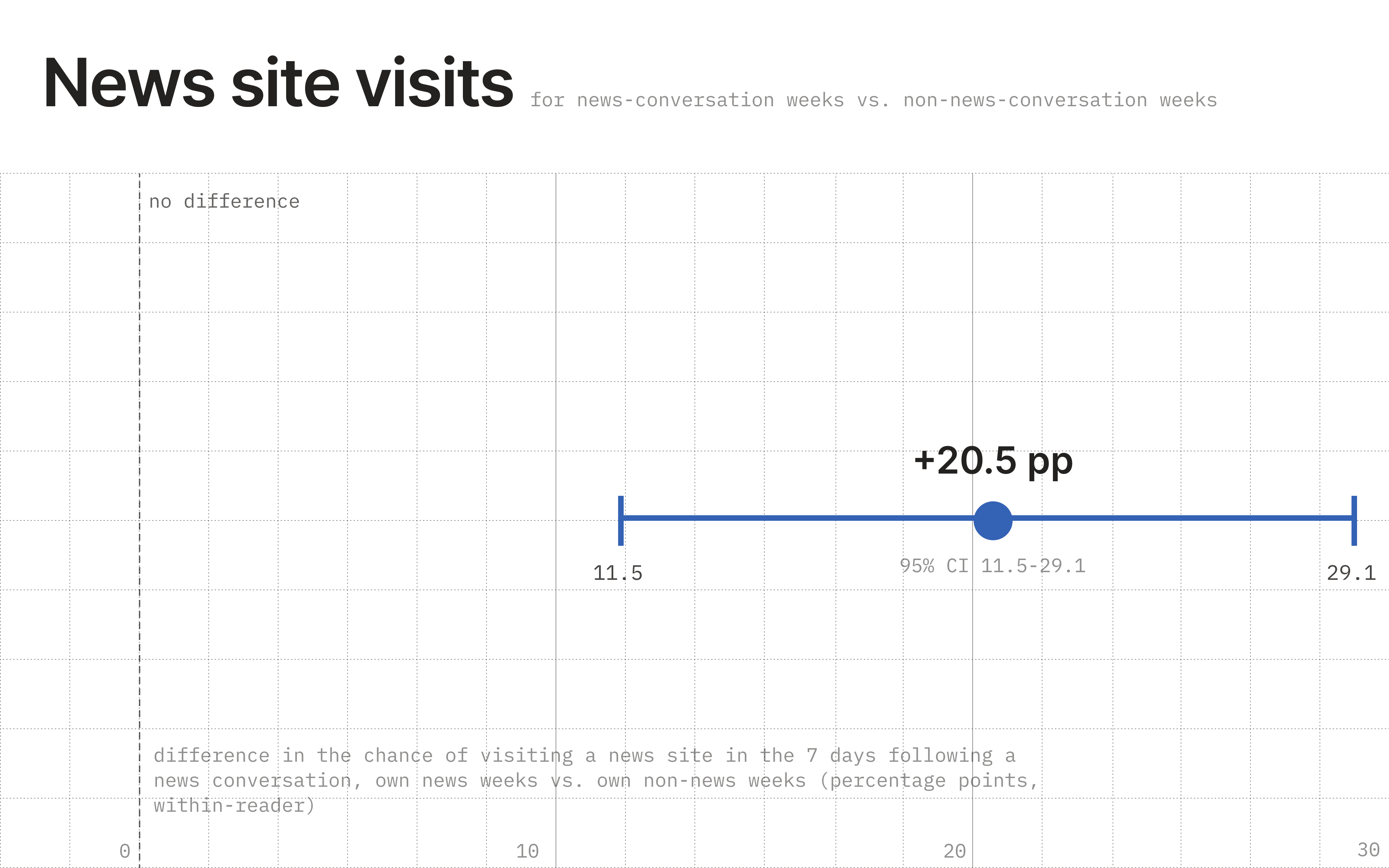
- When someone talks to an AI assistant like ChatGPT about the news, they're 20.5 percentage points more likely to visit a news site the following week than after a non-news conversation.
- Only 1.1% of post-AI conversation news visits show up as direct AI referrals, so a referral dashboard can't tell you whether AI shaped a later search or direct visit.
You don't have to look far for a story about how AI is eating clicks (including on our own website).
AI answers have replaced 10 blue links. For many people, zero-click search is now the default.
That’s an existential shift for every brand. But for news publishers, whose model runs on those clicks, it’s the whole business.
Some publishers are battling AI companies in court. Others are building partnerships with those same companies. Either way, news publishing is the epicenter of the so-called clickpocalypse.
We set out to see what the data says about AI’s impact on human traffic to news websites—and what it can tell us about the upheaval in search every brand is dealing with today.
We analyzed millions of search events from a privacy-safe opt-in panel that links people's real AI conversations to the same people's anonymized web activity (i.e., Google searches and news-publisher visits) from February 2026 to June 2026.
What we found is more complicated than an extinction event. AI is undoubtedly affecting publisher traffic patterns, but there’s more to the story than universal collapse.
You can dig into our findings below.
The headline? AI takes clicks in one place and returns visits in another.
Two AI surfaces tell two different stories
A lot of AI-traffic analysis misses the distinction between generative overlays (i.e., Google AI Overviews) and conversational assistants (e.g., ChatGPT, Perplexity, Gemini, Claude, etc.).
An AIO is inserted into a search the reader was already making. Google decides when it appears. Its immediate effect is on the links beneath it.
A conversational assistant is a destination the reader chooses to open. It can sit before, after, or in the middle of searches and publisher visits. Its role cannot be measured from a single referral click.
Both surfaces use generative AI, but they don’t occupy the same place in the journey, and their effects should not be placed in the same dashboard cell.
Generative overlays land where clicks are already scarce
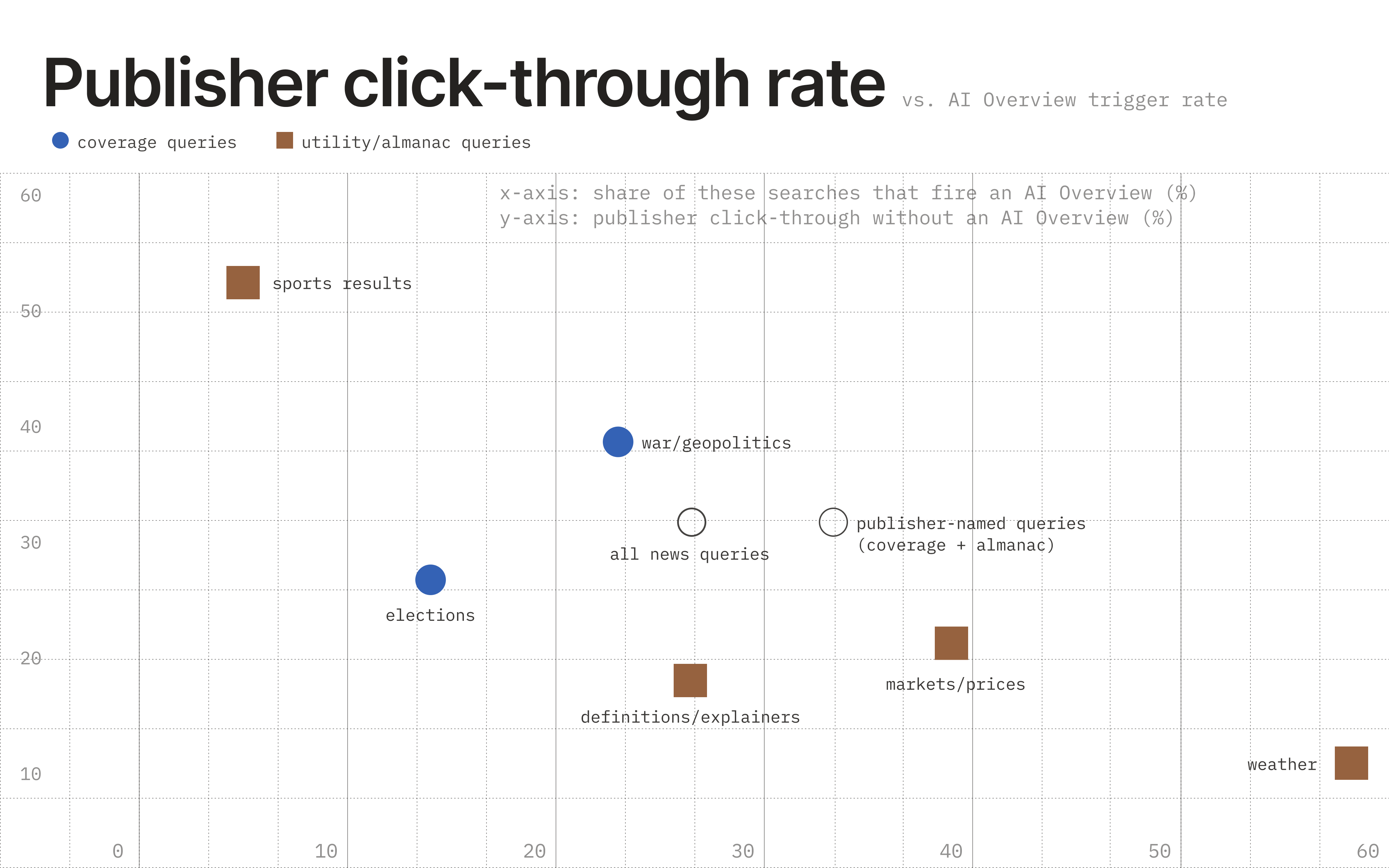
News searches with an AI Overview (AIO) convert to a publisher click about 20% of the time versus about 30% without one. That's a 10-point gap, and it's the number the clickpocalypse story runs on.
But that gap compares one set of searches against a different set. When we hold the search itself fixed—the same query, seen sometimes with a generative overlay and sometimes without—the gap shrinks to about 2 percentage points. That's too small for us to tell apart from zero.
Put another way: Google isn't shrinking these clicks so much as choosing searches that never had many to begin with.
What we mean by “news search”
By "news search," we mean a Google search for current events: breaking news, a named event, coverage of something happening now. Queries that only brush up against a newsy subject (how-tos, shopping, homework, etc.) don't count. The classifier is built for precision, so it under-counts before it over-counts.
A recent experiment confirms that the per-search bite is real for publishers. When researchers hid AI Overviews from a random group of users, outbound clicking went up (Agarwal & Sen, 2026).
But the market impact depends on where Google deploys them—and it mostly picks searches where clicks were already scarce.
Across news searches, AI Overviews appear about one time in four. That's the average of a fast climb: roughly one in six in February, and more than four in 10 by June.
AI Overviews tend to cluster on quasi-news utilities like weather (59% AIO rate), market prices (39% AIO rate), and definitions and explainers (27% AIO rate).
What do all of these have in common? Relatively low publisher click-through rates in the first place (13%, 22%, and 18%, respectively, when no generative overlay appears).
Sports results are a utility query, too, but they only get an AI Overview about 5% of the time. They're also the strongest publisher-click class we measured, at 53% with no overlay. Note: Weather and sports are the thinnest slices in this data cut, so it’s safest to read them as directional.
Election news and war or geopolitical coverage sit in the middle. Elections get an AI Overview 14% of the time, with a 26% click-through rate. War and geopolitics get one 23% of the time, with a 37% click-through rate.
It's not that AI eats the almanac and leaves the front page alone. For news, AI Overviews typically go where clicks were already sparse. Sports is the proof: Readers head to a publisher for a scoreline; Google leaves it alone.
A reminder for brands not in the news business
Every number in this study concerns news searches. The pattern we found is about where Google places AI Overviews within them, not a universal rule that AIOs only land on low-value queries. On any single search, an AI Overview does indeed cost clicks. What decides the impact for your website is which of your queries get one, and that's worth checking directly rather than assuming.
Conversational assistants don’t end site visits
Now let’s look at the surface many studies forget to measure.
We found that when a reader has a news-topic conversation with an AI assistant, the following week contains more news site visits than a week following a non-news conversation.
Comparing each reader only against themselves—their own news-conversation weeks versus their own non-news-conversation weeks—they’re 20.5 percentage points more likely to visit a news site after talking to AI about a news topic.
This isn’t proof that the assistant created new appetite for news: A news conversation also marks a moment when the reader already cares. But it does prove that opening a chatbot doesn’t necessarily end the journey on the open web.
This pattern isn’t simply a pre-existing gap between different kinds of readers, either. Before the conversation, news and non-news sessions have similar trajectories. The difference opens up afterward, survives dropping any one assistant from the comparison, and is specific to news rather than a generic rise in every downstream category.
So the conversational-AI story isn't that AI answers have completely replaced publishers. It's that the answer often becomes one step inside a larger news journey—one that conventional analytics can't reconstruct.
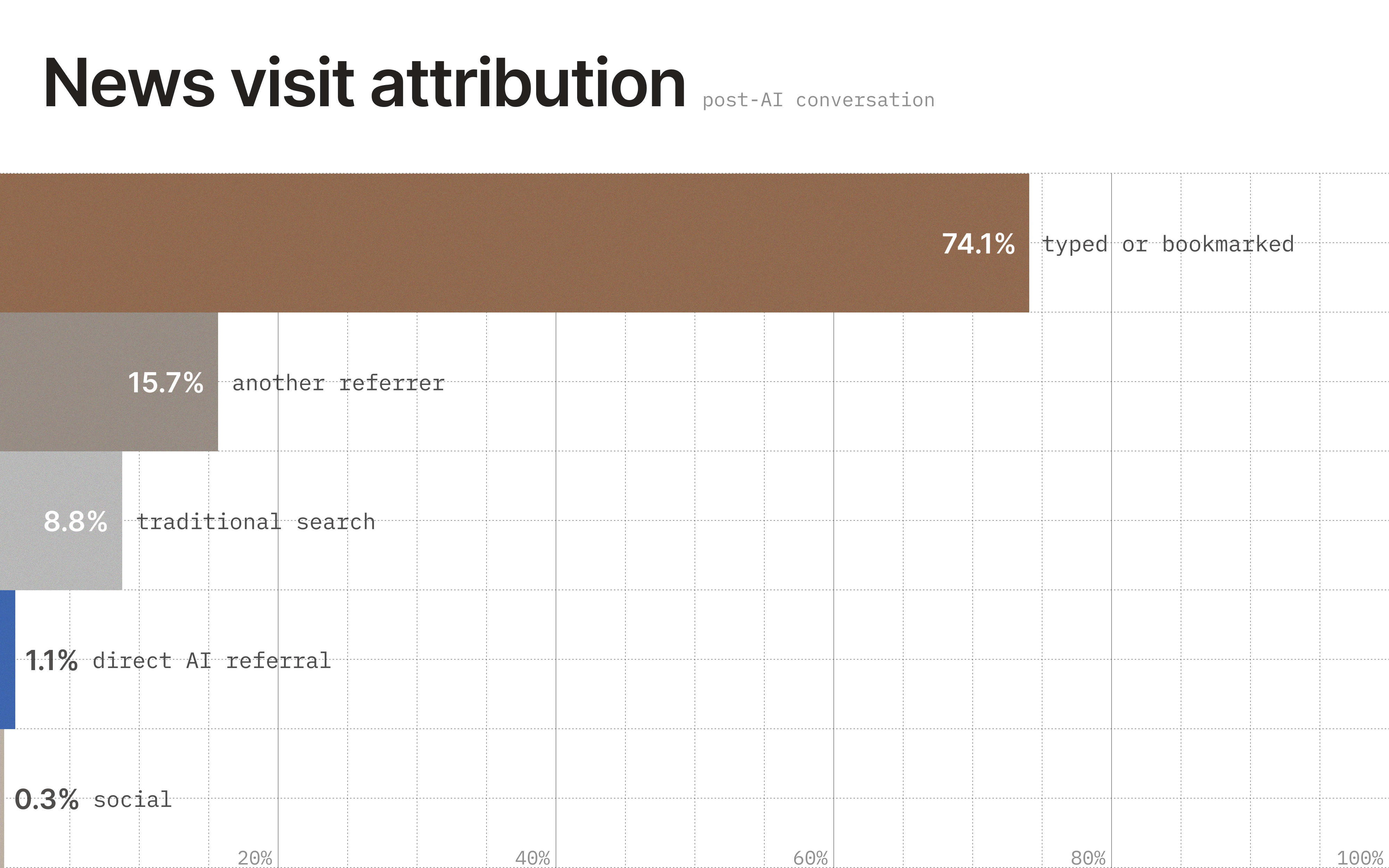
Only about 1.1% of the news visits observed after these conversations arrive with an AI referral. The rest show up through ordinary-looking routes: Direct navigation accounts for about three quarters, traditional search for about 9%, and other referrals for most of the remainder.
That doesn’t mean AI is the cause of 98.9% of news visits. It means referral reporting captures almost none of the broader cross-surface journey surrounding conversational AI.
This is something we explored in our previous study on how AI answers influence buyer behavior.
A referral dashboard can tell you when an AI link was the click right before a visit. It can't tell you whether an answer shaped a later search, put a publisher back into consideration, or influenced a direct visit.
AI answers are distribution layers
Now let's look at which news publishers capture readers after an AI conversation.
When an AI assistant names a source the reader didn't mention in the prompt, that publisher's visit rate jumps 10.6 percentage points by the next day (versus only 1 percentage point for comparable publishers that the same AI answer didn’t name).
By the end of the week, the gap widens to roughly 19.7 percentage points versus 3.1 percentage points.
Our comparison is between publishers named and not named in the same answer, to the same reader, at the same moment, which is far tighter than a before-and-after. But it’s still an association: AI assistants may name outlets the reader was already likely to visit.
Most of the follow-through occurs at publishers already present in the reader’s observed history. That looks more like reactivation than first-time discovery. In this analysis, we don’t consider whether the assistant personalized those source choices or whether widely named outlets simply overlap with readers’ existing habits.
But we did find that being named by AI isn’t the same thing as being chosen by a reader.
Breaking down the publishing players
The tiers we use below are a visibility judgment, not a revenue or traffic ranking. “Major” means the household-name nationals, wire services, and broadcast newsrooms AI assistants reach for by default. “Mid-sized” covers well-known regional, digital-native, magazine, and specialist titles. “Niche” is everything smaller than mid-sized.
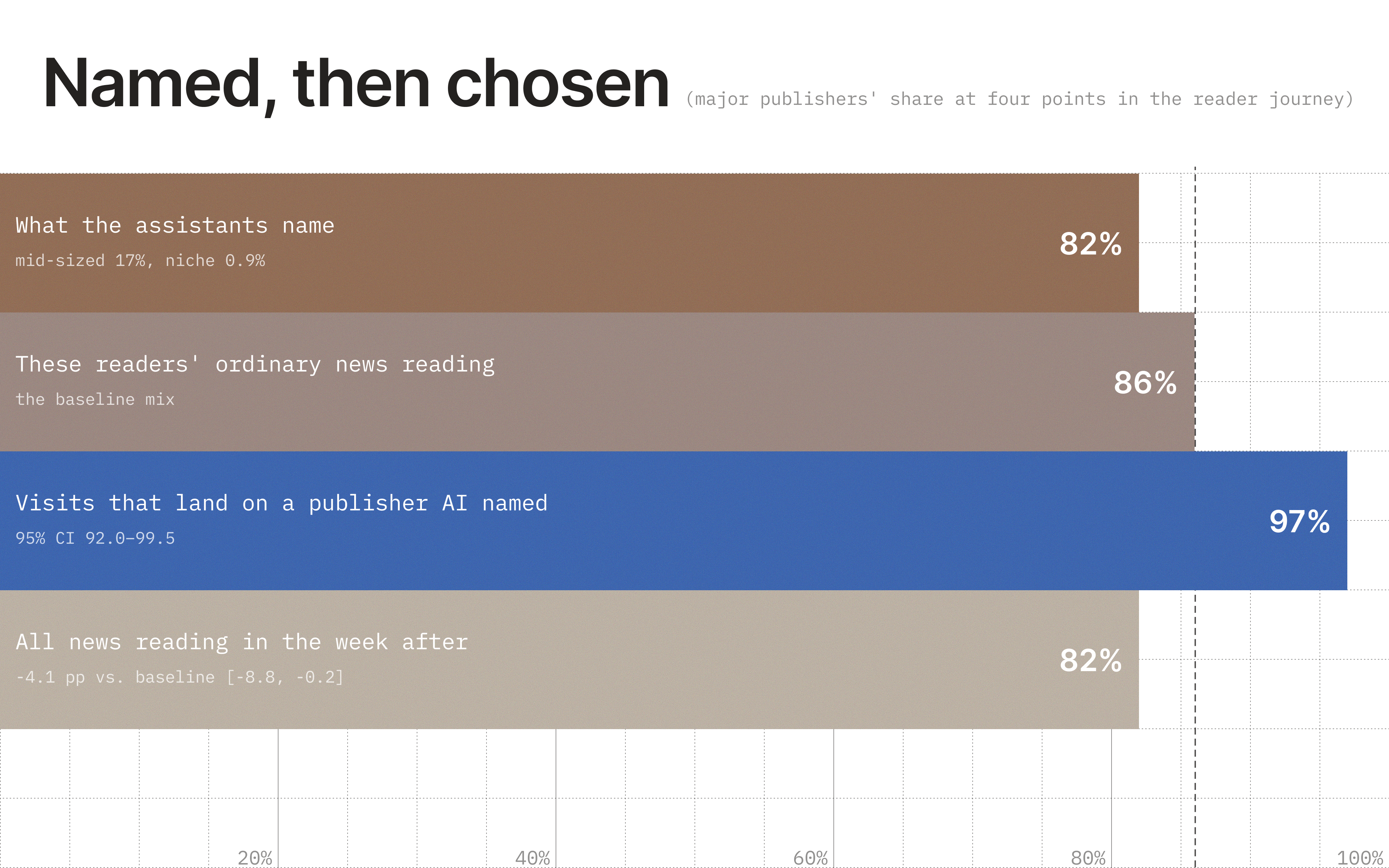
Major publishers make up 82% of the publisher names assistants volunteer, against 17% for mid-sized publishers and under 1% for niche ones.
But of the visits that land on a named publisher, 97% go to a major.
AI assistants put mid-sized publishers in front of readers often enough. Readers are just less likely to pick them.
In the week after an assistant names them, major publishers see a 22.9 percentage point lift in site visits. Mid-sized publishers see just an 8.6 percentage point increase.
Readers’ wider week of news reading doesn’t tilt further toward major incumbents, so the gap concentrates at the moment of choosing.
That reframes the problem for mid-sized publishers. They get named about one time in six, but they don't get chosen at the same rate. That's a reader-recognition gap, not an AI-visibility gap.
Why do major publishers get mentioned more often?
Several mechanisms could reinforce the largest publishers, and our data can’t separate them. Licensing deals may give AI assistants clean access, household names may be safer citations, and some stories may simply be easier to fetch and describe than pages behind paywalls or buried in ad machinery.
What the data does tell us is where to look first. Because assistants name mid-sized publishers reasonably often and those names convert far less well, part of the gap sits with the reader, not the model.
How to survive the clickpocalypse
So what can publishers and non-publishers alike learn from all this?
Publishers are the clearest example of a broader rule: AI exposure doesn’t necessarily look like AI traffic.
A newsroom might get named in an answer, then reached later through direct navigation or traditional search. A consumer brand might get recommended, then researched later through those same ordinary-looking channels.
For any brand, that creates three separate questions:
- Can AI retrieve and correctly understand you?
- Does AI surface you?
- Do people choose you afterward?
Here are a few tips for navigating this new reality:
Focus on brand presence, not just referral traffic
Direct AI referrals are real and powerful, but they’re rarer than traditional search visits and they expose only the immediately preceding click. They can’t tell you if someone searched your site in Google or came direct after having an AI conversation.
Publishers are among the most traffic-obsessed businesses on earth, and even they see an AI referrer on just 1.1% of the news visits that follow an AI chat. Referral data counts the last click, not the influence.
Focus on what you can measure: presence in AI answers. Mentions, citations, answer position, sentiment—they all indicate the likelihood that someone will discover and ultimately choose you, even if your attribution dashboard is blind to it.
Audit your website and act accordingly
Before AI can mention or cite you, it has to be able to read you. A lot of the time, it can't.
Start by auditing your website to understand what’s broken and how to fix it. Both technical and editorial issues can hold you back from showing up in AI answers.
Publishers often block AI bots, which may make sense based on their business models. But for brands in general? Make sure it’s as easy as possible for AI bots to access and consume your content.
Build a brand, not just a search footprint
Being mentioned and being chosen in an AI answer are two separate things.
Mid-sized publishers get a traffic boost from being named in AI answers, but not as much as household names. And while our research shows that AI recommendations have a direct impact on how likely someone is to search you, visit your site, and look at your products online, brand recognition and trust still play an important role.
AI search has scrunched the funnel (pun intended), but staying top of mind outside of AI and building credibility with buyers in other channels helps shape consumer decision-making.
One note of caution for publishers about all of this data: This panel counts observed page visits, not subscriptions, ad revenue, or how long anyone reads.
Before you make moves on any of this, connect it to outcomes you can bank on. But do stop watching a single “AI traffic” line and calling it a day.
AI is redistributing clicks. It's also driving demand. Brands that show up in AI answers are the ones best positioned to capture it.
Referral traffic isn't the metric to watch anymore—brand presence is.
Scrunch is how you measure brand presence in AI answers, understand the why behind it, and take action to improve it.
Be the answer in AI search with Scrunch
Show up better in AI answers. Start a 7-day free trial or get in touch to see how Scrunch can help you optimize your AI search performance.
A quick note on our methodology
This analysis uses a privacy-safe opt-in panel linking the same people’s searches, the conversational-AI sessions included in the analysis, and publisher visits from February 2026 to June 2026. It reports only aggregate rates, changes, and ratios—never individuals or counts.
- Two AI surfaces: Google’s search-triggered AI Overviews and conversational AI assistants like ChatGPT that are deliberately opened by the reader are analyzed separately.
- The overlay: Randomized external evidence establishes that hiding AIOs increases outbound clicking. Our panel contributes evidence about which news searches receive it and how click-prone those searches were, not about Google’s intent. The within-query comparison uses two-way fixed effects on the same query string observed in both states.
- Post-chat news activity: The 20.5 percentage point figure is a within-reader difference-in-differences between weeks following news and non-news conversations, checked against pre-conversation trends and against dropping each assistant in turn. It is evidence of continuation across chat, search, and publisher sites, not a claim that the assistant created net-new demand.
- Attribution: The 1.1% figure is the share of observed post-chat news visits carrying a direct AI referral. It should not be inverted into the share of visits caused by AI.
- Routing: Named publishers are compared with comparable unnamed publishers from the same answer. The result is a strong routing signal, while residual publisher-selection differences remain possible.
- Concentration: What assistants name, what readers act on, and what a reader's wider week looks like are three different compositions, and they do not move together—so a claim about “concentration” has to say which one it means. All three are composition, not causation; a naming response arrives at a moment the reader chose.
- Generalization: The panel is opt-in and AI-engaged. It measures observed page visits rather than subscriptions, revenue, or attention quality.
Data studies



More articles

What happens when you crown yourself #1: Inside thousands of listicles and their impact on AI answers

YouTube influencers have an AI audience: What millions of citation events reveal about influencer sponsorships
