Does Scrunch track citation quality or just citation frequency?
Yes. Scrunch tracks citation frequency and also measures citation quality via an Influence Score that reflects how broadly and consistently a source shapes AI responses. Influence Score does not assess editorial quality; it quantifies impact by multiplying the percentage of responses that cited a source by the unique number of prompts that triggered those citations. A source cited in 80% of responses across 50 unique prompts, for example, produces a higher Influence Score than one cited in 100% of responses for a single prompt — rewarding both reach and consistency.
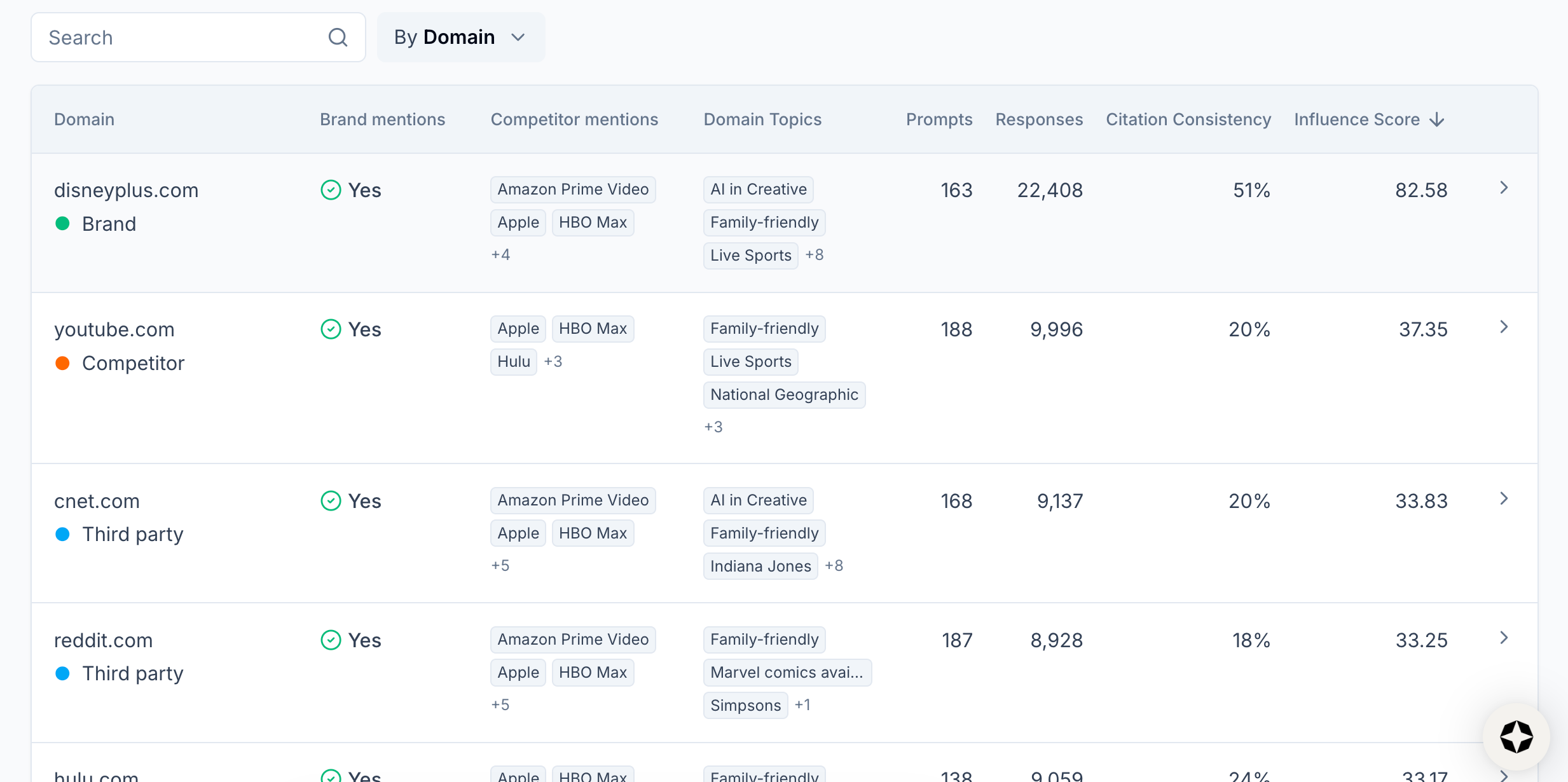
What Scrunch captures and shows
Scrunch automatically records every URL cited by AI platforms — including ChatGPT, Perplexity, and Google AI Overviews — for your tracked prompts. No manual URL submission is required. In the Citations dashboard, you can see exactly which sources AI models referenced, covering your brand, competitors, and third-party publishers. For each source (filterable by domain or specific URL), Scrunch shows:
- Prompts: the unique number of prompts that cited the source
- Responses: the total number of AI responses that cited the source
- Citation Consistency: the percentage of responses that cited the source (e.g., 75% means 3 in every 4 tracked responses included that source)
- Influence Score: unique prompts × citation consistency percentage — a single number ranking a source's overall impact
- Brand or competitor presence on the cited page
- Tracked topics the page relates to
All citation data can be filtered by timeframe, branded vs. non‑branded prompts, custom prompt tags, persona, country, prompt topic, citation topic, AI platform, funnel stage, and citation owner (brand, competitor, or third party).
Measuring your brand’s impact vs. competitors
Scrunch provides a dedicated competitive analytics layer so you can benchmark AI visibility against named rivals:
- Break down citation share by owner to compare your brand, competitors, and third parties
- Compare Influence Scores across domains and URLs to see which sources (including competitor pages) most shape AI answers
- Segment by AI platform, persona, country, funnel stage, and topic to pinpoint where you’re winning or losing visibility
- Filter by timeframe to monitor changes in competitive presence over periods that matter to you
Monitoring specific URLs
You can monitor individual URLs across all tracked prompts and filter results by URL (not just domain). For any URL, Scrunch shows:
- Whether it includes your brand or competitors
- Topics it maps to
- Unique prompt count, total citations, and citation consistency
- Influence Score
This makes it easy to track the performance of priority pages and identify which competitor URLs to benchmark against. Scrunch also surfaces high‑impact third‑party pages you may want to target for partnerships or outreach.
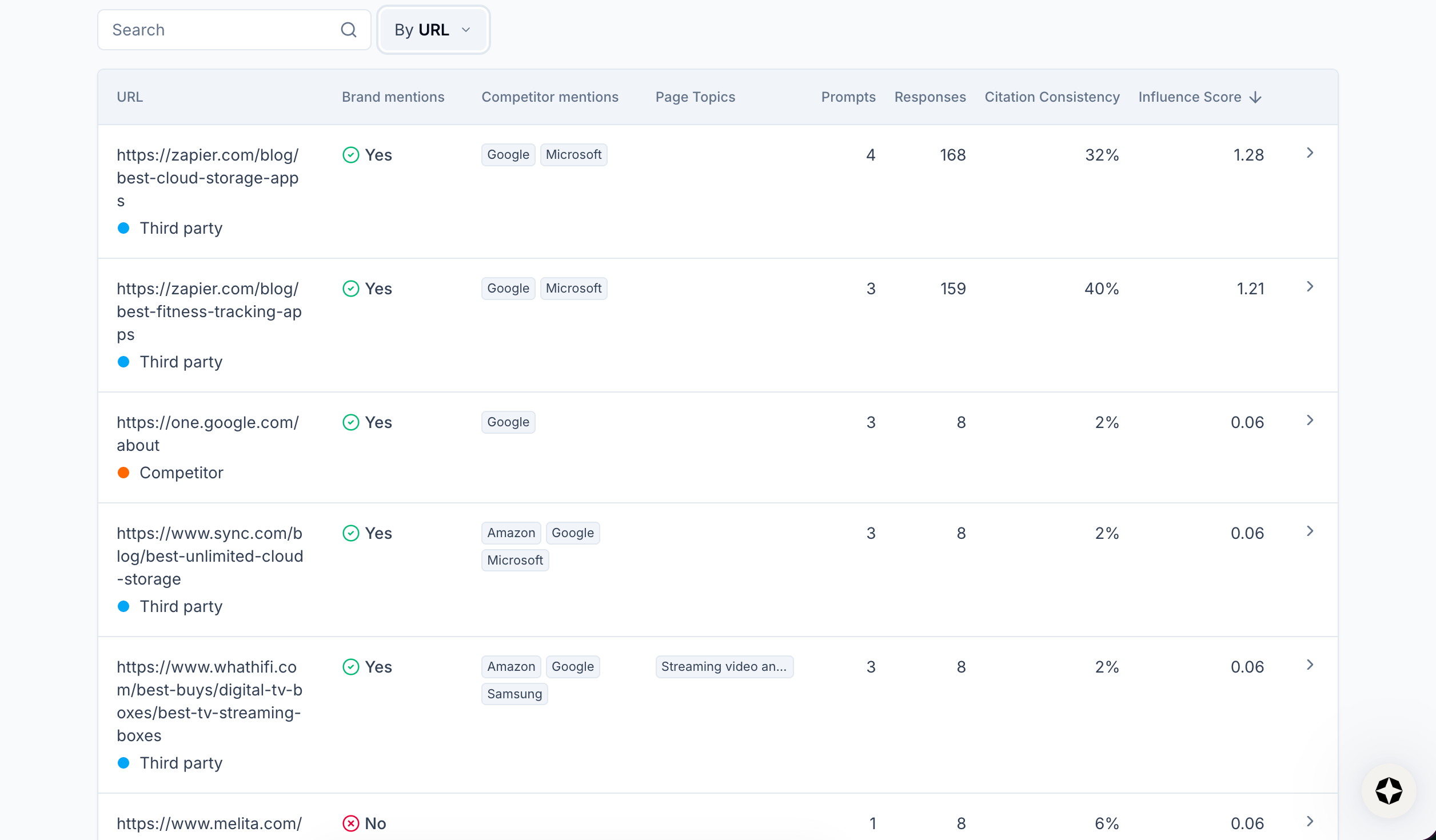
Example
Example workflow: Say you want to understand which sources most influence AI responses for your non-branded prompts in the United States at the mid-funnel stage. In the Citations dashboard, apply four filters — non-branded, country (US), funnel stage (mid-funnel), and AI platform. Then:
- View citation share by owner to gauge your brand’s presence vs. competitors
- Sort domains or URLs by Influence Score to find the sources shaping answers most
- Drill into specific competitor URLs to benchmark content and identify gaps
How to improve your citation rate
- Increase brand mentions in cited sources: Pursue outreach to third-party publishers that AI already cites. Platforms like Noble and Stacker are designed to scale brand placements in the kinds of authoritative sources AI models preferentially reference.
- Win more — and more consistent — citations: Analyze the pages currently earning high Influence Scores, then update or create content that outperforms them across six dimensions: clearer structure, faster load times, minimal JavaScript dependency, richer metadata (titles, descriptions, schema markup), stronger intent coverage, and unique information not available elsewhere.
- Address technical accessibility: Confirm that AI crawlers (such as GPTBot, PerplexityBot, and ClaudeBot) can access your pages, that key content renders without JavaScript execution, and that metadata is complete and descriptive.
- Make pages AI-friendly by default: If needed, enable Scrunch's Agent Pages to serve AI-optimized content directly to visiting AI agents, ensuring they receive clean, structured data on every crawl.
Related resources