Agent Experience
Monitoring & Insights



AEO and GEO tools: How to choose an AI search visibility platform
Definitions, evaluation frameworks, a category map, and honest trade-offs for picking a tool in a still-emerging market
Contents:
What makes a good platform for AI monitoring?
AI search visibility tools like Scrunch help you see, understand, and improve how AI platforms like ChatGPT, Perplexity, Gemini, Claude, Google AI Overviews, and more talk about and cite your brand in answers to prompts relevant to you and your industry.
The category is young and crowded. The fastest way to tell tools apart is to score any platform across four layers: Does it help you observe (what is AI saying and doing?), understand (why is AI behaving that way?), act (how do I make necessary changes?), and deliver (how do I serve AI what it needs?).
Most tools stop at monitoring. A smaller set—Scrunch among them—also diagnoses, optimizes, and delivers, which is what actually moves visibility in AI answers.
Why choosing an AI search tool is confusing right now
This category didn’t exist a few years ago. Now it has dozens upon dozens of vendors, tons of terms, and a lot of claims that don't survive a demo.
The stakes are real, which is why everyone's paying attention.
Our own research found that, when an AI platform recommends your brand to someone new, that person becomes approximately 182% more likely to search you on Google, 117% more likely to visit your site, and 185% more likely to view your products on a retailer's page within the week.

Meanwhile, according to Shopify, AI-referred visitors convert about 50% better than organic traffic, and at a 14% higher order value.
This is in a world where AI agents now generate more web traffic than humans and 94% of B2B buyers use AI during the purchase and vendor evaluation process.
AI search is here, and budgets are moving to match it. The pressure to buy something is high, and that's exactly when it's easy to buy the wrong thing.
This guide is the antidote. We'll define the terms, give you a framework for what tools in this category can actually do, show you the criteria that separate real platforms from vaporware, and map the current landscape (including where we fit and where we don't).
A note on who "we" are: Scrunch is an Agent Experience Platform (AXP) designed to help brands improve their performance in AI search. We're a biased party, and we'll say so plainly wherever it matters.
We've tried to make this useful even if you pick someone else. After all, that’s kind of the whole point of a guide.
What AEO and GEO actually mean
There are lots of terms floating around the AI search space. These four are often used interchangeably and may cause some confusion.
Here's the plain-language version of each:
Answer engine optimization (AEO)
This is the practice of improving how AI platforms—ChatGPT, Perplexity, Gemini, Claude, Google AI Overviews, and the like—mention, cite, and recommend your brand when they respond to a question.
Generative engine optimization (GEO)
This is the same thing as AEO by a different name. Some people try to quibble that AEO and GEO refer to different types of LLM-powered surfaces (e.g., a Google AI Overview versus ChatGPT), but when people use them, they’re generally referring to the same concept.
AI search visibility
This is the umbrella outcome both AEO and GEO are working toward: showing up in AI answers consistently, accurately, and favorably.
LLM monitoring
This is the narrower activity of tracking what AI platforms say about you—the measurement layer, not the acting-on-it layer.
One more term you'll see everywhere: citation. A citation is a website source an AI platform uses as reference material to inform its answer. Citations help shape which brands end up in an answer, which is why so much of this category revolves around them.
The relationship is simplest to hold this way: LLM monitoring is part of measuring AI search visibility, and AEO/GEO is the work you do to improve it.
Tools built only to monitor tell you the score. Tools built to act on it—like Scrunch—help you change the score.
⊹ Do you even need a dedicated AI search visibility tool?
This is a fair question, especially as lots of well-known SEO tools are adding AI visibility features.
It’s important to remember that SEO tools were built to measure keywords and backlinks, not prompts, citations, and the AI agents reading your website.
Our take (yes, as a company selling a dedicated AI search visibility tool): Now that AI answers are shaping how buyers see you, you need a platform purpose-built to show you how you’re performing in those answers and what to do about it.
That doesn’t mean an AEO/GEO platform is a replacement for an SEO tool. Here's the structural difference:
| What you want to know Keyword rankings and backlinks | Traditional SEO tool (Ahrefs, Semrush) Yes—their core strength | Dedicated AEO/GEO platform No |
| What you want to know Brand presence in AI answers (mentions, sentiment, answer position, etc.) | Traditional SEO tool (Ahrefs, Semrush) Limited or add-on | Dedicated AEO/GEO platform Yes—prompt-level |
| What you want to know Citations across ChatGPT, Perplexity, Gemini, Claude, Google AI Overviews, etc. | Traditional SEO tool (Ahrefs, Semrush) Limited or add-on | Dedicated AEO/GEO platform Yes—cross-model |
| What you want to know AI bot traffic on your site | Traditional SEO tool (Ahrefs, Semrush) No | Dedicated AEO/GEO platform Yes (a subset of platforms like Scrunch) |
| What you want to know Why your site isn’t performing well (AI-specific audit) | Traditional SEO tool (Ahrefs, Semrush) No | Dedicated AEO/GEO platform Yes—domain- and page-level (a subset of platforms like Scrunch) |
| What you want to know What to update or create (AI-specific recommendations) | Traditional SEO tool (Ahrefs, Semrush) No | Dedicated AEO/GEO platform Yes—technical and editorial (a subset of platforms like Scrunch) |
| What you want to know Serving AI-optimized content to AI agents | Traditional SEO tool (Ahrefs, Semrush) No | Dedicated AEO/GEO platform Yes (a subset of platforms like Scrunch) |
SEO tools are adding AI features, and for keyword-led teams that already live in them, an AI add-on can be a reasonable first step.
But if SEO and AEO/GEO are both material to your brand (and for most brands, they are), we recommend you leverage both a dedicated SEO tool and AEO/GEO tool.
They answer different questions using different data architectures, and mature teams use them side by side.
What we see in the market
Scrunch surveyed 600-plus marketing and public relations professionals about their approach to AI search in 2026.
Seventy-three percent of respondents said they currently use tools to monitor brand or client visibility in AI answers, but oftentimes they’re using homegrown solutions or tools not designed specifically for AI search.
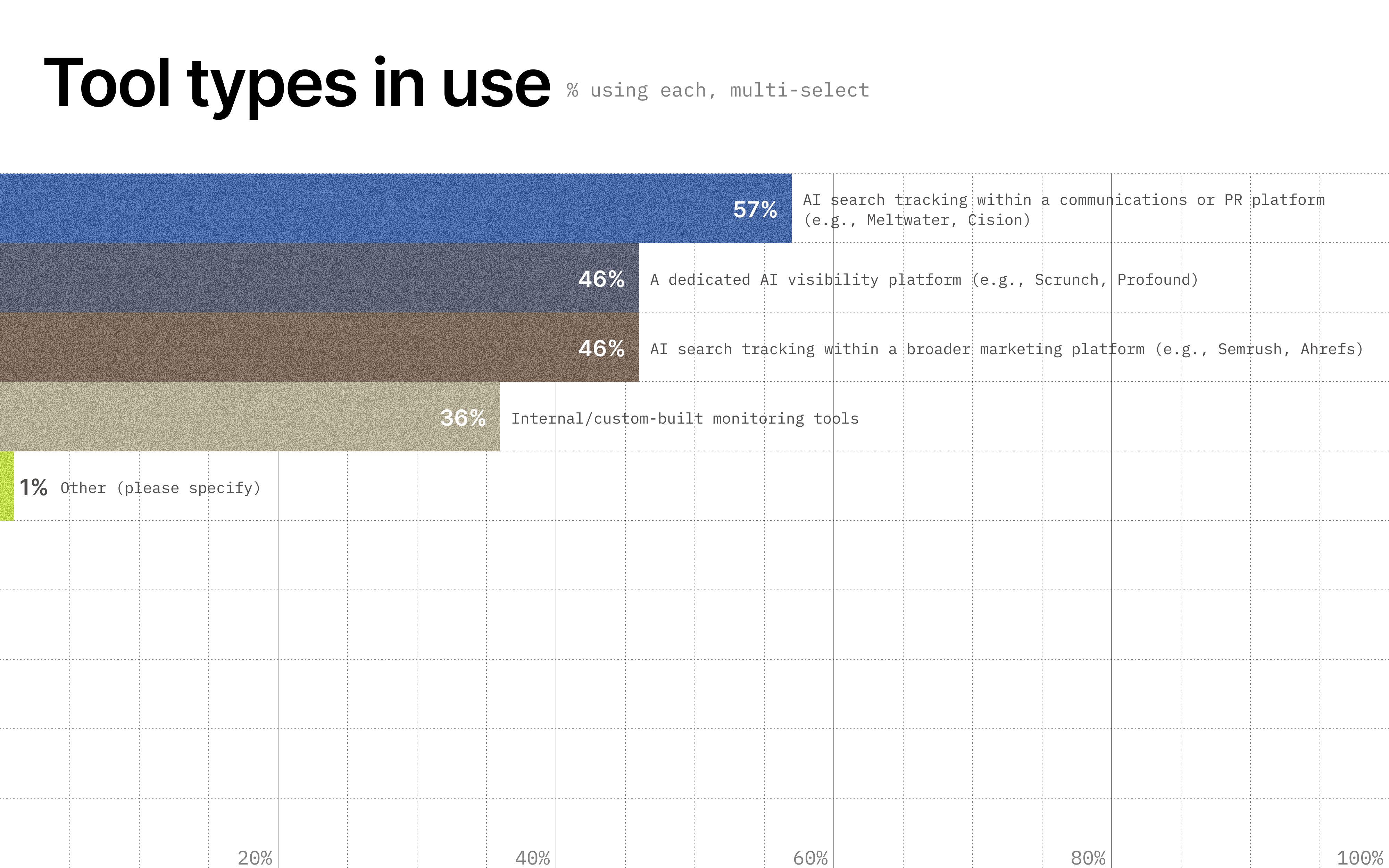
Data shows that:
- 10% of respondents collect data but rarely act on it.
- 43% are still learning how to apply the insights.
- 59% can’t confidently interpret the data and translate it into action.
The money is following the channel. Organizations are investing in tooling. But many teams are still struggling to understand their AI search performance and how to improve it.
⊹ The 4 layers of AI search visibility
This is a framework we developed at Scrunch to cut through the "we do everything" vendor noise.
Every tool in this category operates across one or more of four layers. The higher the layer, the rarer it is—and the more it actually helps you improve AI search visibility.
| Layer Layer 1: Observe (what is AI saying and doing?) | What it entails Track your brand's mentions, share of voice, citations, sentiment, and answer position—alongside AI agent traffic and AI referrals—across the major AI platforms, ideally sliced by prompt, topic, persona, funnel stage, country, and any other dimension that matters to your brand. This is the crowded layer. It's necessary, it's where the category started, and it's where most tools stop. |
| Layer Layer 2: Understand (why is AI behaving that way?) | What it entails Explain performance. Audit the website to find out what's helping or hurting AI search visibility—blocked access for AI crawlers, technical issues, content structure and quality, content gaps. The observe layer tells you that a page isn't cited—the understand layer tells you why and what to fix first. |
| Layer Layer 3: Act (how do I make necessary changes?) | What it entails Turn the diagnosis into specific fixes—whether that’s manual changes or automated updates—that are on-message and brand-approved. The strongest tools help you apply them rather than just recommend them. |
| Layer Layer 4: Deliver (how do I serve AI what it needs?) | What it entails Serve AI-optimized content directly to AI agents when they arrive on your site, separate from the human-facing experience. This is the rarest layer, and it's where real differentiation lives, in our opinion. It not only optimizes what AI consumes about your brand, it also makes it far easier for AI to consume it in the first place. |
Of course, two tools can claim the same layer and feel nothing alike in practice. That's why you need criteria to evaluate any tool against.
⊹ The 10 criteria that actually matter
These are the 10 criteria that separate a real platform from just another dashboard—and which ones are essential versus nice to have.
Consider it a scorecard for your next vendor evaluation.
| Criteria 1. AI platform coverage | Questions to ask a vendor How many AI platforms does it track? Note: The more the better, but look for ChatGPT, Perplexity, Gemini, Claude, and Google AI Overviews at a minimum. |
| Criteria 2. Business prerequisites | Questions to ask a vendor For enterprises: Does it have enterprise-grade security and compliance (i.e., SOC 2 Type II compliance, single sign-on, role-based access control, audit logs, etc.)? For agencies: Does it have the capability to manage and optimize AI search performance across multiple brands and websites in one workspace? |
| Criteria 3. Data transparency & flexibility | Questions to ask a vendor How does it collect data? Can data be easily exported and integrated with other systems via API? |
| Criteria 4. Time to impact | Questions to ask a vendor How quickly can data be collected and actioned on? |
| Criteria 5. Self-service and customizability | Questions to ask a vendor Can you create and customize prompts without technical assistance? Can data be filtered and segmented across business-critical dimensions (e.g., persona, funnel stage, country, custom tag, etc.)? |
| Criteria 6. AI integration and automation | Questions to ask a vendor Can data be queried via AI conversation (in-app chat and MCP)? Can it automate data reporting, insight extraction, and strategy execution? |
| Criteria 7. Observability breadth and depth | Questions to ask a vendor How does it track brand mentions, share of voice, citations, sentiment, answer position, and other key monitoring metrics? |
| Criteria 8. Site auditing breadth and depth | Questions to ask a vendor How does it surface technical and editorial issues hurting AI search performance? |
| Criteria 9. Site optimization breadth and depth | Questions to ask a vendor How does it assist in making technical or editorial changes to improve website performance? |
| Criteria 10. Content delivery breadth and depth | Questions to ask a vendor How does it assist in serving AI-optimized content to AI agents? |
Pro tip: On a demo call, ask the vendor to (1.) set up your brand in 10 minutes, (2.) create a custom prompt live, (3.) filter, drill down, and export the data, and (4.) show the enterprise controls—SOC 2 Type II, RBAC, API, multi-brand.
If any of the four stalls, you've learned something the vendor’s marketing won't tell you.
The category at a glance
Here's the landscape, based on the five vendors we most often encounter in deals, scored the same way for everyone.
The feature matrix shows which of the four layers each platform operates in. The detail table adds information on pricing, backing, and who each is built for.
If you want a deeper dive into different vendors, check out our comparison guides here:
- The 7 best answer engine optimization (AEO)/generative engine optimization (GEO) tools for 2026
- The 4 best answer engine optimization (AEO)/generative engine optimization (GEO) platforms for enterprise companies in 2026
- The 3 best answer engine optimization (AEO)/generative engine optimization (GEO) platforms for agencies in 2026
Note: Verify current pricing and funding before relying on them, and tell us if anything's out of date ([email protected])—we correct these.
| Tool | Observe | Understand | Act | Deliver |
|---|---|---|---|---|
| Scrunch | 🟢 Yes | 🟢 Yes | 🟢 Yes | 🟢 Yes |
| Adobe Brand Visibility | 🟢 Yes | 🟢 Yes | 🟢 Yes | 🟢 Yes |
| AthenaHQ | 🟡 Partial | 🟢 Yes | 🟢 Yes | 🔴 No |
| Bluefish | 🟡 Partial | 🟢 Yes | 🔴 No | 🔴 No |
| Peec AI | 🟢 Yes | 🟡 Partial | 🟡 Partial | 🔴 No |
| Profound | 🟢 Yes | 🟢 Yes | 🟢 Yes | 🔴 No |
The main takeaway: Of the tools our buyers compare most often, only Scrunch and Adobe Brand Visibility include AI-optimized content delivery to AI agents.
Worth pointing out: Scrunch doesn't yet offer general-purpose AI content generation—it's on the roadmap, but not in the product today. If AI content generation inside the platform is your top requirement, factor that in.
| Tool | Pricing | Backing | Best for |
|---|---|---|---|
| Scrunch | 🔵 Core: $250/mo 🔵 Agency Core: $500/mo 🔵 Enterprise/Agency Enterprise: custom 🔵 7-day free trial | ~$26M raised, now part of Sitecore (~$1.23B raised) | Enterprise, mid-market, and agencies that want an end-to-end solution |
| Adobe Brand Visibility | Not publicly available | Public | Enterprise, particularly if already on Adobe Experience Cloud |
| AthenaHQ | 🔵 Essential: free 🔵 Starter: $295/mo 🔵 Enterprise: custom | ~$2.7M raised | Mid-market, particularly if looking for AI content generation |
| Bluefish | Not publicly available | ~$68M raised | Enterprise, particularly if looking for reputation management |
| Peec AI | 🔵 Starter: $80/mo 🔵 Pro: $205/mo 🔵 Advanced: $420/mo 🔵 Enterprise: custom 🔵 Essential (Agency): $205/mo 🔵 Growth (Agency): $420/mo 🔵 Scale (Agency): $675/mo 🔵 Comprehensive (Agency): custom 🔵 7-day free trial | ~$29M raised | SMBs and agencies |
| Profound | 🔵 Starter: $99/mo 🔵 Growth: $399/mo 🔵 Agency Growth: $99/mo + add-ons 🔵 Enterprise/Agency Enterprise: custom 🔵 7-day free trial | ~$155M raised | Enterprise, particularly if looking for AI content generation |
Choosing for your business
Different organizations may want to prioritize different things when selecting an AI search visibility platform.
In our view, coverage across the four layers is non-negotiable. But here are a few situation-specific notes:
- Enterprise teams: These teams should treat security and scale as gates: SOC 2 Type II, SSO, RBAC, audit logs, a data API, and multi-brand, multi-region, multi-language support in one workspace. The usual trigger points are a security review, tracking a vast number of prompts across different dimensions, or needing to act rather than just observe. Based on our own sales data, the enterprise shortlist typically includes Scrunch, Adobe Brand Visibility, Bluefish, and Profound—with the caveat that only Scrunch and Adobe deliver content to agents.
- Agency teams: These teams should weigh four things: multi-client infrastructure, fast and self-serve client onboarding, client-ready reporting (by persona, funnel stage, country, custom tag, etc.), and API-first access for business intelligence and white-labeled dashboards.
- Lean in-house teams: These teams should optimize for time to impact, self-service, and AI automation: fast setup, complete customizability, AI assistance, and automated alerts and actions so you're not living in a dashboard.
What "it works" looks like
Revenue growth that can be attributed directly to AI search is the gold standard for return on investment, but direct AI referrals account for only a small portion of AI’s influence.
Scrunch research found that when an AI platform recommends a brand to someone with no recent sign of using it, over the next week, that person becomes approximately:
- 182% more likely to search the brand on Google (3.28% → 9.24%)
- 117% more likely to visit the brand's website (3.43% → 7.45%)
- 185% more likely to view it on a retailer's product page (0.94% → 2.68%)

Brands should measure AI referrals, but in order to prove that AEO/GEO is working, they should concentrate on brand mentions, share of voice, sentiment, answer position, citations, and AI agent traffic (specifically retrieval bots).
Here are a few examples from brands using Scrunch:
- Akamai: 5x increase in brand presence in AI search results
- Runpod: 4x increase in new paying customers
- Strapi: 226% increase in citations
- Tinybird: 3x increase in share of voice
- Proper Propaganda: 5x increase in lead generation
- Stratabeat: 260%-plus increase in AI visibility for clients
More broadly, more than 500 companies and agencies use Scrunch—including Lenovo, Skims, Paychex, NatWest, Publicis Groupe, Seer Interactive, and DEPT.
How to decide
If you take one thing from this guide, take the four layers.
Audit your current setup against them: Are you only monitoring, or can you also understand, act, and deliver?
Find the layer where you go dark—that gap is usually where your visibility is stuck.
Then weight the 10 criteria to your situation, shortlist two or three vendors, and test them with your real data on a short trial.
Hands-on experience will ultimately teach you more than any comparison table, including ours.
Want to see where you stand today? Run a free brand audit.
Frequently asked questions
What's the difference between AEO and GEO?
None—they're used interchangeably. Both describe optimizing how AI platforms mention, cite, and recommend your brand in AI answers. AI search visibility is the broader outcome they both serve.
Do I need an AEO tool if I already use Ahrefs or Semrush?
Yes. SEO tools measure keywords and backlinks using data architecture based on traditional search. AEO/GEO platforms are purpose-built to measure prompts, citations, and AI agent traffic.
What are the best AEO tools right now?
The tools our buyers evaluate most in 2026 are Scrunch, Adobe Brand Visibility, AthenaHQ, Bluefish, Peec AI, and Profound. They differ most on how many of the four layers of AI search visibility they cover—only Scrunch and Adobe cover all four, including content delivery to agents.
Which AEO/GEO tool is best for enterprises?
For security, scale, and the full end-to-end AI optimization loop, the common enterprise shortlist is Scrunch and Adobe Brand Visibility, with Bluefish and Profound also evaluated. See our enterprise platforms guide for the detailed comparison.
Which AEO/GEO tool is best for agencies?
For multi-client agency work that goes beyond basic monitoring, Scrunch. AthenaHQ and Peec AI also come up during evaluations. See our agency platforms guide for the full breakdown.
What are the best alternatives to Profound?
Our buyers comparing Profound most often look at Scrunch, Adobe Brand Visibility, and Bluefish.
What are the best alternatives to Peec AI?
Our buyers comparing Peec AI most often look at Scrunch and AthenaHQ.
How is Scrunch different from Profound or Peec AI?
Scrunch covers all four layers of AI search visibility—observe, understand, act, and deliver—while Profound stops before content delivery and Peec AI focuses primarily on monitoring. Scrunch is also part of Sitecore, which matters for enterprise buyers evaluating stability and scale.
What should an agency look for in an AI search platform?
Multi-client workspaces, fast and self-serve brand setup, client-ready reporting, and an API for business intelligence workflows and white-labeled reporting.
What does an enterprise-grade AEO platform need?
At minimum: SOC 2 Type II, SSO, RBAC, audit logs, a data API, and multi-brand, multi-region, multi-language support in a single workspace.
How much do AEO/GEO tools cost?
Pricing generally runs from from around less than $100 per month for entry-level monitoring tools up to custom enterprise pricing; Scrunch starts at $250 per month. Watch how pricing scales with usage, as that's typically where costs grow.
What metrics actually matter for AI search visibility?
Mentions (are you named?), share of voice (how does your presence compare to competitors?), citations (are you linked to?), sentiment (how are you described?), position (where in the answer?), AI traffic (are agents consuming your content?), and AI referrals (is AI sending people to your site directly?) all matter—especially when sliced by topic, prompt, platform, persona, and funnel stage.
How long until I see results from an AEO/GEO tool?
Monitoring gives you a baseline immediately. Visibility changes from site optimization and content delivery typically take a matter of weeks to show up in mentions and citations.
Get started with Scrunch
Get your site AI-ready so you show up in answers, get cited, and grow revenue. Try a free 7-day trial or book a demo.