Agent Experience
Monitoring & Insights





What happens when you crown yourself #1: Inside thousands of listicles and their impact on AI answers
- A third of AI's cited sources are comparison and evaluation pages
- Where you’re cited sets the ceiling on impact
- The risk of naming rivals depends on their visibility
- How brands should move forward
- Don't confuse a listicle with a strategy
- Know your AI platform
- If you name rivals, do it deliberately
- Make your content easy for AI to find and cite
- Own AI recommendations with Scrunch
- A quick note on our methodology
TLDR:
- When AI cites your self-promoting listicle, your odds of being recommended rise modestly from about 4% to roughly 7% across AI assistants.
- Meanwhile, AI answers that cite a brand's listicle mention the brand about 39% of the time, versus roughly 19% when they don't.
- AI assistants like Gemini and Claude are more likely to make recommendations in the first place, while others like Perplexity and Microsoft Copilot mostly summarize. ChatGPT sits in the middle.
- Naming high-visibility rivals doesn’t increase their odds of being recommended, but naming low-visibility rivals is murkier. The biggest risk is when a low-visibility brand names low-visibility rivals.
Ranking yourself No. 1 in your own comparison content has become a common AI search tactic. We wanted to know if it actually works.
Based on our analysis of thousands of AI citations, nearly one-third of comparison pages cited by AI are listicles where vendors rank themselves No. 1.
So we asked: When you recommend yourself, does AI follow suit?
The answer is yes, but not by much. When an AI assistant cites a brand's self-promoting listicle, it nudges the brand's recommendation odds upward. The bigger effect shows up in brand mentions.
That said, in certain scenarios, naming competitors in listicle content may lend your rivals a hand.
You can dig into our full findings below.
The bottom line? When cited, the lift from self-promoting listicles is real, if modest.
A third of AI's cited sources are comparison and evaluation pages
We analyzed roughly 10,000 AI-cited URLs between May 17 and June 30, 2026.
Of the nearly 8,000 pages we could classify using our content taxonomy system, comparison and evaluation pages accounted for 33%. Of those pages, roughly 30% were self-promoting listicles (i.e., content where the company ranks their own product No. 1 in a “best [category]” list).
We wanted to know if AI mirrors the self-promoting sentiment when it cites these pages.
To find out, we held the prompt, brand, and AI assistant fixed, then compared the responses that cited the listicle against the ones that didn't.
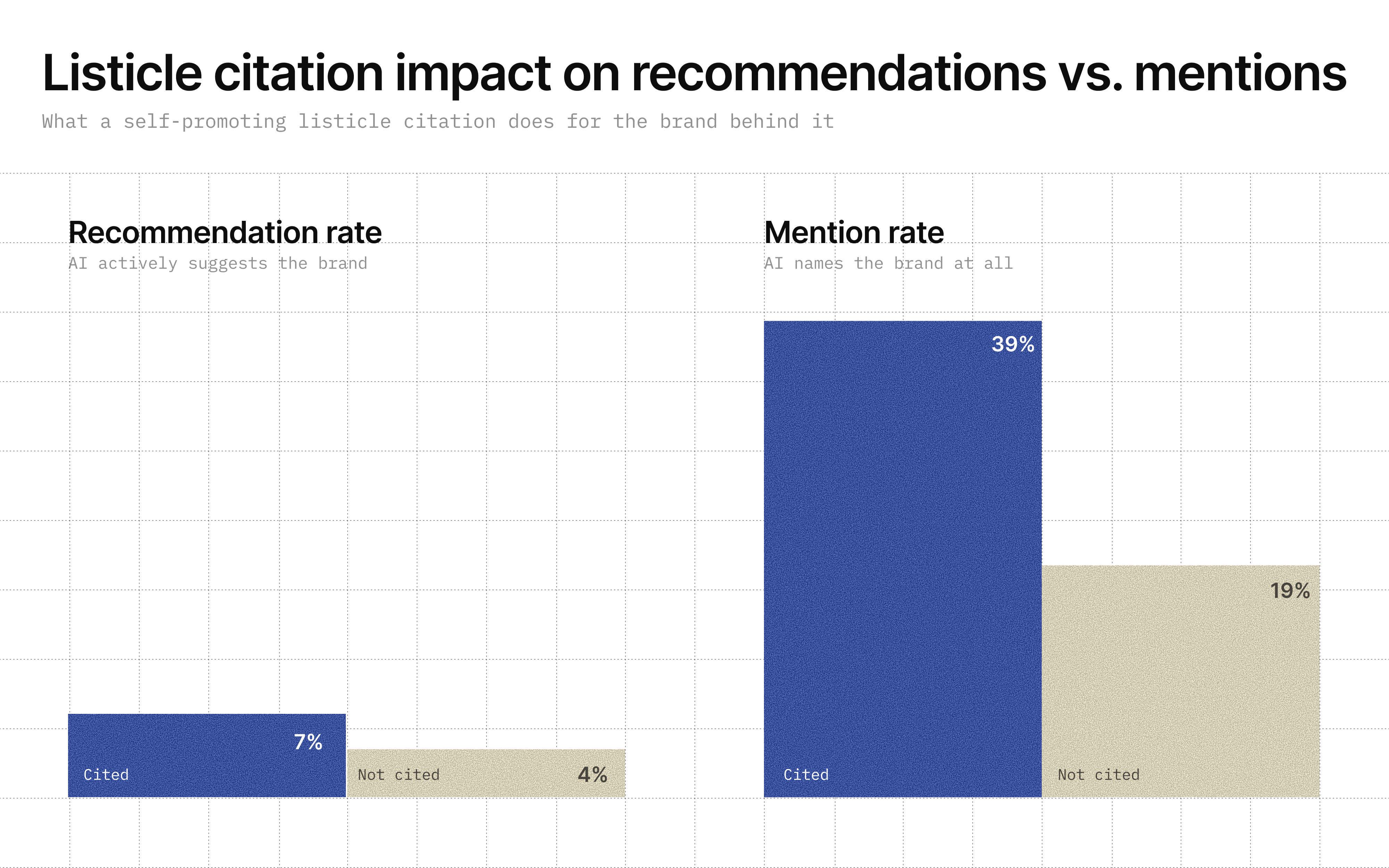
Our analysis shows that for the author brand (aka the brand that published the listicle), recommendation rate goes from about 4% to roughly 7% across AI assistants when their self-promoting listicle is cited.
To check that, we ran a falsification test. First we set aside every answer that cited the listicle, so nothing left in the pile had been touched by it. Then we split what remained by whether that same listicle got cited in a later answer to the same question.
A citation that hasn't happened yet can't change today's answer, so both groups should look alike. If the soon-to-be-cited group is already ahead, that brand was climbing on its own and the listicle isn't what moved it.
The placebo gap comes out to about a quarter to a third of the real one. So part of what we're seeing is brands that were already trending up in AI search results, but most of it isn't.
The number of brands you list matters
One pattern worth flagging shows up in our data: Pages listing 4-10 brands get the author brand recommended more often than pages listing only 2-3 brands or cramming in 11-15. If you run these, that's the range the data favors.
Keep in mind that AI is more likely to recommend nobody at all. In 63.9% of responses, it treats the listicle as raw material for a balanced overview rather than adopting the page’s No. 1 ranking as its own advice.
The effect of self-promoting listicles is much larger for brand mentions. AI answers that cite a brand's listicle name the brand about 39% of the time, versus approximately 19% when the listicle isn’t cited.
That's roughly 4x-to-6x the recommendation lift, and the clearest upside of these pages, even if a recommendation never lands.
Mentions vs. recommendations
It’s worth unpacking the difference between a mention and a recommendation.
A mention is your brand being named in an AI answer. A recommendation is when AI actively suggests your brand.
As we reported in a separate data study, when a brand is recommended, users are nearly twice as likely to search the brand on Google, visit its website, and view its products on a retailer’s product page compared to a mention alone.
A mention is still valuable in terms of visibility, particularly if the answer position is high and the sentiment is positive, but a recommendation does approximately double the work.
Where you’re cited sets the ceiling on impact
The same citation is worth more in some AI assistants than in others.
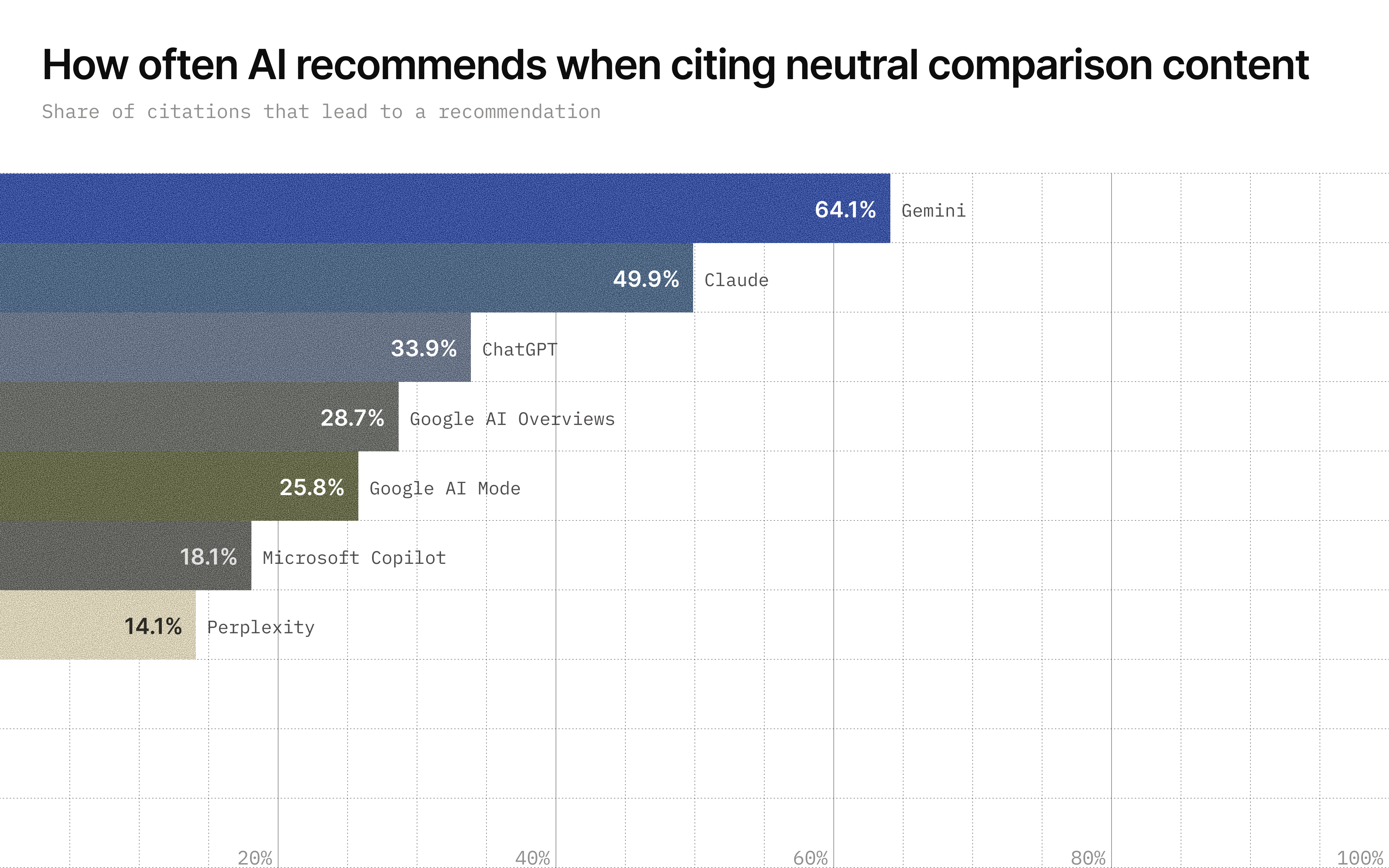
When citing a neutral comparison page (aka an independent roundup where the author brand sells nothing on the list), AI assistants like Gemini and Claude regularly pick a winner, recommending someone in 64.1% and 49.9% of responses, respectively.
Google AI Overviews (28.7%), Google AI Mode (25.8%), Microsoft Copilot (18.1%), and Perplexity (14.1%) do so more rarely. These platforms mostly just summarize what they read.
ChatGPT sits in the middle of the pack, recommending a brand 33.9% of the time.
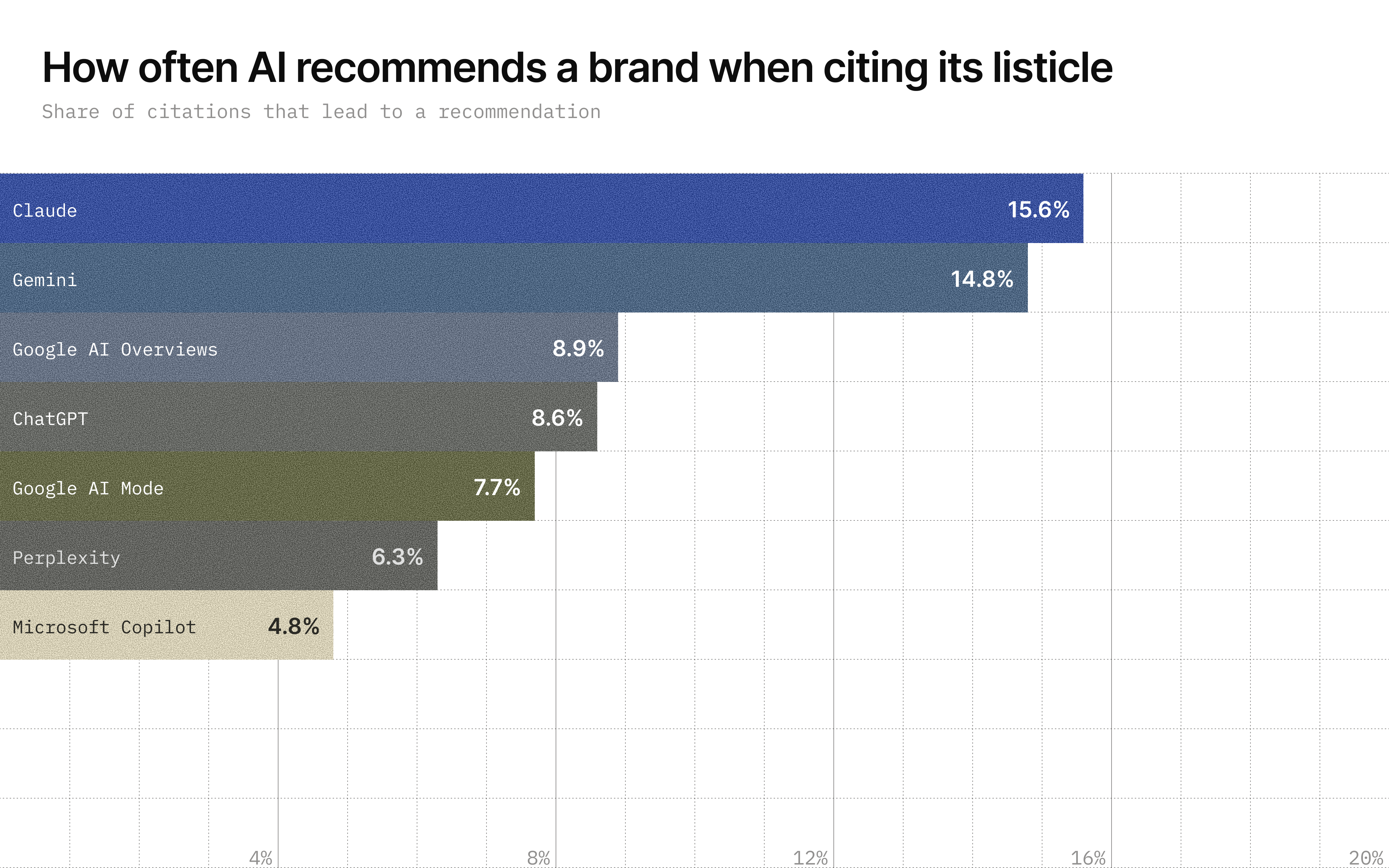
Narrowing the scope to how often the brand behind a self-promoting listicle gets recommended, these are the results, per platform: Claude 15.6%, Gemini 14.8%, Google AI Overviews 8.9%, ChatGPT 8.6%, Google AI Mode 7.7%, Perplexity 6.3%, Copilot 4.8%.
Note: These rates cover every AI answer that cited the listicle. The 4%-to-7% lift mentioned above comes from a narrower comparison designed to isolate the listicle's effect, so the numbers aren't directly comparable.
The risk of naming rivals depends on their visibility
It’s important to remember that AI platforms pull from multiple sources, not just yours.
Looking at every AI answer that cites a self-promoting listicle, 43.4% also cite a competitor’s website (something that correlates with a slightly lower recommendation rate for author brands).
Meanwhile, AI almost never cites any other source that features the brand behind a listicle: A page other than their own listicle backs the author brand in just 1.4% of answers.
Put simply: When your listicle gets cited, it's usually the only thing vouching for you. Your competitors, meanwhile, might have their own sites and independent coverage to back them up.
Does that mean self-promoting content is self-defeating? We set out to test that, too.
We wanted to know if naming competitors in listicle content may inadvertently help them instead of you.
The worst version of this is what's known as a ghost citation: when your content gets cited but your brand never gets named at all.
That's rare in our analysis. The more common version is softer: You're named, but a rival gets the recommendation.
We found that when a listicle is cited, a competitor gets recommended instead of the author brand 24.3% of the time. This holds under every cut we tried, including a platform-matched replication.
A roughly one-in-four rate might sound like naming a rival backfires, but the real question is whether your listicle is what got them recommended.
So we tested that directly.
Initially, the raw numbers look alarming: When a brand's own listicle is cited, the odds that at least one listed rival gets recommended run 2.8-to-3.4 percentage points higher.
But here's the catch: Some brands are simply already on their way up in AI search results, getting cited and recommended more for reasons that have nothing to do with any one page. If you’re not careful, it’s easy to credit the listicle for a rise that was already happening.
We ran the same falsification test mentioned above here, only on rivals instead of author brands.
The placebo gap came out to +4.4 percentage points, bigger than the real one it was meant to rule out.
These findings indicate that a brand’s listicle isn’t behind a rival being recommended. The rival was likely already gaining ground for some unrelated reason, and the brand’s listicle just happened to get cited around the same time.
But we wanted to go a level deeper, so we ran this same check across four visibility-based scenarios, splitting author brands and competitors into high- and low-visibility tiers based on how often they’re named as a rival elsewhere and how often they show up organically.
Here’s what we found:
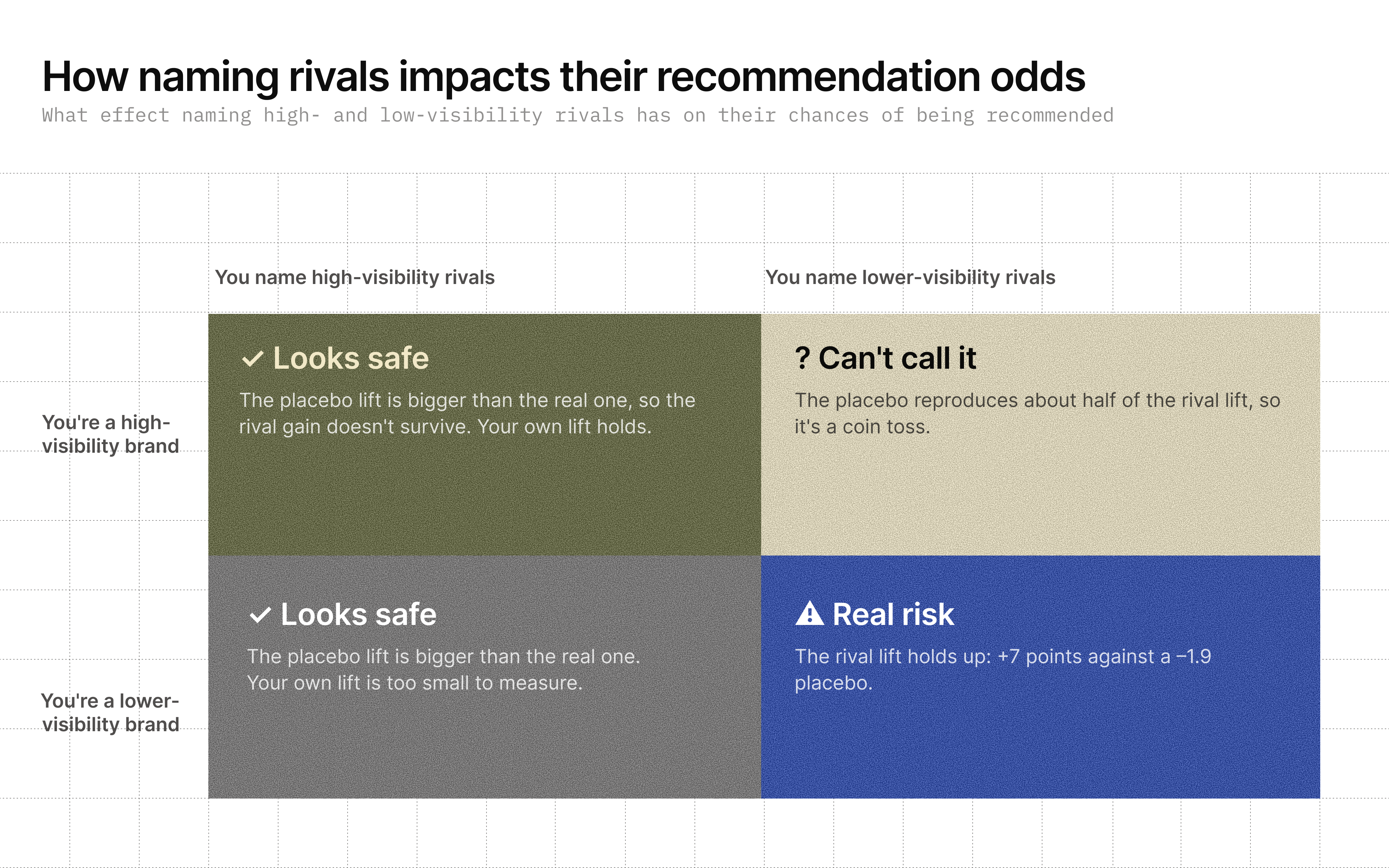
- Naming high-visibility rivals looks safe: When a high-visibility brand names high-visibility rivals, the author brand still gets its own boost and the rival lift fails the falsification test cleanly. When a lower-visibility brand names high-visibility rivals, the rival lift fails the same test, but the author's own boost is too small to measure.
- Naming lower-visibility rivals is where the risk concentrates: When a high-visibility brand names lower-visibility rivals, the placebo reproduces about half of the rival’s lift, so we can't call this one either way. And when a lower-visibility brand names other low-visibility rivals, the rival lift holds up: a real effect of +7 percentage points against a placebo of -1.9.
One caution on that +7 number: It's one of four scenarios we split the data into, and we didn't correct for looking at four. A much thinner slice of the same data put the number at +11 points, with too few observations to separate from zero.
Both numbers point in the same direction, but neither is precise. That said, a low-visibility brand naming low-visibility rivals is the only scenario where the rival lift cleanly passes the falsification test, so we can't dismiss it.
How brands should move forward
Whether you’re publishing this type of content or not, here are some tips to keep in mind:
Don't confuse a listicle with a strategy
Listicles reliably win citations, give brands a modest recommendation boost, and provide more substantial mention uplift.
But a listicle on its own won’t build the authoritative third-party presence that drives sustainable visibility gains, and it's not a panacea for filling real content gaps.
Find out which sources are most influential for the prompts you’re tracking, then invest in securing placement in them, or, in the case of competitor sources, displacing them.
Know your AI platform
Listicles don’t move every AI assistant the same way.
With Gemini or Claude, listicles give you a genuine shot at a recommendation. With Copilot or Perplexity, they’re more of a visibility play.
Keep that in mind when you’re measuring results (and invest in a product that tells you which platforms are driving agents and humans to your site so you can prioritize).
If you name rivals, do it deliberately
Naming high-visibility rivals looks safe in our data. Naming lower-visibility rivals is the unsettled question: We can’t rule out a benefit to the competitor you name.
Another unknown: Our numbers measure the AI citing a rival’s site in the same answer, and we didn’t test whether linking to a rival from your page (versus just naming them) changes what gets retrieved.
So consider who you name, and treat outbound links as an open question.
Make your content easy for AI to find and cite
Listicle or not, AI can’t retrieve and cite your content if it can’t access, read, and understand it.
Invest in technical and editorial updates to your site to make it as easy as possible for AI to consume your content.
Then consider how to serve that content to AI in an optimized format.
We built Scrunch to show you exactly how AI assistants are citing and recommending your brand today, which competitors are showing up alongside you, and what you can do to win.
Crowning yourself No. 1 may give you a small boost, but don’t expect the crown to do all of the work.
Ultimately, the brands that follow the data, and act on it onsite and off, will win the AI answer.
Own AI recommendations with Scrunch
Optimize your content for AI. Start a 7-day free trial or get in touch to see how Scrunch can help you develop and deliver AI-friendly content at scale.
A quick note on our methodology
- The established numbers: Presence, recommendation rate, co-citation cost, platform splits, etc. come from our original run: 818 self-ranking treatment pages against 1,033 neutral third-party comparisons as control, 29,382 recommend/neutral/caution labels from a response-text classifier. We hand-audited the groups: Treatment came out 29 of 30 audited pages correct (96.7%), control 10 of 10.
- The window: Responses span May 17 to June 30, 2026. For six of the seven surfaces, our sampling (the five most recent citing responses per page) effectively covers June 10 to 30; Claude covers the full window. AI search systems change fast, so read every number as a snapshot of that window, not a constant.
- Units and denominators: One response can cite more than one of our pages, so the working unit is the page-response pair: 5,434 pairs over 4,594 unique responses on treatment. The two denominators agree within about a point everywhere.
- Surface mix: Pooled rates blend two kinds of surface. Google’s AI Overviews and AI Mode make up 31% of the treatment sample (1,692/5,434) and recommend far less often than the chat assistants: the author brand gets recommended 8.6% of the time there (145/1,692) versus 12.2% on the chat assistants (455/3,742). The pooled 11.0% sits in between; the platform section carries the full split.
- The causal numbers: Author-boost reversal, the rival-lift falsification tests, etc. come from a same-prompt, same-platform, same-brand comparison: Does the exact same question get answered differently when the listicle happens to be cited versus when it isn’t? This is a tighter test than comparing a vendor’s own page to its performance elsewhere, and it's run on a capped sample covering roughly 6% of the eligible population, with a full-scale run planned to confirm the headline magnitudes. The two lower-visibility scenarios are the exception: Those already use every observation we have, so more data won't sharpen them.
- What a citation does, not what a name does: What varies between the two groups is whether the AI happened to cite the listicle, not what's on the page. So these numbers describe what a citation does for the brands already listed, not what adding or removing a name would do. The looser version of this test, comparing a vendor's rate on its own listicle against its appearances elsewhere with platform held fixed, found nothing: a median of 0.0pp over 61 cells, p=0.62.
- Falsification, not just correlation: For every recommendation lift we report, we checked whether a citation happening later could predict the outcome today. If it can, the lift is probably a pre-existing trend, not a causal effect, and we say so plainly rather than reporting the raw number alone. The mention lift hasn't been through this check yet.
- Scrunch prompt data: We describe how AI assistants treat these pages when asked our monitored questions, not what buyers ultimately do. Grok and Meta AI weren't part of our dataset, so results aren't included here.
Data studies



More articles

YouTube influencers have an AI audience: What millions of citation events reveal about influencer sponsorships

Surviving the clickpocalypse: What millions of search events say about AI eating the news
