Agent Experience
Monitoring & Insights






Impostors are in your AI answers: Inside the websites posing as your brand and why LLMs cite them
- Impostor citations are found across AI assistants
- Impostors rarely make Google’s first page
- Certain prompts surface impostor sites more frequently
- Here’s how to fight back against the fakes
- Watch what AI says, not just where you rank
- Check your high-stakes questions first
- Mind your expiring and look-alike domains
- Keep your brand and customers safe with Scrunch
- A quick note on our methodology
TLDR:
- In the US alone, AI assistants show people more than a million answers a year that cite a website impersonating a real brand.
- About 3 in 4 AI answers citing a known impostor treat it as the brand’s own source. Only 0.3% of answers warned the reader that the site might be fake.
- The greatest risk concentrates in queries that can cost consumers money or account access: refund, cancellation, login, account, and support questions.
Your brand has a body double, and AI keeps citing it.
In the course of building our new Citation Optimization feature, we discovered something alarming: Fraudulent websites posing as real brands turn up in AI answers week after week.
We quickly learned that about 1 in 13 Scrunch customers was impacted by these impostor sites, and, as of first analysis, roughly 17% of the Fortune 500 (those are just the instances we could initially confirm).
To get to the bottom of it, our team analyzed millions of the AI answers our customers monitor across ChatGPT, Perplexity, Gemini, Google AI Overviews, Google AI Mode, and Microsoft Copilot from May to October 2026.
After cross-referencing our citation data with common user queries and public usage figures, we found that, in the US alone, assistants show people more than a million answers a year that cite a domain impersonating a real brand.
Most of the impostors aren't on any list of known fakes, almost none appear on public threat feeds, and Google rarely ranks them on the first page.
You can dig into our full findings below.
The main takeaway? Impostor sites that used to be buried in search engine results pages are being used as trusted sources by AI, and the only way to catch them is to see them in AI answers themselves.
We should note: Scrunch has shared this information with affected customers and worked with them to resolve the issue. We’ve also built dedicated impostor detection and resolution into our platform.
Who are the impostors?
Impostor sites are domains that imitate a brand they don’t belong to, most often through brand name misspellings, brand-plus-word variants, lookalike country domains, free-hosting pages, or expired brand domains that someone else reregistered.
Impostor citations are found across AI assistants
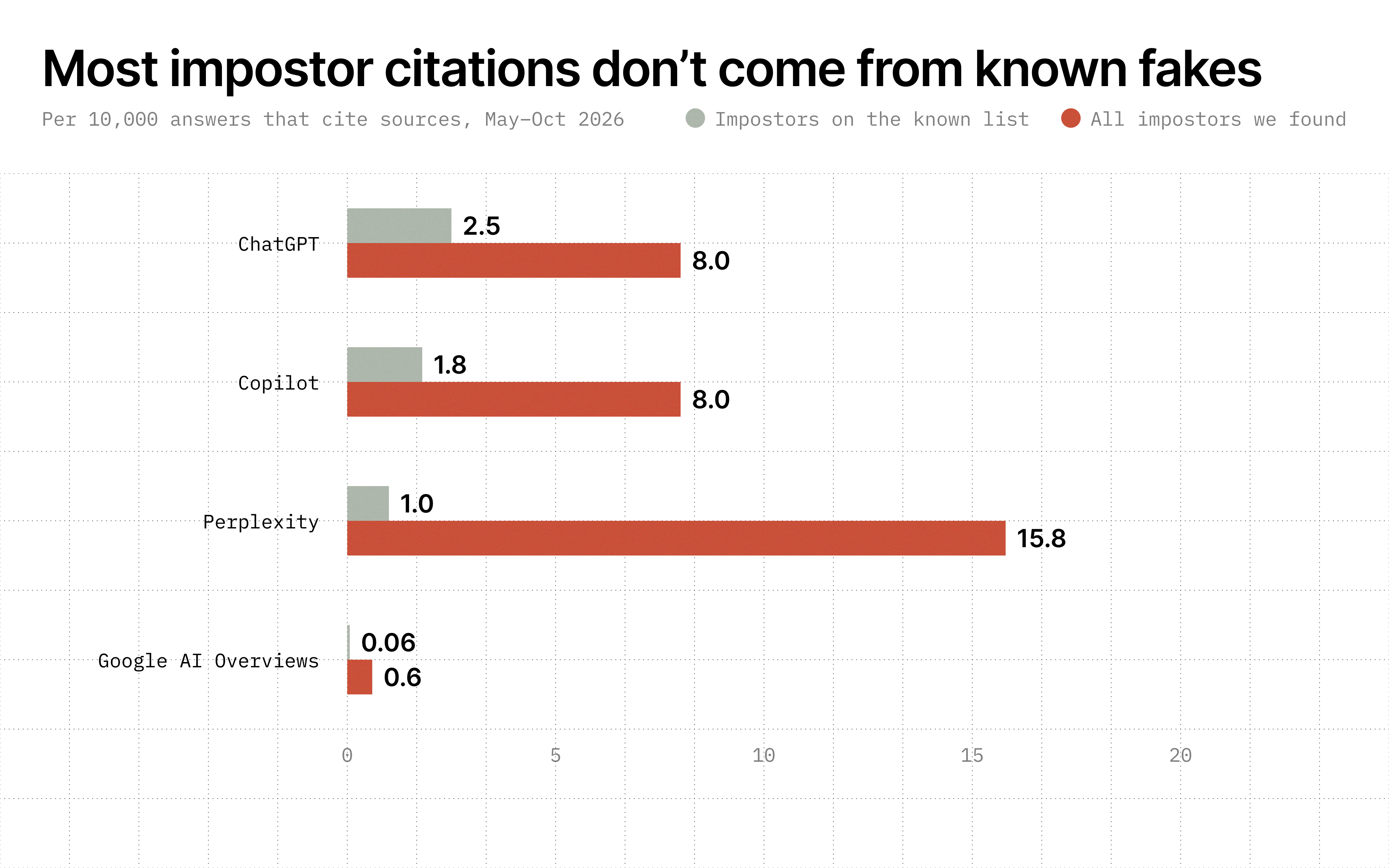
Looking at the data, we can see that this isn’t a platform-specific phenomenon: Impostor sites are cited across multiple AI assistants.
Across the assistants we measured, about 1 in 1,250 AI answers with sources cited an impostor.
On a platform-by-platform basis, AI Overviews is the outlier. It cites impostors at a significantly lower rate compared to other AI surfaces. More on that later.
A note on the AI platforms in our charts
We studied Gemini and Google AI Mode as part of our research, but they’re not included in our charts. In terms of known impostors, similar to AI Overviews, both had lower citation rates. Claude, Grok, and Meta AI weren’t included in our analysis, so we can’t speak to their impostor citation rates.
Among AI answers citing a known impostor, the citation usually looks like an ordinary footnote: 3 in 4 answers present it as the brand’s own source.
The answer describes the brand's products, prices, or policies, and credits the impostor. Only 0.3% of answers warned the reader that the site might be fake.
We searched the sites AI assistants cited for impostors using a hand-built list of known fakes, then searched for impostors that weren't on our list. The known list accounts for about 3 in 10 of ChatGPT's impostor citations, and fewer than 1 in 4 across other assistants.
Meanwhile, fewer than 1% of the impostor domains AI cited, known or newly found, appear on any of three public threat feeds.
Impostors rarely make Google’s first page
We wanted to understand why AI was reaching for these sites.
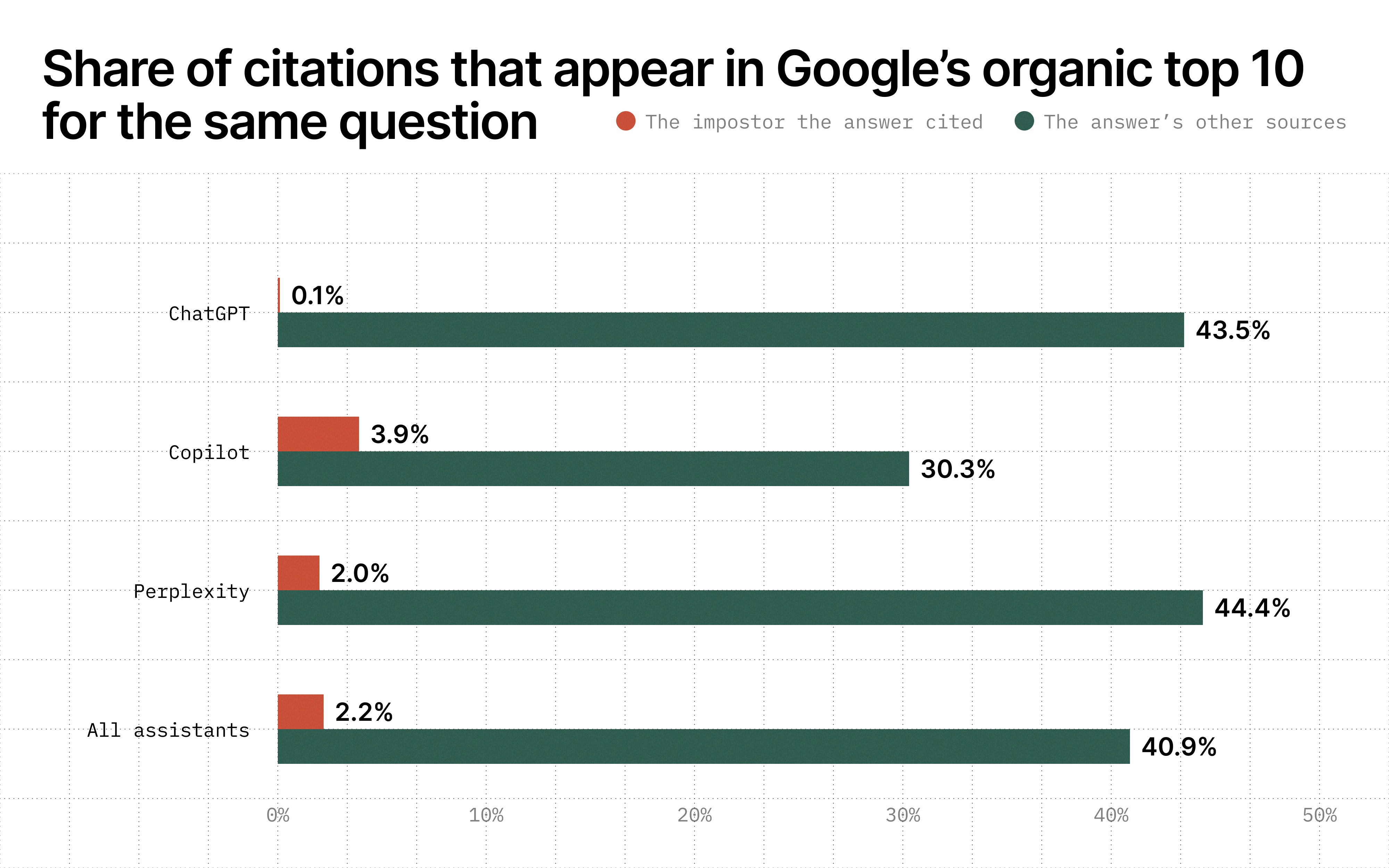
For every AI answer that cited an impostor, we ran the same question on Google within a day and looked at the top 10 organic results.
Google ranked the impostor on the first page 2.2% of the time. It ranked the other sources in AI answers on the first page 40.9% of the time, between 30.3% and 44.4%, depending on the AI assistant.
ChatGPT showed the widest gap, with its impostor sites being ranked on Google’s first page only 0.1% of the time versus its other sources being ranked on the first page 43.5% of the time.
Our research suggests that the problem is more about semantics than online popularity.
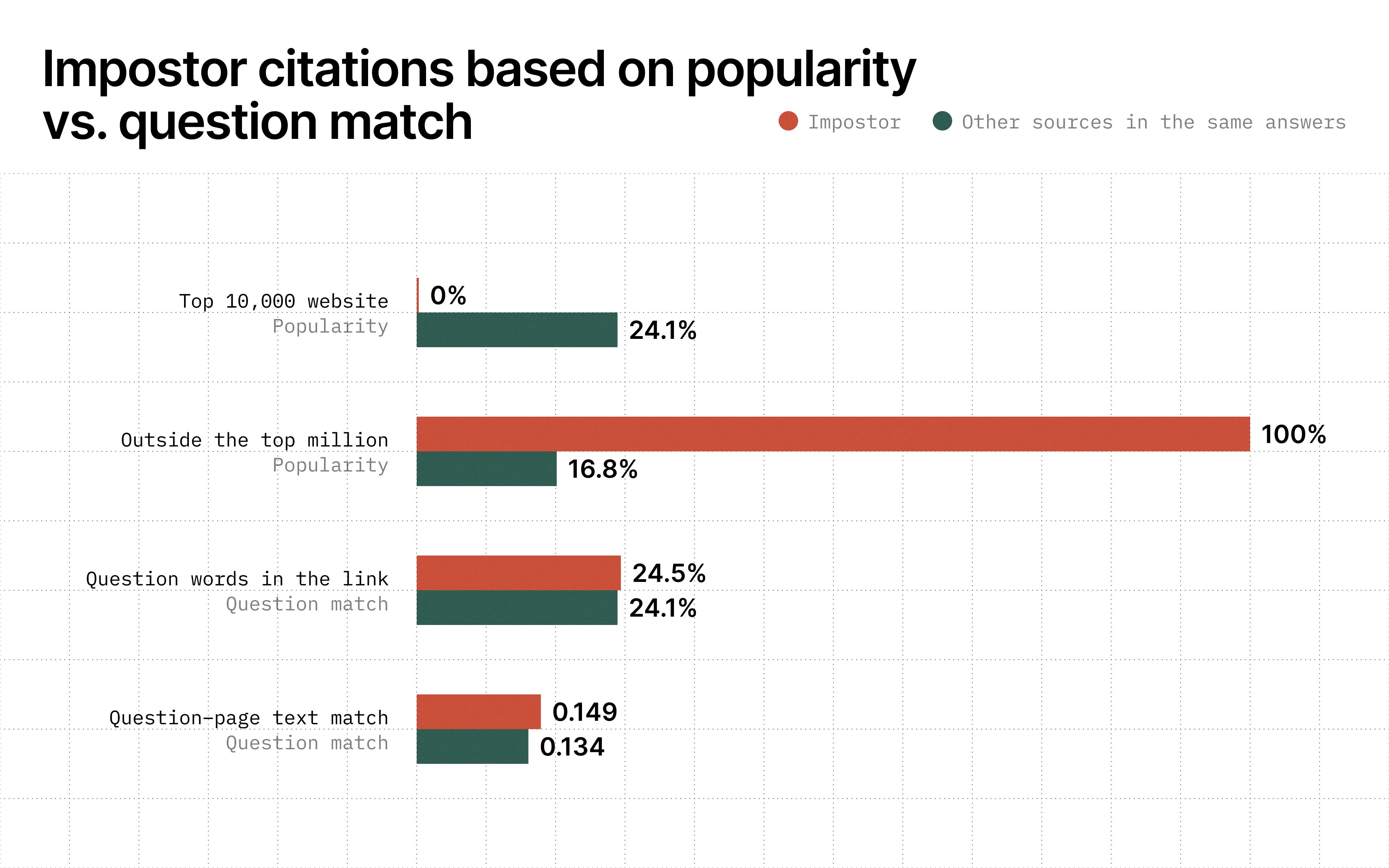
In the same answers, every known impostor ranked outside the top million websites by popularity, as determined by traffic. About a quarter of the other sources were in the top 10,000.
Low popularity didn't keep these sites out of AI answers. Neither did Google's first page leaving them off.
Why? One explanation is that the impostor pages matched the wording of the question more closely than the real sources cited next to them.
It’s possible that AI search filters less aggressively than Google. Together with the fact that AI assistants pull from a large collection of sources to synthesize a single answer, it helps explain why sites that don’t make Google’s first page are popping up in AI answers.
Certain prompts surface impostor sites more frequently
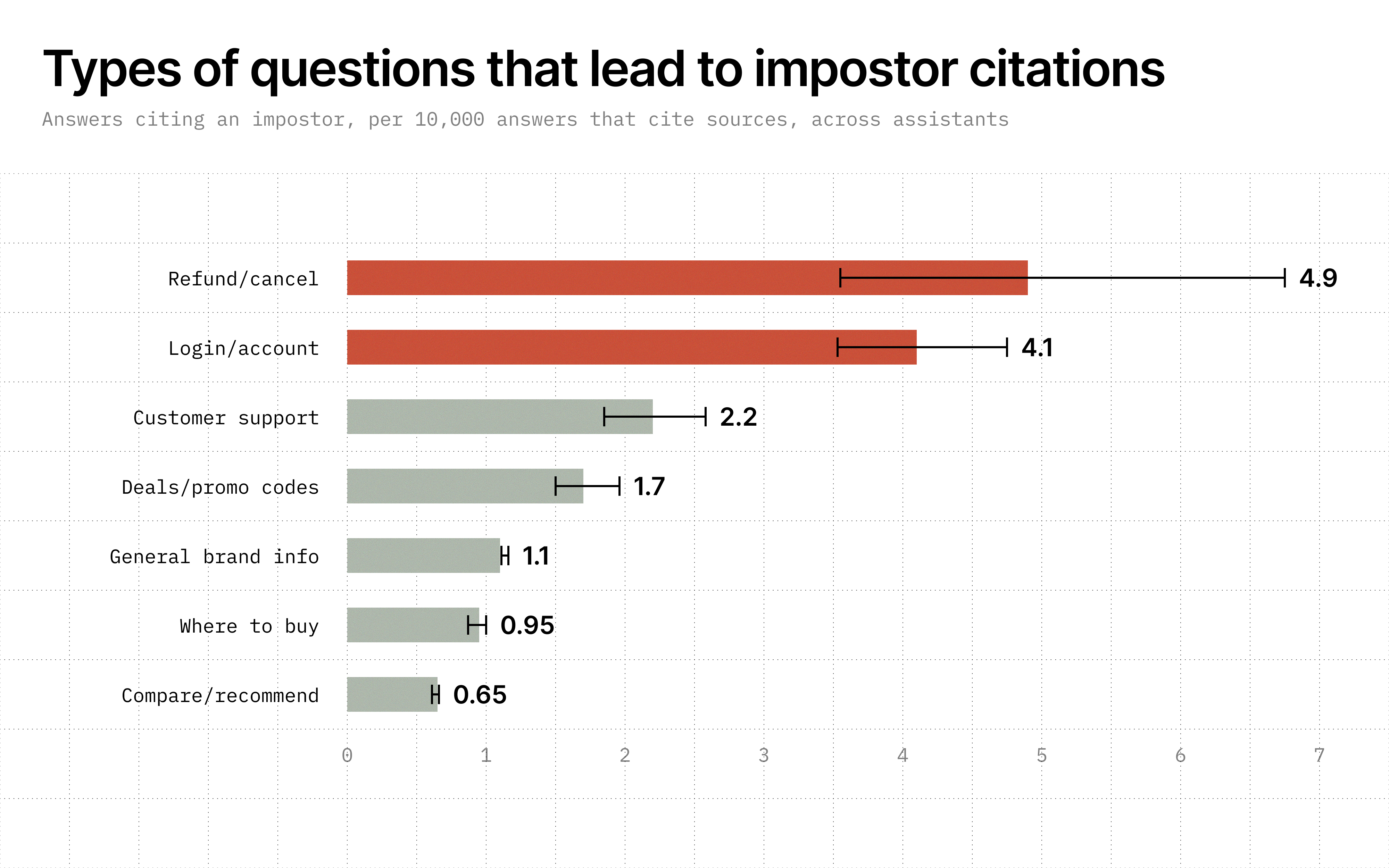
Not all prompts lead to impostor sites at the same rate.
Answers to refund and cancellation questions cited known impostors about 7.5 times as often as answers to product-comparison questions, and answers to login and account questions about 6.3 times as often.
Unfortunately, these are the types of questions where a wrong link can cost someone money or account access.
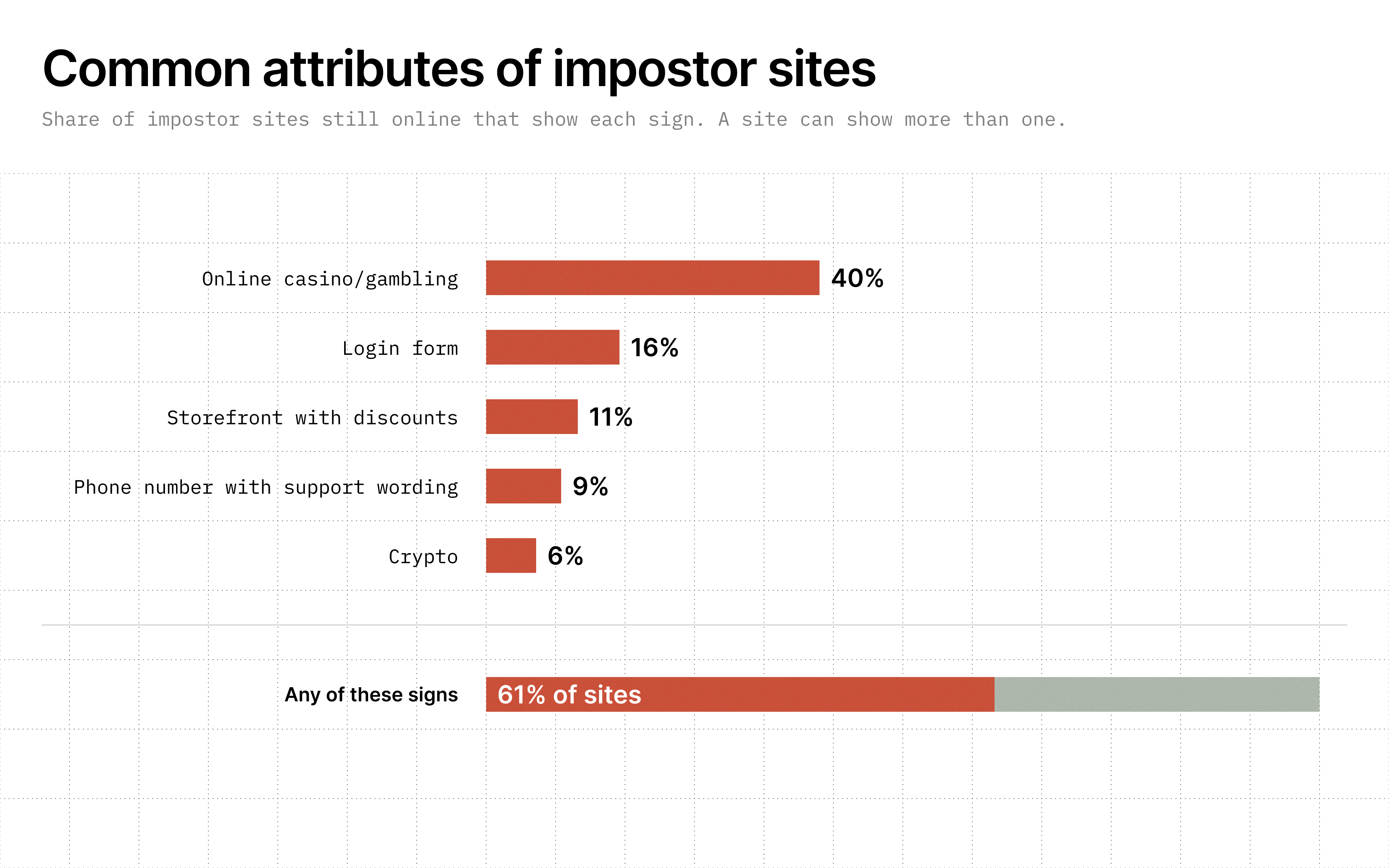
We checked every impostor site on the known list AI had cited. About a third were still online.
Of those, about 6 in 10 included one of the following: online casino/gambling, login form, storefront with discounts, phone number with support wording, crypto.
While we can’t confirm that every site with a login form is a phishing attempt, we observed numerous instances of suspicious behavior.
These ranged from an impostor site for a large financial services brand that asked visitors to log in and verify their information using their Social Security number to one for a major insurer that provided visitors with a fake telephone number to call.
Here’s how to fight back against the fakes
In response to these findings, we built imposter detection and resolution into the Scrunch platform.
Our Citation Optimization feature automatically surfaces sites that may be impersonating your brand, tells you why we suspect them, and highlights the AI answers they’re appearing in.
You can review possible impersonations to determine if the website is legitimate (such as a partner, distributor, or unrelated business) or fraudulent. If it’s the latter, we help you prepare a site takedown with a single click.
We supply you with the contact information of the relevant hosting and domain providers, draft messaging on your behalf, and provide you with a downloadable PDF of the evidence you can include with your message.
Once you’ve reached out, mark it as sent in Scrunch and we’ll keep you updated on the site’s status until it’s taken care of. In our experience, brands typically receive a response within 24-48 hours.
Whether you’re a Scrunch customer or not, here are some tips to keep in mind:
Watch what AI says, not just where you rank
Your Google rankings and your referral dashboard will not surface this activity. Impostor sites typically sit off of Google’s first page and won’t send a tracked referral to your website.
The only way to catch a fake wearing your name is to monitor AI answers themselves: which sources AI pulls from when it talks about you, and whether any of them are pretending to be you.
Check your high-stakes questions first
Start where the risk concentrates. Run your refund, cancellation, login, account, and support questions through the major AI assistants and read the sources they cite.
Those are the answers most likely to carry an impostor, and most likely to cost a customer money or account access when they do.
Mind your expiring and look-alike domains
Hold onto old support and campaign domains, and keep an eye on the obvious misspellings and brand-plus-word variants of your own domain.
An expired domain you let go of can come back as someone else’s casino with your name still attached in AI’s memory.
Impostor citations are a real risk to brands and their customers. And as the number of prompts that AI assistants process daily grows, more answers are exposed.
Known-impostor lists, threat feeds, and search rankings miss most of these sites, so AI answers are the place to look.
The first step for every brand is not only getting visibility into what AI says about you, but who it’s citing when it does.
Keep your brand and customers safe with Scrunch
Flag and fix impostor citations. Start a 7-day free trial or get in touch to see how Scrunch can help you detect sites impersonating your brand and get them taken down.
A quick note on our methodology
- Data: AI answers Scrunch monitors across ChatGPT, Perplexity, Gemini, Google AI Overviews, Google AI Mode, and Microsoft Copilot, from late April to Oct 26, 2026, covering millions of answers. We also used real-world AI-assistant use, Google results for the same questions, archived copies of web pages, a review of each known impostor site, a public website popularity ranking, and three public threat feeds (OpenPhish, Phishing Army, and Phishing.Database).
- Impostors: A domain that poses as a brand it doesn't belong to: a misspelling, the brand name plus a word, a look-alike country domain, a free-hosting page, or a copy of the brand's site. Sites that use a brand's name in their domain but openly run someone else's reviews, guides, or affiliate content are counted separately as brand-name sites. We call a site phishing only when it collects logins or payment details. Old domains of closed businesses, projects, or people that someone else now runs under the old name also turned up in AI citations; we couldn't size them reliably and don't count them.
- Finding impostors: We started from a hand-built list of known impostors. We then matched every site AI assistants cited against monitored brands' names and common misspellings, labeled each match, plus large random samples of every other cited site, with AI models. To turn labels into rates, we drew a stratified random sample of about 3,000 cited domains across every label, including sites the models had cleared, with heavily cited sites more likely to be picked. An independent AI reviewer with web search checked each one against evidence, such as company records and the brand's own sites, and a second independent review rechecked every site found to be an impostor. A site counts only when both reviews call it a look-alike impostor. The sample is then weighted back up to every cited domain.
- Rates: "Rate" means the share of answers that cite at least one impostor, among answers that cite any sources, shown per 10,000 answers. Across the four assistants in the chart, about 8 in 10,000 (95% interval 4 to 12). Rates cover every answer Scrunch monitors, not only US ones. An answer citing two impostors counts twice; on the known list that adds under 1%. Brand-name sites aren't included in the rates.
- Over time: Trends hold each assistant's set of questions fixed from month to month and use only newly found impostors. Counting brand-name review and affiliate sites as well, Copilot's rate roughly tripled. The hand-built list was assembled at the end of October from sites being cited then, which makes recent months look higher than earlier ones on that list.
- Google comparison: For each AI answer citing an impostor, we ran the same question on Google within a day and checked whether each cited site appeared in the organic top 10. Covers late September to October 26, 2026. It shows impostors rarely rank on Google's first page. It doesn't show where the assistants found them or whether Google indexes them.
- Known-list findings: How answers present impostors, the question types, the site review, the Motorola case, and popularity are measured on the hand-built list of known impostors. How answers present them was classified twice, independently, giving the 73–79% range. Fewer than 1% of these answers told people to log in, pay, or call through the impostor; most passed along information taken from the site. Question-type rates have wide 95% intervals.
- Site review: Done in late October 2026, without logging in or entering anything, so it shows what the sites show now, not necessarily what they showed when cited. About two-thirds of cited impostor sites were already offline. A login form means a page asks for a password; it doesn't prove the site steals them.
- Popularity and question match: Popularity rankings measure traffic, not trustworthiness. Question match is measured on answers where both pages could be read, and part of it may come from impostors copying a brand's own text.
- Intervals: For impostor rates, 95% intervals come from the sampling design. Other findings use 95% intervals from resampling the answers. The US estimate gives a 90% range.
- US estimate: About 2 million answers a year (90% range about 0.9 to 4.4 million), from a model built from our citation rates, real-world AI use, and public usage figures. Its main assumption is that the ratio of all impostors to known ones that we measured on monitored questions also holds for people's own questions. ChatGPT and Perplexity make up most of the total. It counts answers shown, not people, clicks or losses, and leaves out Copilot.
- Examples: We didn't observe whether anyone clicked through in the Motorola case. For the restaurant chain, we can't say whether the ads and the AI citations are connected.
- Status: Preliminary findings. Labels come from AI models checked by two independent AI reviews, not by hand.
Data studies




More articles

AI reads your local paper: What testing tells us about the connection between location and AI answers

What happens when you crown yourself #1: Inside thousands of listicles and their impact on AI answers
