Agent Experience
Monitoring & Insights






AI reads your local paper: What testing tells us about the connection between location and AI answers
- ChatGPT may lean local even when the question doesn’t
- Ask a local question, get a local source
- Not all categories have a hometown
- Think global, act local
- Syndicate content for local coverage
- Secure placement in influential local sources
- Don’t lose the local thread
- Make it easy for AI agents to consume your content
- Measure and move on what AI says with Scrunch
- A quick note on our methodology
TLDR:
- AI answers may shift based on where you are, even if your question has nothing to do with location.
- When ChatGPT cites a local source, it’s about 3x more likely to pick one from your state. Nothing in the conversation has to tell it where you’re located.
- Ask for a car dealership near you and you get neighborhood names. Ask for a checking account and you get the same national banks everywhere. Whether AI answers local or national depends on what you ask for.
Ask AI how to keep a sourdough starter alive and it may cite a newspaper article from your hometown. Even if you never told it where you live. Even if nothing in the conversation did.
AI pulls from across the web to answer user questions. We wanted to know what role user location plays in those answers.
So together with Stacker we analyzed millions of AI answers across ChatGPT, Google AI Overviews, and Google AI Mode from our privacy-safe opt-in panel of real US consumers.
We also ran a series of controlled tests using a commercial service that allows us to run AI queries from a chosen location.
You can dig into our full findings below.
The main takeaway? Even when the question isn’t local, the source shaping the answer might be.
A note on the AI platforms we studied
We focused on ChatGPT and Google's AI surfaces because they're the most widely used, so they gave us the most data. We didn't test other assistants, so these results may not carry over to them.
ChatGPT may lean local even when the question doesn’t
When people prompt ChatGPT about something non-local (think celebrity news, health tips, etc.), the share of answers that cite local news sources is small. But at ChatGPT’s scale (hundreds of millions of prompts per day from users in the US alone), that’s still a lot of answers.
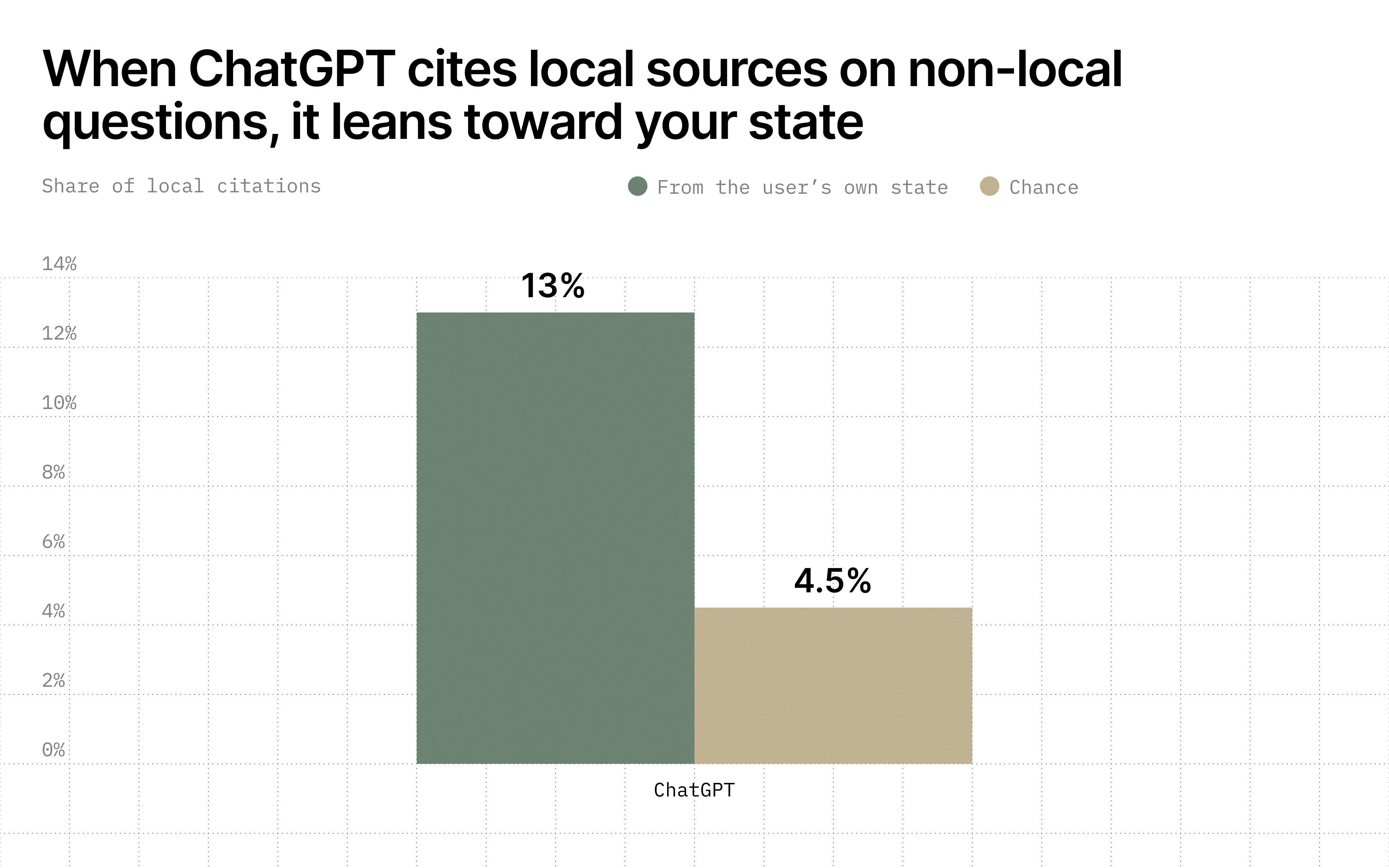
And when ChatGPT does go local, it goes to your backyard: The source is about 3x more likely to be from a user’s state (13% versus 4.5%).
Even when we strip out anything that could be read as local (TV listings, weather, and the like), ChatGPT is still more than twice as likely to cite an outlet from the user's state (10% versus 4.6%).
Google's AI surfaces leaned in this direction, but the results didn't hold up across every test.
This occurs even on the first message of a conversation, before anything in the chat could hint at where a user is.
In one of our tests, we asked an admittedly morbid question about recent celebrity deaths with our location set to Texas. ChatGPT cited the Dallas Morning News.
When we asked the same question with our location set to Ohio, it cited Cleveland.com. Set to California, ABC7 San Francisco.
It’s not just a case of AI remembering where you are from past conversations.
Panelists in our dataset who never mentioned where they live in any AI conversation still got local sources from their state, and people who moved got sources from their new state. Cited sources didn't drift closer to people over time, as they would if ChatGPT were learning from past chats.
Our best read: AI works out roughly where you are, then picks sources nearby. From the outside, we can't tell exactly which signal it uses.
A couple of things to keep in mind:
- We place panelists by their internet connection. In cases where their connection and their devices’ own clocks disagree about the time zone, the sources aligned with the device. So if anything, our measurement may be undercounting how often this happens.
- One local URL isn’t the only thing being cited. AI answers pull from multiple sources. For instance, in the example query up above, the LA Times was cited across every state alongside the local source.
Ask a local question, get a local source
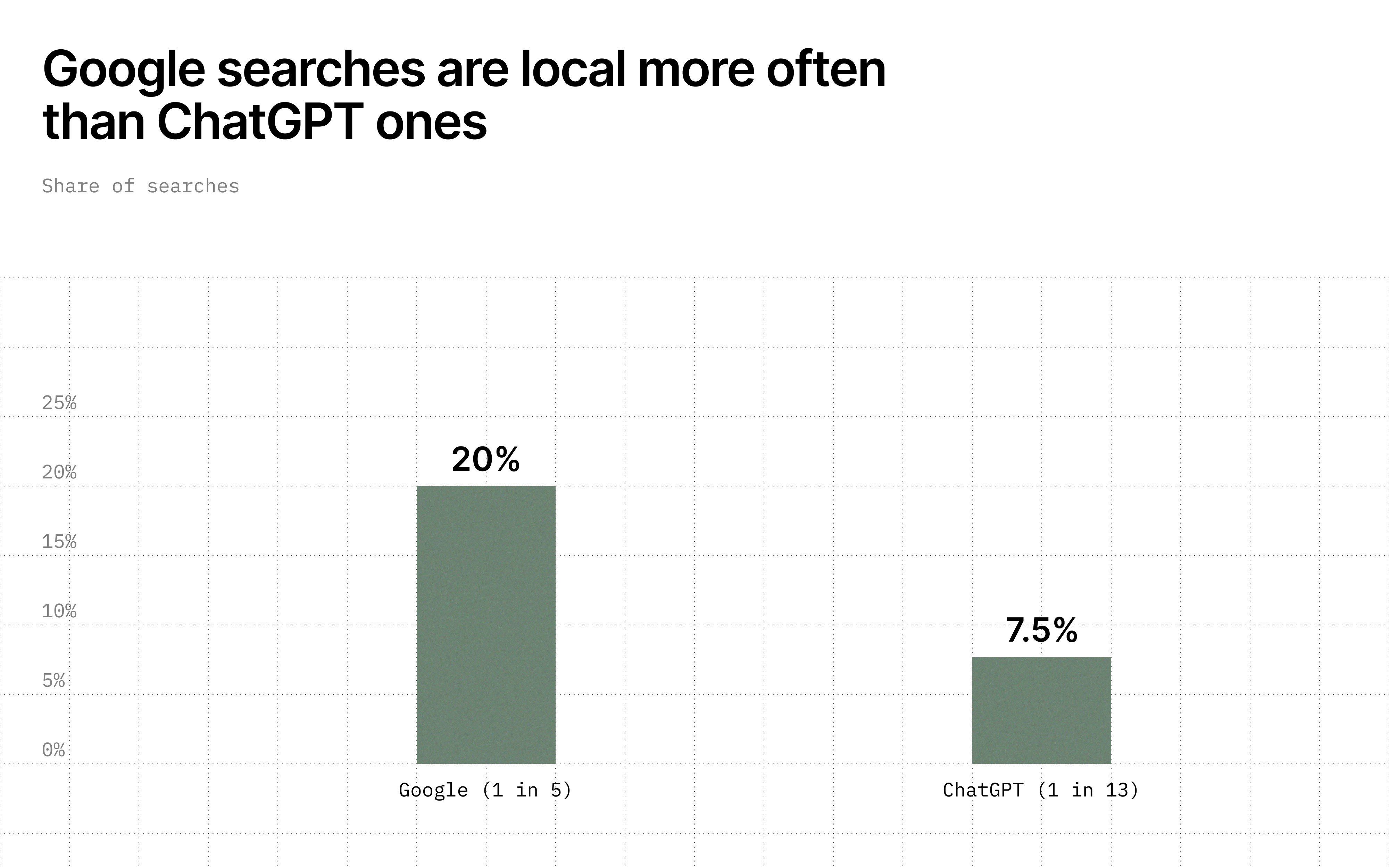
About one in five Google searches in our panel is local, meaning it either names a place or is about the searcher's own area without naming one (e.g., "pharmacy open now," "accident near me").
For ChatGPT, it's about one in 13.
In these scenarios, AI answers lean heavily on local news: from your own area if you don't name a place, and from the place you name if you do.
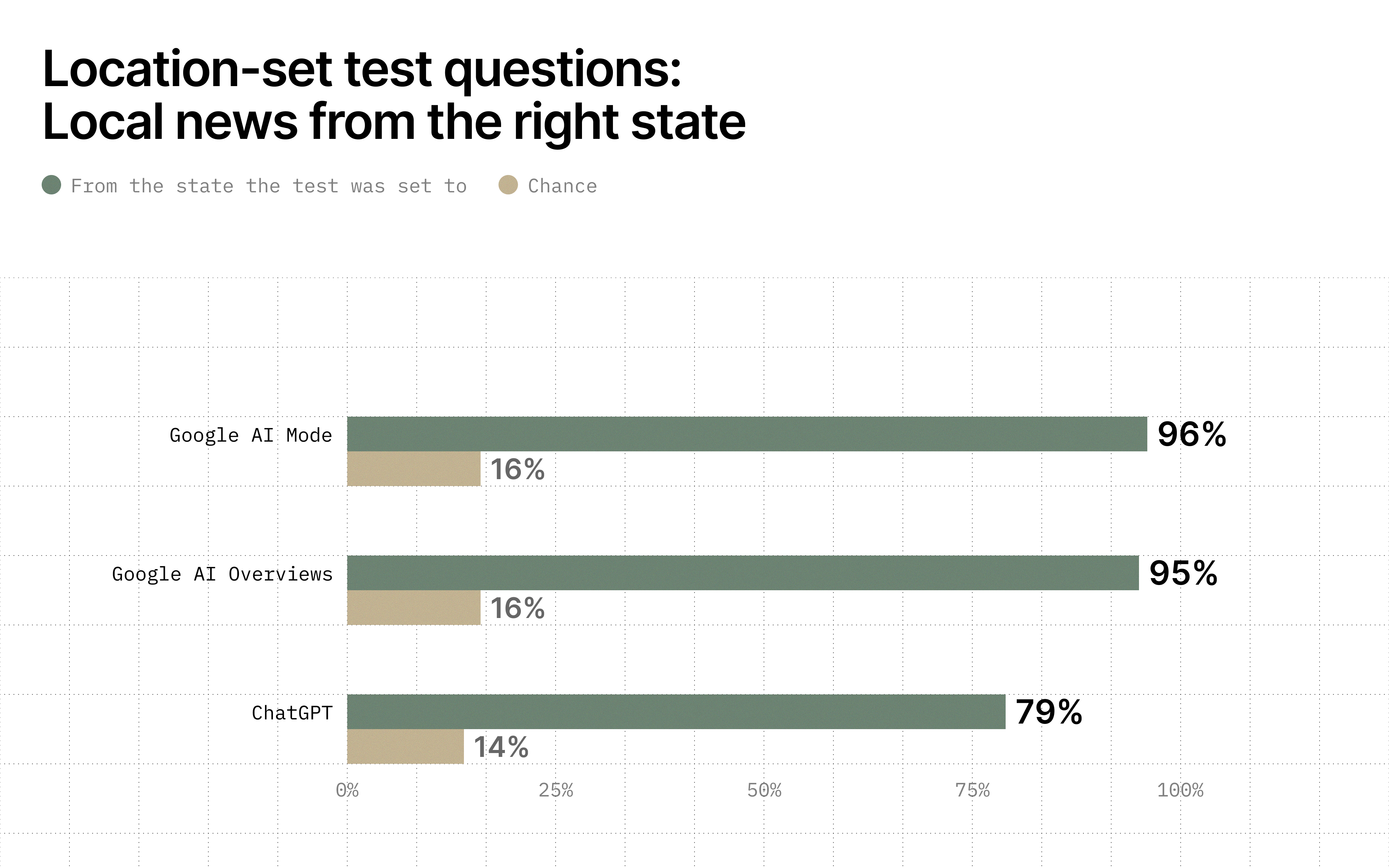
Ask about your area without naming it, and AI cites an outlet from your own state about half the time: ChatGPT about 52%, Google about 48%. By chance alone, that would happen only about 5% of the time.
Name a place, and Google cites an outlet from that place roughly 80% of the time. The pattern holds even when the place isn't where you live: a Texan asking about Reno gets a Nevada outlet approximately 64% of the time.
Not all categories have a hometown
Unsurprisingly, local questions may impact recommendations, too.
As part of our testing, we asked 30 everyday questions, like "What's the best car dealership near me?" and "Who's the best plumber near me?" across 10 cities.
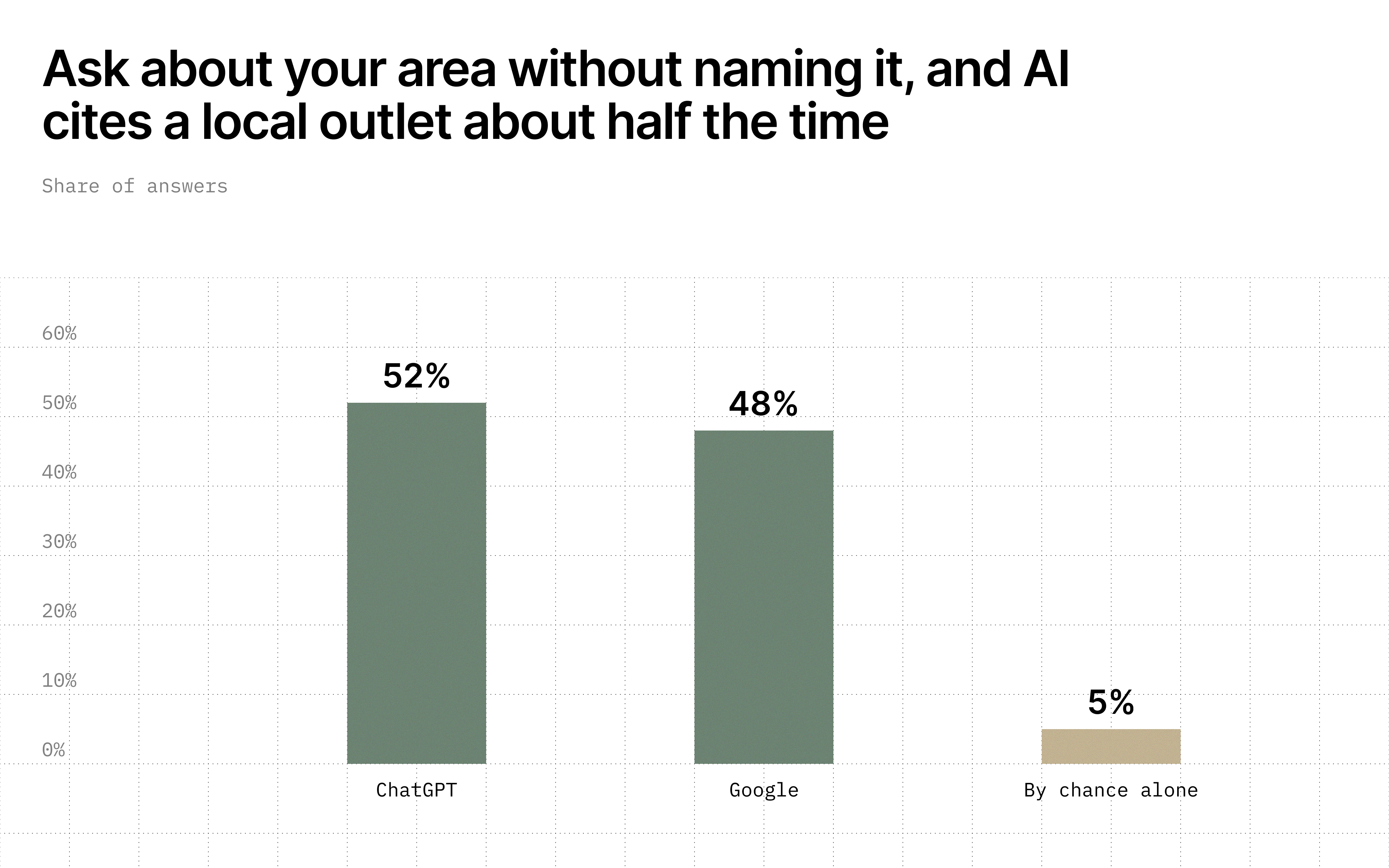
Ninety-six percent of the businesses ChatGPT recommended were in the user’s state, and two cities’ lists only shared 2% of the same names (versus 12% for the same question asked twice from the same city).
Google AI Overviews behaved much in the same way. Two runs from one city shared about half their names; two different cities shared only 4%.
What stood out was what AI decided not to localize.
Ask ChatGPT for car dealers, home services, restaurants, and hotels, and 89% to 100% of the businesses named in one city were named in no other.
Likewise, for the query "best car dealership near me," each city that got a list got different local dealers in Google AI Overviews.
But other queries get national name-checks: Checking accounts went to the same online and national banks everywhere, flu shots to CVS and Walgreens, organic groceries to Whole Foods and Sprouts, etc.
It’s tempting to read the exceptions as national by nature, but restaurants and hotels have national chains, too. The sorting seems to be less about whether big brands exist in a category, and more about whether the question has a local answer.
At any rate, even questions asked from the same city see high volatility in responses: a good reminder to focus on measuring a consistent prompt set over time to separate real trend signals from noise.
Think global, act local
There are a few things brands can do to capitalize on these findings:
Syndicate content for local coverage
AI cites local newsrooms when people ask local questions, and it may pick publishers near a user even when the question has nothing to do with location.
That makes syndication a way into more local AI answers: The more local outlets that carry your content, the more markets you can show up in. Where a story lands matters, too. In our tests, a few copies of a story on large metro news sites were cited for people asking from all states we tested.
Platforms like Stacker help brands place content across local and national news outlets at scale.
Secure placement in influential local sources
Whether AI gives a local recommendation depends on multiple factors: whether the question is local, where your buyer is located, what they’re asking for.
You can’t control any of that, but you can show up in the sources AI finds when it goes looking.
Scrunch shows you which sources get cited most often across the greatest number of unique prompts, so you can see exactly which ones are most influential for your prompt set. A local source that AI cites frequently is an ideal outreach target.
Don’t lose the local thread
The same prompt can return different answers depending on a user’s state and city.
Brands in categories that tend to resolve locally can bake location into tracked prompts to approximate a local view.
Also remember that AI agents mostly find content through regular web search and URLs. In other words: Keep your local presence accurate and up to date in traditional search channels.
Make it easy for AI agents to consume your content
Your website is one of the sources AI can pull from to answer a question, local or not. So make sure your content is optimized for AI consideration and selection.
If pages on your site or a localized satellite site are buried in code and technical clutter, difficult for AI to parse, or missing key context, AI can’t easily consume it or use it. In those cases, your buyer gets someone else's answer.
Ensure your content is technically and editorially optimized, then serve it straight to the AI agents that need it.
Location may shape what AI says, sometimes even if the user doesn’t ask it to.
AI already knows where your buyers are. The question is whether it knows you.
Measure and move on what AI says with Scrunch
Show up better in AI answers. Start a 7-day free trial or get in touch to see how Scrunch can help you get visibility into AI search and act on what you find.
A quick note on our methodology
- The panel: US members of an opt-in consumer panel available to Scrunch: ChatGPT answers from July 2025 through September 2026, and Google AI Overviews and Google AI Mode answers from March 2026 through September 2026. A panelist's state is where their internet connection places them most of the time.
- Local sources: Every local news site or source name these answers cited, identified by one AI model and confirmed by another, then checked by hand against each outlet's homepage: 97% to 98% were local news, and 98% were placed in the right state.
- What was asked: An AI model sorted each question, or the conversation so far, into "names a place," "local without naming one," and "not local," checked against two other models.
- Chance: Each rate is compared with what random pairing of outlets and askers would give, keeping each month's real mix of outlets and askers.
- Controlled tests: The same questions sent to ChatGPT, Google AI Overviews, and Google AI Mode with the location set to six states (news) or 10 cities (businesses), using commercial services that run AI queries from a chosen location.
- Limits: We can see which news site an answer cites but rarely which article, so we can't say Stacker stories cause citations. The panel describes our panelists, not every AI user.
Data studies




More articles

What happens when you crown yourself #1: Inside thousands of listicles and their impact on AI answers

YouTube influencers have an AI audience: What millions of citation events reveal about influencer sponsorships
